 Indietro
Neurons, Synapses & Signaling: Study Guide for General Biology
Guida di studio - Note intelligenti
 Appunti personalizzati basati sui tuoi materiali, ampliati con definizioni chiave, esempi e contesto.
Neuronal Signaling and Membrane Transport
Membrane Potential & Resting Neuron
The membrane potential is a fundamental property of neurons, reflecting the difference in electrical charge across the cell membrane. At rest, neurons maintain a negative internal environment relative to the outside, mainly because of selective permeability and ion gradients.
Selective Permeability: The neuronal membrane allows certain ions, especially K+ (potassium), to move more freely than others, contributing to the resting potential. (The ions are still firing, but the neuron is at rest)
Ion Gradients: Na+ concentration is higher outside the neuron, while K+ is higher inside. (They are like stored potential energy. They exist because the membrane is selectively permeable and because cells spend energy to keep the imbalance.)
Na+/K+ Pump: This active transport mechanism uses ATP to move 3 Na+ out and 2 K+ in, maintaining the ion gradients necessary for electrical signaling. (: (1) it creates and maintains those gradients by pumping 3 Na⁺ out and 2 K⁺ in (using ATP), so the gradients don’t “run down” over time, and (2) it makes the inside slightly more negative because it moves out more positive charge than it brings in (net +1 out each cycle).
Resting Potential: The inside of the neuron is negative relative to the outside, typically around -70 mV.
Channel Types:
Note: Imagine the neuron as a little house, and the cell membrane as the wall. Ion channels are like doors that let tiny “marbles” (ions) move in or out.
Leak channels: Always open, contribute to resting membrane potential. (Doors that are always cracked open; marbles can slowly drift through all the time.
Voltage-gated channels: Open in response to changes in membrane potential, essential for action potentials.(They open on behalf of the wall’s “electric feeling.” When they open, marbles rush in and fly all over the house.
Ligand-gated channels: Open when signaling molecules bind, converting chemical signals into electrical changes. (They are doors with a keyhole. They open when a specific key unlocks the door)
Example: The Na+/K+ pump is a classic example of active transport, while ion movement through channels is passive transport down an electrochemical gradient.
Action Potentials
Phases and Ion Movement
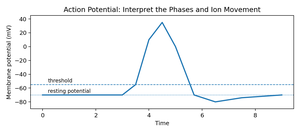
An action potential is a rapid change in membrane potential that propagates along the neuron, allowing for communication within the nervous system. The process involves distinct phases, each linked to specific ion channel behavior.
Threshold: Sufficient depolarization triggers an action potential; below-threshold stimuli do not initiate it. (There’s a “start line” at the top. If you push the kid enough to get past the start line, they go down. If you push not enough, they don’t go—no big slide ride happens.)
All-or-None Principle: Once threshold is reached, the action potential occurs with a characteristic amplitude. (Once the kid crosses the start line, they go down the slide the normal way—same kind of ride each time. A tiny bit past the line vs. a lot past the line doesn’t make a “half-slide” or “extra-big-slide.” It’s either a full slide ride or none.)
Depolarization: Voltage-gated Na+ channels open, Na+ enters the neuron. (This is the “GO!” moment. Special doors called voltage-gated Na⁺ channels open, and Na⁺ rushes in. That makes the inside less negative (more “positive-ish”), like the neuron is turning its signal ON.)
Peak/Repolarization: Na+ channels inactivate, voltage-gated K+ channels open, K+ exits the neuron. (At the top of the ride, the Na⁺ doors stop letting Na⁺ in (they “inactivate”), and different doors called voltage-gated K⁺ channels open.)
Hyperpolarization: K+ channels close slowly, making the membrane more negative than the resting potential. (: The K⁺ doors close slowly, so extra K⁺ leaves for a moment. That makes the inside even more negative than usual—like the neuron “over-resets” past its normal resting level.)
Refractory Period: The membrane cannot immediately initiate another action potential, ensuring one-way propagation and limiting firing frequency. ( Right after the slide ride, the kid can’t instantly go again. The neuron needs a short break where it’s hard or impossible to start another action potential)
Example: Stronger stimuli increase the frequency of action potentials, not their amplitude.
Propagation, Myelin & Neuron Types
Signal Transmission and Neuron Classification
Action potentials regenerate along the axon; ions are not physically carried from one end to the other. Myelin and neuron types play crucial roles in signal transmission.
Propagation: Depolarization at one axon region opens voltage-gated channels in adjacent regions, regenerating the signal. (Imagine a line of dominoes. When one domino falls, it knocks over the next one, and the next one… That’s like a nerve message)
Myelin: Insulates axon regions, enabling saltatory conduction at nodes of Ranvier and increasing conduction speed. (Myelin is like a plastic coat around an electrical wire. The coat helps the message travel faster because it doesn’t leak out)
Loss of Myelin: Slows or disrupts signal propagation due to current leakage. (If the coat is ripped, the message can leak out and get weak—so the message goes slow or sometimes doesn’t make it.)
Neuron Types :
Sensory neurons: Carry information from receptors to the CNS. (Sensory neurons are like “reporters” that tell your brain what you feel (hot, cold, touch).
Interneurons: Integrate information within the CNS. (Interneurons are like “thinkers” in your brain/spinal cord that decide what to do.)
Motor neurons: Carry commands from the CNS to effectors. (Motor neurons are like “helpers” that carry the brain’s orders to muscles (like “move your hand!”)
Example: Multiple sclerosis is a disease characterized by myelin loss, which impairs neural conduction.
Chemical Synapses & Cell Communication
Synaptic Transmission and Signal Integration
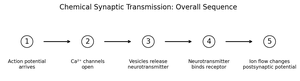
Chemical synapses convert electrical signals in the presynaptic neuron into chemical signals, which then elicit electrical responses in the postsynaptic cell. This process is essential for neuronal communication.
Neurotransmitter Binding: Receptor-specific; can open ligand-gated ion channels or initiate signaling pathways. (Each neurotransmitter can only stick to certain receptors—like a key that fits only one lock. When it binds, it can do two simple things: open a door (a channel) to let tiny particles (ions) in/out, or press a button that starts a longer set of changes inside the cell.)
Excitatory vs. Inhibitory Effects: Excitatory effects increase the likelihood of reaching threshold; inhibitory effects decrease it. (Some messages are like a green light —they help the next cell “go” (more likely to reach threshold and fire). Those are excitatory. Other messages are like a red light —they help the cell “stop” (less likely to reach threshold). Those are inhibitory.
Signal Integration: Postsynaptic cells integrate multiple excitatory and inhibitory inputs to determine if threshold is reached. (The postsynaptic cell is like it’s listening to lots of people at once. It adds up the green lights and the red lights, then decides: “Do I have enough ‘go’ to reach the ‘GO line’ (threshold)?” If yes, it fires; if no, it doesn’t.)
Cell Communication Steps: Reception (neurotransmitter binds receptor) → Transduction (receptor/channel response) → Response (change in postsynaptic membrane potential).
(First, Reception: the message (neurotransmitter) sticks to the right lock (receptor). Next, Transduction: the lock opening/pressing a button causes something to happen (like a channel opening). Finally, Response: the next cell’s “charge” changes a bit (its membrane potential changes), making it more likely—or less likely—to reach threshold.)
Example: Glutamate is a common excitatory neurotransmitter, while GABA is inhibitory.
Experimental Predictions in Neuronal Signaling
Effects of Channel Blockers, Ion Gradients, and Myelin Loss
Understanding neuronal signaling allows for predictions about the effects of various experimental manipulations.
Experimental Change | Predicted Consequence |
|---|---|
Block voltage-gated Na+ channels | Depolarization/action-potential initiation and propagation are reduced or prevented. |
Block voltage-gated K+ channels | Repolarization is delayed; the membrane stays depolarized longer. |
Reduce extracellular Na+ | Na+ driving force is reduced; depolarization is typically reduced. |
Damage myelin | Conduction becomes slower and may fail. |
Block neurotransmitter release | Postsynaptic response to that presynaptic neuron is reduced or absent. |
Block a postsynaptic receptor | The postsynaptic cell cannot respond normally to that neurotransmitter. |
Key Terms and Concepts
Essential Vocabulary for Neuronal Signaling
Additional info: The notes integrate AP Biology concepts of membrane transport and cell communication, providing context for neuronal signaling mechanisms.
Resting potential: The cell’s “resting” charge, where the inside is a little negative compared to the outside.
Polarization: A difference in charge between the inside and outside of the cell.
Depolarization: When the inside of the cell becomes less negative (more positive) than it was.
Repolarization: When the cell returns toward its normal resting negative inside after depolarizing.
Hyperpolarization: When the inside becomes even more negative than the resting potential.
Threshold: The “go” point where the cell must reach a certain voltage to start an action potential.
Action potential: A fast electrical signal that travels down a neuron like a wave.
Electrochemical gradient: The push that moves ions because of both concentration and charge differences
Na⁺/K⁺ pump: A protein that uses energy to pump Na⁺ out and K⁺ in to help maintain resting potential.
Leak channel: A channel that is always open and lets certain ions slowly drift across the membrane.
Voltage-gated channel: A channel that opens or closes when the membrane voltage changes.
Ligand-gated channel: A channel that opens when a chemical messenger (ligand) binds to it.
Refractory period: A short time after an action potential when the neuron can’t fire again (or is much harder to fire).
Myelin: A fatty “insulating cover” around axons that helps signals travel faster.
Node of Ranvier: A small gap in the myelin where ions can move and the signal gets boosted.
Saltatory conduction: When the signal “jumps” from node to node, making it travel faster.
Sensory neuron: A neuron that carries information from the body’s sensors to the brain/spinal cord.
Interneuron: A neuron in the CNS that connects and processes information between other neurons.
Motor neuron: A neuron that carries commands from the CNS to muscles or glands. Presynaptic cell: The neuron that sends the signal across a synapse.
Postsynaptic cell: The neuron (or muscle/gland cell) that receives the signal.
Synapse: The tiny gap/connection point where one neuron communicates with another.
Neurotransmitter: A chemical messenger that carries the signal across the synapse.
Excitatory: Something that makes a neuron more likely to reach threshold and fire.
Inhibitory: Something that makes a neuron less likely to reach threshold and fire.
