 Indietro
Nucleic Acids and DNA: Structure, Synthesis, and Repair
Guida di studio - Note intelligenti
 Appunti personalizzati basati sui tuoi materiali, ampliati con definizioni chiave, esempi e contesto.
Nucleic Acids and DNA: Structure, Synthesis, and Repair
Introduction to Genes and Genetic Material
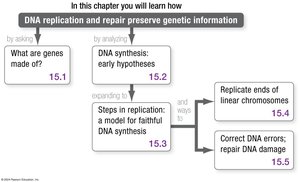
Understanding the molecular nature of genes and their replication is foundational to biology. Early experiments established the principles of inheritance, but the chemical identity of genes and the mechanisms of their replication and repair were clarified through pivotal research in molecular genetics.
Genes are segments of DNA that encode information for the synthesis of proteins and functional RNA molecules.
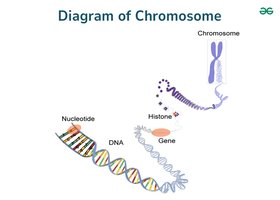
Chromosomes are composed of DNA and proteins, with DNA serving as the hereditary material.
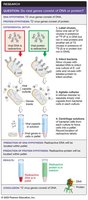
Key experiments, such as the Hershey–Chase experiment, demonstrated that DNA, not protein, is the genetic material.
Chapter Roadmaps
What Are Nucleic Acids?
Structure of Nucleic Acids
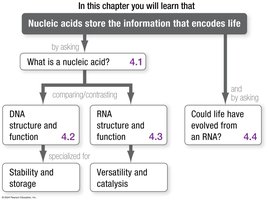
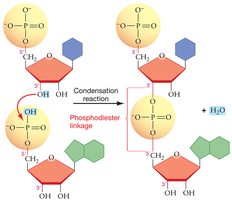
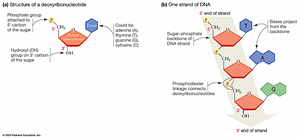
Nucleic acids are polymers made of nucleotide monomers. Each nucleotide consists of three components: a phosphate group, a five-carbon sugar, and a nitrogenous base. The sequence of these bases encodes genetic information.
Ribonucleotides (RNA): Contain ribose sugar.
Deoxyribonucleotides (DNA): Contain deoxyribose sugar (lacking an oxygen atom at the 2' carbon).
Nitrogenous bases are classified as purines (adenine, guanine) and pyrimidines (cytosine, thymine in DNA, uracil in RNA).
DNA Structure
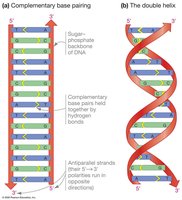
DNA is a double-stranded molecule with antiparallel strands forming a double helix. The backbone consists of alternating sugar and phosphate groups, with nitrogenous bases projecting inward. The strands are held together by hydrogen bonds between complementary bases.
Base pairing: Adenine (A) pairs with Thymine (T); Guanine (G) pairs with Cytosine (C).
Strands have directionality: a 5' end (phosphate group) and a 3' end (hydroxyl group).
Antiparallel orientation: One strand runs 5' to 3', the other 3' to 5'.
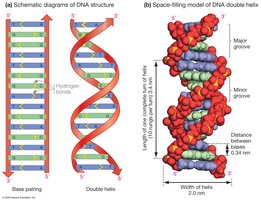
DNA as an Information-Containing Molecule
DNA stores genetic information in the sequence of its bases. This information is used for the growth, development, and reproduction of organisms. The double helix structure provides stability, making DNA an effective molecule for long-term information storage.
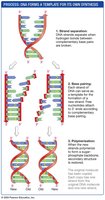
Replication involves separating the two strands and using each as a template for synthesis of a new complementary strand.
Complementary base pairing ensures accurate copying of genetic information.
DNA Replication: Mechanisms and Models
Models of DNA Replication
Three models were proposed for DNA replication: semiconservative, conservative, and dispersive. The Meselson–Stahl experiment confirmed the semiconservative model, where each daughter DNA molecule consists of one old and one new strand.
Semiconservative replication: Each new DNA has one parental and one new strand.
Conservative replication: Parental molecule remains intact; new molecule is entirely new.
Dispersive replication: Each strand is a mix of old and new DNA segments.
Enzymes and Steps in DNA Synthesis
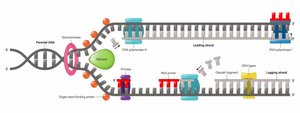
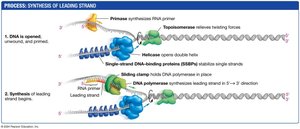
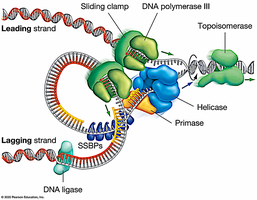
DNA polymerase is the enzyme responsible for synthesizing new DNA strands. It adds nucleotides only to the 3' end, so DNA synthesis proceeds in the 5' to 3' direction. Synthesis requires a primer, usually made of RNA by the enzyme primase.
DNA polymerase: Catalyzes the addition of deoxyribonucleotides to a growing DNA strand.
Primase: Synthesizes short RNA primers to provide a starting point for DNA polymerase.
Helicase: Unwinds the DNA double helix.
Single-strand binding proteins (SSBPs): Stabilize unwound DNA strands.
Topoisomerase: Relieves tension ahead of the replication fork.
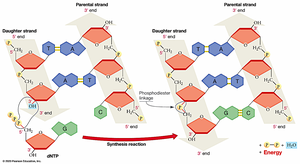
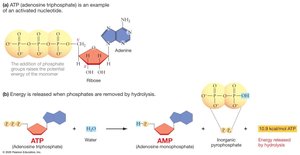
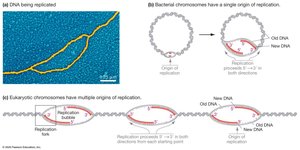
Leading and Lagging Strand Synthesis
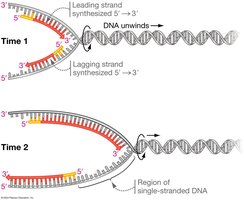
Because DNA polymerase can only add nucleotides to the 3' end, the two new strands are synthesized differently:
Leading strand: Synthesized continuously toward the replication fork.
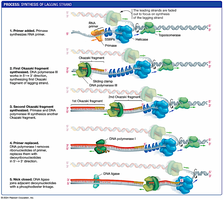
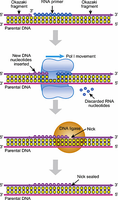
Lagging strand: Synthesized discontinuously away from the fork in short fragments called Okazaki fragments.
Okazaki fragments are later joined by DNA ligase.
DNA Repair Mechanisms
Proofreading and Mismatch Repair
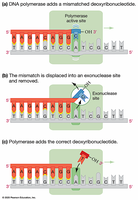
DNA polymerase has proofreading ability, correcting errors during synthesis. Additional repair systems, such as mismatch repair, correct errors missed during replication.
Proofreading: DNA polymerase removes incorrectly paired nucleotides using its exonuclease activity.
Mismatch repair: Enzymes recognize and repair mismatched bases after DNA synthesis is complete.
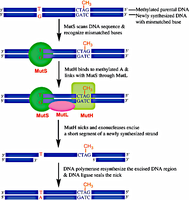
Repairing Damaged DNA
DNA can be damaged by environmental factors such as UV light and chemicals. The nucleotide excision repair system recognizes and removes damaged DNA, using the undamaged strand as a template for repair.
Nucleotide excision repair: Removes bulky lesions, such as thymine dimers, and fills in the gap with new DNA.
Defects in DNA repair systems can lead to diseases such as xeroderma pigmentosum, which increases sensitivity to UV light and risk of skin cancer.
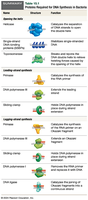
Summary Table: Proteins Required for DNA Synthesis in Bacteria
Protein | Function |
|---|---|
Single-strand DNA-binding proteins (SSBPs) | Stabilize single-stranded DNA |
Topoisomerase | Relieves twisting forces |
Helicase | Opens double helix |
Primase | Synthesizes RNA primer |
DNA polymerase III | Extends leading strand and Okazaki fragments |
Sliding clamp | Holds DNA polymerase in place |
DNA polymerase I | Removes RNA primer and replaces with DNA |
DNA ligase | Joins Okazaki fragments |
Additional info: Accurate DNA replication and repair are essential for maintaining genetic stability and preventing diseases such as cancer. The interplay of multiple enzymes and repair systems ensures the fidelity of genetic information across generations.
