 Indietro
Nucleic Acids and the RNA World: Structure, Function, and Evolution
Guida di studio - Note intelligenti
 Appunti personalizzati basati sui tuoi materiali, ampliati con definizioni chiave, esempi e contesto.
Chapter 4: Nucleic Acids and an RNA World
4.1 What Is a Nucleic Acid?
Nucleic acids are essential biological macromolecules that store and transmit genetic information. They are polymers composed of monomers called nucleotides. Each nucleotide consists of three components:
Phosphate group
Pentose (five-carbon) sugar
Nitrogenous base
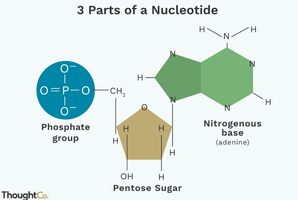
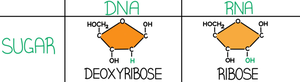
The sugar is the central component of the nucleotide. The type of sugar distinguishes DNA from RNA:
Ribonucleotides (RNA): contain ribose sugar
Deoxyribonucleotides (DNA): contain deoxyribose sugar (lacking one oxygen atom compared to ribose)
Nitrogenous Bases
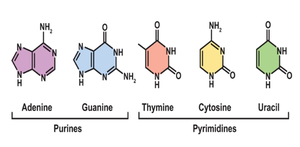
Nucleotides differ in their nitrogenous bases, which are classified as either purines or pyrimidines:
Purines: Double-ring structures (adenine and guanine)
Pyrimidines: Single-ring structures (cytosine, thymine, and uracil)
Polymerization of Nucleotides
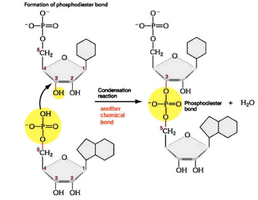
Nucleotides polymerize via condensation reactions between the hydroxyl group on the sugar of one nucleotide and the phosphate group of another, releasing a water molecule. This forms a phosphodiester linkage:
Polymerization produces RNA (from ribonucleotides) and DNA (from deoxyribonucleotides).
Directionality and Energy
Nucleic acid strands have directionality: 5' phosphate end to 3' hydroxyl end.
Sequences are written from 5' to 3' (e.g., ATTAGC).
Adenosine triphosphate (ATP) provides energy for nucleotide polymerization. The addition of phosphate groups increases potential energy due to repulsive forces between negatively charged phosphates; energy is released when new, stable bonds form.
4.2 DNA Structure and Function
The structure of DNA was elucidated through X-ray crystallography by Rosalind Franklin and Maurice Wilkins, revealing a helical, regularly repeating structure. Watson and Crick determined that DNA consists of two antiparallel strands twisted into a double helix, stabilized by complementary base pairing:
Adenine (A) pairs with Thymine (T) via two hydrogen bonds
Guanine (G) pairs with Cytosine (C) via three hydrogen bonds
Purines always pair with pyrimidines
Base stacking and van der Waals interactions further stabilize the helix, creating major and minor grooves
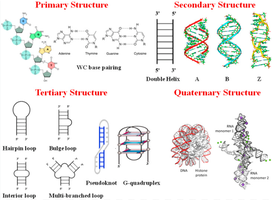
Key structural levels of DNA:
Primary structure: Linear sequence of nucleotides
Secondary structure: Double helix formed by antiparallel strands
Tertiary structure: Supercoiling for compaction
Quaternary structure: DNA packaged into chromatin
During replication, hydrogen bonds between strands are broken, allowing each strand to serve as a template for synthesis of a new complementary strand.
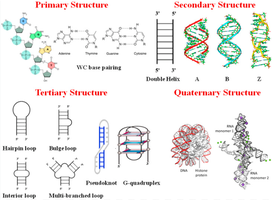
4.3 RNA Structure and Function
RNA, like DNA, has a primary structure of four nitrogenous bases extending from a sugar-phosphate backbone. However, RNA contains ribose sugar and uses uracil (U) instead of thymine (T):
RNA bases: Adenine (A), Guanine (G), Cytosine (C), Uracil (U)
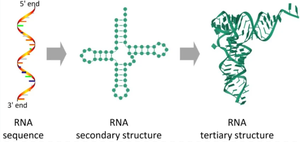
RNA is typically single-stranded but can form complex secondary and tertiary structures
Secondary structure: RNA forms hydrogen bonds between complementary bases on the same strand, creating hairpin loops and other motifs.
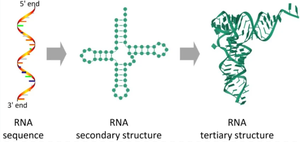
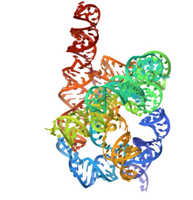
Tertiary structure: Secondary structures fold into complex three-dimensional shapes, such as pseudoknots. RNA molecules are more structurally diverse than DNA and can function as enzymes (ribozymes).
Messenger RNA (mRNA): Serves as an intermediate, transmitting genetic information from DNA to the ribosome for protein synthesis.
Ribozymes
Some RNA molecules, called ribozymes, have catalytic activity similar to protein enzymes. For example, the Tetrahymena ribozyme catalyzes both hydrolysis and condensation of phosphodiester linkages in RNA.
RNA Replication and the Central Dogma
RNA can serve as a template for its own replication, forming complementary strands through base pairing and condensation reactions.
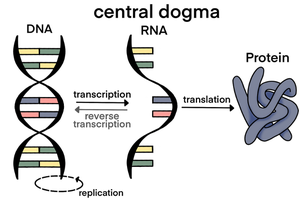
The Central Dogma of molecular biology describes the flow of genetic information: DNA is transcribed into RNA, which is then translated into protein.
4.4 In Search of the First Life-Form
The RNA world hypothesis suggests that early life may have relied on RNA both to store genetic information and to catalyze chemical reactions, preceding the evolution of DNA and proteins. This highlights the versatility and central role of RNA in the origin of life.
