 Indietro
Nucleic Acids and the RNA World: Structure, Function, and Evolution
Guida di studio - Note intelligenti
 Appunti personalizzati basati sui tuoi materiali, ampliati con definizioni chiave, esempi e contesto.
Chapter 4: Nucleic Acids and the RNA World
Introduction to Nucleic Acids
Nucleic acids are essential biomolecules that store and transmit genetic information. The chemical evolution of life led to the production of molecules capable of self-replication, with DNA and RNA playing central roles. The RNA world hypothesis suggests that RNA was once both the genetic material and a catalyst for its own replication, marking a critical stage in the origin of life.
Section 4.1: What Is a Nucleic Acid?
Nucleic Acids and Nucleotides
Nucleic acids, DNA and RNA, are polymers made from repeating nucleotide monomers. Each nucleotide consists of three parts:
Phosphate group
Five-carbon sugar (ribose in RNA, deoxyribose in DNA)
Nitrogenous base (A, T, G, C for DNA; A, U, G, C for RNA)
The phosphate group and nitrogenous base attach to the sugar. Nucleosides are composed of a sugar and a base, while nucleotides are nucleosides with one or more phosphate groups. Nucleotides join via phosphodiester bonds, forming a directional sugar-phosphate backbone.
General Structure of a Nucleotide
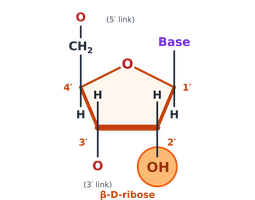
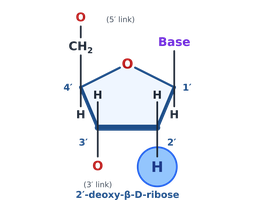
The structure of the sugar distinguishes RNA from DNA at the 2′ carbon position:
Ribose (RNA): Has a hydroxyl group (–OH) at the 2′ carbon.
Deoxyribose (DNA): Has a hydrogen (H) instead of –OH at the 2′ carbon.
Functional Consequences of the 2′-OH Group in RNA
Structural flexibility: The 2′-OH allows RNA to form additional hydrogen bonds, enabling complex folding.
Catalytic activity: Some RNAs (ribozymes) catalyze chemical reactions, such as peptide bond formation in ribosomes.
Diverse functions: RNA can serve as mRNA, tRNA, rRNA, miRNA, and regulatory/catalytic RNAs.
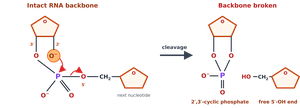
However, the 2′-OH also makes RNA less stable, as it can attack the phosphodiester backbone, leading to self-cleavage.
Nitrogenous Bases: Purines and Pyrimidines
Nitrogenous bases are classified by their ring structures:
Purines: Adenine (A) and Guanine (G) – two rings
Pyrimidines: Cytosine (C), Thymine (T), and Uracil (U) – one ring
C is found in both DNA and RNA; T is exclusive to DNA; U is exclusive to RNA. The sequence of bases encodes genetic information.
Polymerization of Nucleotides
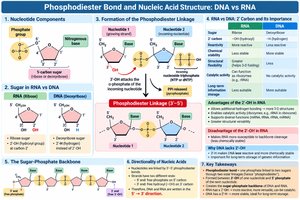
Nucleic acids polymerize via condensation reactions, releasing water. A phosphodiester linkage forms between the 5′ phosphate of one nucleotide and the 3′ hydroxyl of another. This creates a directional sugar-phosphate backbone.
Directionality and Energy Requirement
Directionality: Nucleic acid strands have a 5′ end (phosphate) and a 3′ end (hydroxyl).
Polymerization energy: Requires activated (triphosphate) nucleotides, such as ATP, GTP, CTP, UTP for RNA and dATP, dGTP, dCTP, dTTP for DNA. The addition of two extra phosphates increases potential energy, making polymerization spontaneous.
Section 4.2: DNA Structure and Function
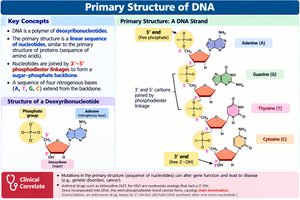
Primary Structure of DNA
DNA is a linear sequence of deoxyribonucleotides, with four nitrogenous bases (A, T, G, C) extending from the backbone. Mutations in the primary structure can lead to disease.
Secondary Structure: The Double Helix
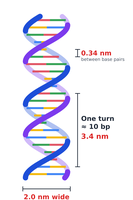
Early evidence for DNA's double helix came from nucleotide chemistry, Chargaff's rules (A = T, G = C), and X-ray crystallography. Watson and Crick's model describes DNA as an antiparallel double helix stabilized by complementary base pairing:
Antiparallel strands: One runs 5′→3′, the other 3′→5′.
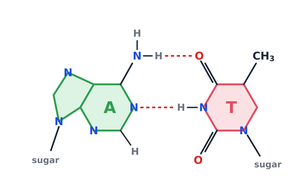
Complementary base pairing: A pairs with T (2 hydrogen bonds), G pairs with C (3 hydrogen bonds).
Helical structure: Sugar-phosphate backbone faces outward; bases face inward.
Stability and Information Storage
The double helix is highly stable due to phosphodiester linkages, hydrogen bonds, and hydrophobic interactions. DNA stores genetic information in the sequence of bases, which can be copied precisely during replication.
Tertiary Structure: DNA Supercoiling and Packaging
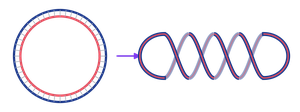
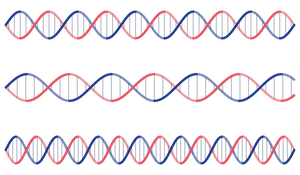
DNA forms more compact structures in cells, including supercoiling and wrapping around histone proteins. Supercoiling helps fit DNA inside the cell and regulates replication and transcription.
Relaxed vs supercoiled DNA: Supercoiling compacts DNA.
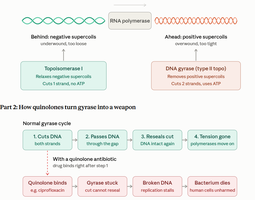
Underwound (negative) vs overwound (positive): Underwound DNA separates more easily; overwound DNA builds up ahead of RNA polymerase.
Histone wrapping: In eukaryotes, DNA wraps around histone cores, forming nucleosomes.
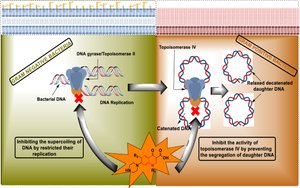
Topoisomerases: Enzymes that control supercoiling. Topoisomerase I relaxes supercoils; Topoisomerase II (DNA gyrase) introduces negative supercoils in bacteria.

Section 4.3: RNA Structure and Function
Primary Structure of RNA
RNA is a polymer of ribonucleotides (A, U, G, C) with a sugar-phosphate backbone. RNA contains ribose and uracil, making it less stable than DNA due to the reactive 2′-OH group.
Secondary and Tertiary Structure of RNA
Secondary structure: RNA folds into hairpin structures via complementary base pairing (A-U, G-C) within the same strand.
Tertiary structure: Secondary structures fold into complex three-dimensional shapes, allowing diverse functions and catalytic activity.
Comparison Table: DNA vs RNA Structure
Feature | DNA | RNA |
|---|---|---|
Sugar | Deoxyribose | Ribose |
2′ Position | H | OH |
Bases | A, T, G, C | A, U, G, C |
Strands | Double-stranded | Single-stranded |
Stability | More stable | Less stable |
Functions | Genetic storage | Information transfer, catalysis |
RNA's Versatility
RNA can fold into complex shapes, act as an information carrier (mRNA), regulate gene expression, and catalyze reactions (ribozymes).
Section 4.4: The RNA World Hypothesis
The RNA world hypothesis proposes that early life forms used RNA for both genetic storage and catalysis. Ribozymes demonstrate RNA's ability to catalyze reactions, supporting the idea that RNA could have replicated itself before the evolution of DNA and proteins.
Summary Table: DNA and RNA Structure
Aspect | DNA | RNA |
|---|---|---|
Sugar | Deoxyribose | Ribose |
2′ Group | H | OH |
Bases | A, T, G, C | A, U, G, C |
Strands | Double | Single |
Stability | High | Low |
Function | Storage | Transfer, catalysis |
Key Equations and Concepts
Phosphodiester bond formation:
Base pairing:
DNA double helix measurements: , ,
Clinical Connections
5-fluorouracil: Inhibits thymidylate synthase, blocking DNA synthesis in cancer treatment.
AZT: Stops viral DNA extension by replacing thymidine, preventing phosphodiester bond formation.
Ciprofloxacin: Inhibits bacterial DNA gyrase, blocking DNA supercoiling and replication.
Sickle-cell disease: A single nucleotide change alters the β-globin protein, causing disease.
Conclusion
Nucleic acids are fundamental to life, serving as the basis for genetic information storage, transmission, and catalysis. Understanding their structure and function is essential for grasping molecular biology, genetics, and the evolutionary origins of life.
