Indietro
Nucleic Acids and Transcription: Structure, Function, and Regulation
Guida di studio - Note intelligenti
 Appunti personalizzati basati sui tuoi materiali, ampliati con definizioni chiave, esempi e contesto.
Nucleic Acids and Transcription
DNA Structure
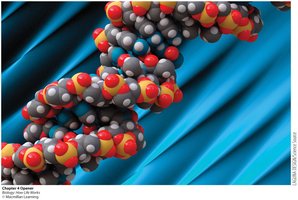
The structure of DNA is fundamental to its role as the hereditary material in cells. DNA is a double helix composed of two strands of nucleotides, each containing a sugar, phosphate, and nitrogenous base. The sequence of bases encodes genetic information.
Nucleotides: The building blocks of DNA, each consisting of a deoxyribose sugar, a phosphate group, and one of four nitrogenous bases (adenine, thymine, cytosine, guanine).
Double Helix: Two strands run antiparallel and are held together by hydrogen bonds between complementary bases (A-T, C-G).
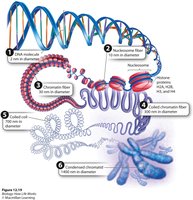
Chromatin Structure: DNA is packaged into chromatin, which further condenses into chromosomes during cell division.
Example: The DNA molecule's structure allows for accurate replication and transmission of genetic information.
The Central Dogma of Molecular Biology
The central dogma describes the flow of genetic information within a biological system: DNA is transcribed into RNA, which is then translated into protein. This process is essential for gene expression and cellular function.
Transcription: The process by which RNA is synthesized from a DNA template.
Translation: The process by which proteins are synthesized from an RNA template.
Reverse Transcription: In some cases, RNA can be reverse-transcribed into DNA (e.g., retroviruses).
Example: The central dogma explains how genetic information is used to produce functional proteins.

Comparison of RNA and DNA
Chemical Differences
RNA and DNA are both nucleic acids but differ in their chemical structure and function. These differences are crucial for their roles in the cell.
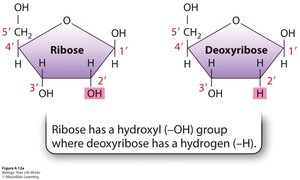
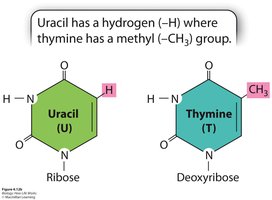
Sugar: RNA contains ribose, while DNA contains deoxyribose.
Bases: RNA uses uracil instead of thymine found in DNA.
Structure: RNA is usually single-stranded; DNA is double-stranded.
Example: The presence of a hydroxyl group in ribose makes RNA less stable than DNA.
Transcription
Overview and Mechanism
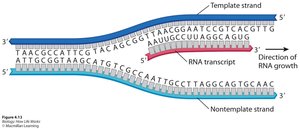
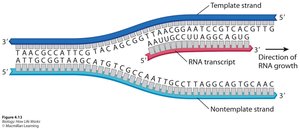
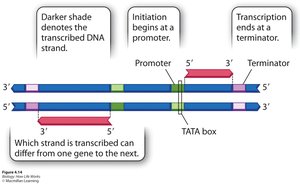
Transcription is the process by which a segment of DNA is used as a template to synthesize a complementary RNA strand. This process is carried out by RNA polymerase and involves three main stages: initiation, elongation, and termination.
Template Strand: The DNA strand used to synthesize RNA.
Directionality: RNA is synthesized in the 5' to 3' direction.
Stages: Initiation, elongation, and termination.
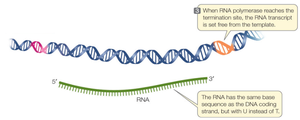
Example: During transcription, T's in DNA are replaced by U's in RNA.
Regulation of Transcription
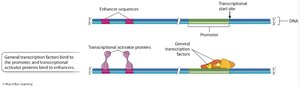
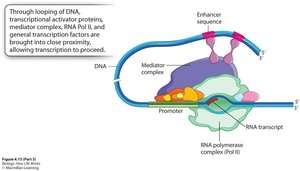
Transcription is tightly regulated to ensure that genes are expressed only when needed. Regulatory elements such as promoters, enhancers, and transcription factors play key roles in this process.
Promoter: DNA sequence where RNA polymerase binds to initiate transcription.
Enhancer: DNA sequence that increases transcription efficiency.
Transcription Factors: Proteins that assist in the initiation of transcription.
Example: Housekeeping genes are transcribed continuously, while others are regulated based on cellular needs.
Transcription Elongation and Polymerization
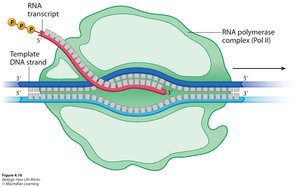
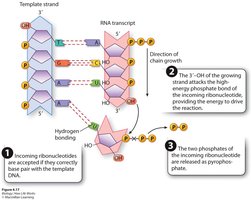
During elongation, RNA polymerase moves along the DNA template, adding ribonucleotides to the growing RNA strand. The energy for this reaction comes from the cleavage of high-energy phosphate bonds.
Polymerization: Addition of ribonucleotides to the RNA strand.
Direction: RNA polymerase moves 3' to 5' on the template, synthesizing RNA 5' to 3'.
Example: The 3'-OH group attacks the phosphate of the incoming nucleotide, releasing pyrophosphate.
Transcription Termination
Transcription ends when RNA polymerase encounters a terminator sequence. The RNA transcript is released and is known as the primary transcript.
Terminator: DNA sequence signaling the end of transcription.
Primary Transcript: The initial RNA product, which may require further processing.
Example: In protein-coding genes, the primary transcript becomes mRNA.
RNA Processing in Eukaryotes
Modification of Primary Transcript
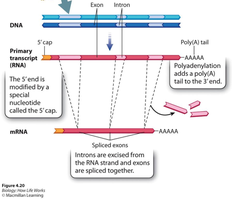
In eukaryotes, the primary RNA transcript undergoes several modifications before becoming mature mRNA. These modifications are essential for stability, export, and translation.
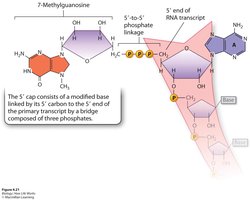
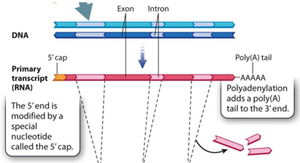
5' Cap: Addition of a modified guanine nucleotide to the 5' end.
Poly-A Tail: Addition of a string of adenine nucleotides to the 3' end.
RNA Splicing: Removal of introns and joining of exons.
Example: Without the 5' cap, mRNA would not be recognized by the ribosome.
RNA Splicing and Alternative Splicing
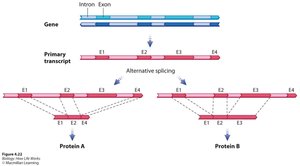
RNA splicing removes non-coding introns from the primary transcript, leaving only coding exons. Alternative splicing allows a single gene to produce multiple protein products by varying the combination of exons included in the final mRNA.
Spliceosome: Complex of RNA and protein that catalyzes splicing.
Alternative Splicing: Generates diversity in protein products from a single gene.
Example: Most human genes undergo alternative splicing.
Transcription in Prokaryotes vs. Eukaryotes
Cellular Location and Coupling
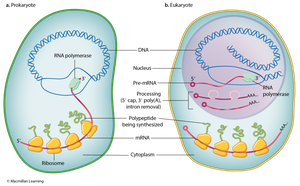
Transcription and translation occur in different locations in prokaryotic and eukaryotic cells. In prokaryotes, both processes are coupled in the cytoplasm, while in eukaryotes, transcription occurs in the nucleus and translation in the cytoplasm.
Prokaryotes: No nuclear envelope; transcription and translation are coupled.
Eukaryotes: Nuclear envelope separates transcription and translation; mRNA is processed before export.
Example: In prokaryotes, primary transcripts may contain information for multiple genes.
Summary Table: Transcription in Prokaryotes vs. Eukaryotes
Feature | Prokaryotes | Eukaryotes |
|---|---|---|
Location | Cytoplasm | Nucleus (transcription), Cytoplasm (translation) |
mRNA Processing | None | 5' cap, poly-A tail, splicing |
Coupling | Transcription and translation are coupled | Transcription and translation are separated |
Primary Transcript | mRNA (ready for translation) | Pre-mRNA (requires processing) |