Indietro
Chapter 5B: Nucleic Acids: Structure, Function, and Gene Expression
Guida di studio - Note intelligenti
 Appunti personalizzati basati sui tuoi materiali, ampliati con definizioni chiave, esempi e contesto.
Nucleic Acids
Roles of Nucleic Acids: DNA and RNA
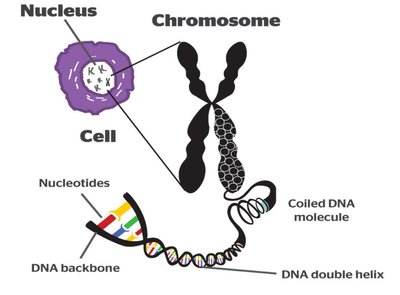
Nucleic acids are essential macromolecules responsible for the storage, transmission, and expression of hereditary information in all living organisms. The two primary types are deoxyribonucleic acid (DNA) and ribonucleic acid (RNA).
DNA stores genetic information and provides instructions for its own replication.
RNA is involved in gene expression, carrying instructions from DNA to ribosomes for protein synthesis.
Gene Expression
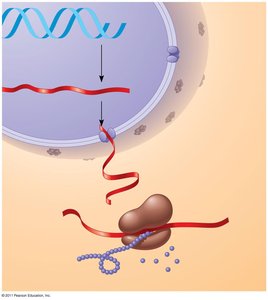
Gene expression is the process by which information from a gene is used to synthesize functional gene products, typically proteins. This involves two main steps: transcription and translation.
Transcription: DNA is transcribed into messenger RNA (mRNA) in the nucleus.
Translation: mRNA is translated into a polypeptide (protein) at the ribosome in the cytoplasm.
Structure and Components of Nucleic Acids
Nucleotides and Polynucleotides
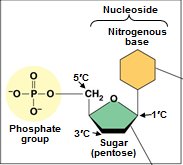
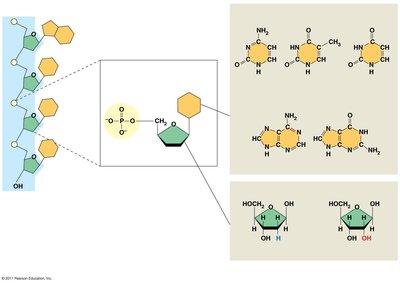
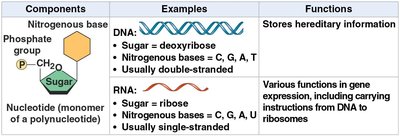
Nucleic acids are polymers called polynucleotides, made up of monomers called nucleotides. Each nucleotide consists of three components:
Nitrogenous base
Pentose sugar (deoxyribose in DNA, ribose in RNA)
Phosphate group
The portion of a nucleotide without the phosphate group is called a nucleoside (nitrogenous base + sugar).
Families of Nitrogenous Bases
Nitrogenous bases are classified into two families:
Pyrimidines: Cytosine (C), Thymine (T, in DNA), Uracil (U, in RNA) – single 6-membered ring
Purines: Adenine (A), Guanine (G) – 6-membered ring fused to a 5-membered ring
Nucleotide Polymerization
Nucleotides are joined by phosphodiester bonds between the 3' hydroxyl group of one nucleotide and the 5' phosphate group of the next. This forms a sugar-phosphate backbone with nitrogenous bases as appendages.
The sequence of bases is unique for each gene.
One DNA molecule contains many genes.
Structures of DNA and RNA Molecules
DNA: Double Helix and Antiparallel Strands
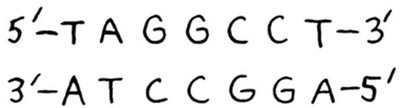
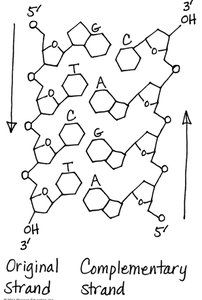
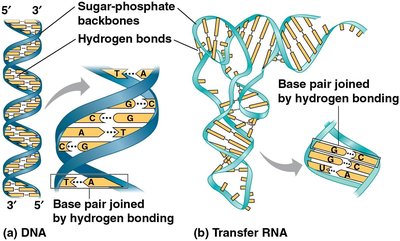
DNA consists of two polynucleotide chains forming a double helix. The two backbones run in opposite directions (antiparallel: 5' → 3' and 3' → 5').
Base pairs are joined by hydrogen bonds: Adenine (A) pairs with Thymine (T), Guanine (G) pairs with Cytosine (C).
Each strand serves as a template for replication.
RNA: Single-Stranded and Base Pairing
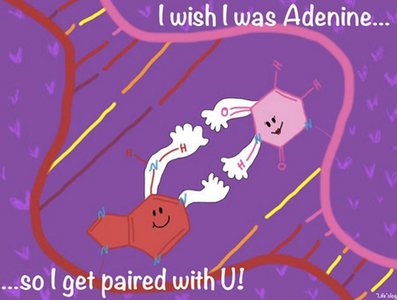
RNA molecules are usually single-stranded, but complementary base pairing can occur within the same molecule or between two RNA molecules. In RNA, Uracil (U) replaces Thymine (T), so Adenine (A) pairs with Uracil (U).
Comparison of DNA and RNA
Key Differences
DNA: Double helix, deoxyribose sugar, bases = A, T, C, G
RNA: Single helix, ribose sugar, bases = A, U, C, G
Biological Macromolecules and Their Monomers
Overview Table
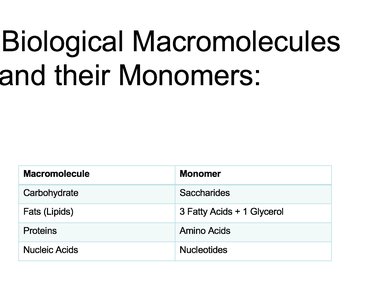
Biological macromolecules are polymers formed from specific monomers. The type of linkage varies by macromolecule.
Macromolecule | Monomer |
|---|---|
Carbohydrate | Saccharides |
Fats (Lipids) | 3 Fatty Acids + 1 Glycerol |
Proteins | Amino Acids |
Nucleic Acids | Nucleotides |
Monomers or Components | Polymer or Larger Molecule | Type of Linkage |
|---|---|---|
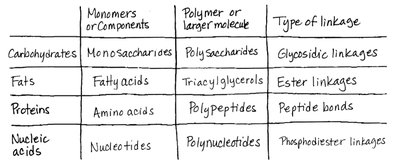
Carbohydrates: Monosaccharides | Polysaccharides | Glycosidic linkages |
Fats: Fatty acids | Triacylglycerols | Ester linkages |
Proteins: Amino acids | Polypeptides | Peptide bonds |
Nucleic acids: Nucleotides | Polynucleotides | Phosphodiester linkages |
Practice Questions and Review
Sample Questions
The sex hormones estradiol and testosterone belong to which class of molecules? Answer: Lipids
The type of bond that forms monomers into polymers (such as starch & proteins) is a(n) ____ bond. Answer: Covalent
Why does the body make cholesterol? Answer: Cholesterol is the precursor for many important molecules such as sex hormones.
Which of the following lists the chemical components of a nucleotide? Answer: A nitrogenous base, a phosphate group, and a pentose sugar.
Summary of Key Concepts
Nucleic acids are polymers of nucleotides, essential for genetic information storage and expression.
DNA is double-stranded, contains deoxyribose, and uses A, T, C, G bases.
RNA is single-stranded, contains ribose, and uses A, U, C, G bases.
Phosphodiester bonds link nucleotides in polynucleotide chains.
Gene expression involves transcription (DNA to mRNA) and translation (mRNA to protein).