 Indietro
Nucleic Acids: Structure, Function, and Replication
Guida di studio - Note intelligenti
 Appunti personalizzati basati sui tuoi materiali, ampliati con definizioni chiave, esempi e contesto.
Nucleic Acids (DNA and RNA)
Introduction to Nucleic Acids
Nucleic acids are essential biomolecules that store and transmit genetic information in all living organisms. The two main types are deoxyribonucleic acid (DNA) and ribonucleic acid (RNA). DNA serves as the hereditary material, while RNA plays various roles in gene expression and regulation.
Learning Outcomes
Relate DNA structure to its function as the hereditary molecule.
Explain how nucleotides polymerize to form nucleic acids.
Explain DNA’s polarity.
Outline the process of DNA replication.
Explain why proofreading mechanisms are important for DNA replication.
Structure of Nucleotides
Nucleotide Components
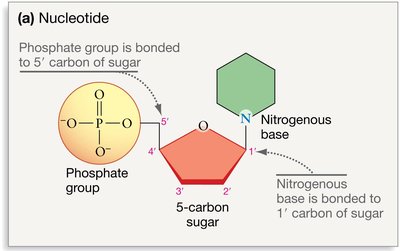
Nucleotides are the building blocks of nucleic acids. Each nucleotide consists of three components:
Phosphate group
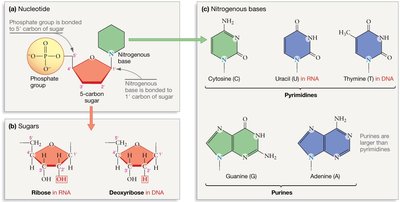
Five-carbon sugar (deoxyribose in DNA, ribose in RNA)
Nitrogenous base (Adenine, Guanine, Cytosine, Thymine in DNA; Uracil replaces Thymine in RNA)
Types of Nitrogenous Bases
Nitrogenous bases are classified into two groups:
Pyrimidines: Cytosine (C), Thymine (T, in DNA), Uracil (U, in RNA)
Purines: Adenine (A), Guanine (G)
Comparison of DNA and RNA Nucleotides
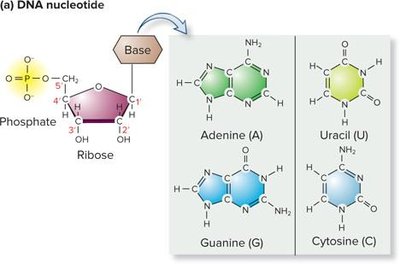
The main differences between DNA and RNA nucleotides are the sugar component and one of the nitrogenous bases:
DNA contains deoxyribose; RNA contains ribose.
DNA uses thymine; RNA uses uracil instead.
Polymerization of Nucleotides
Formation of Nucleic Acid Strands
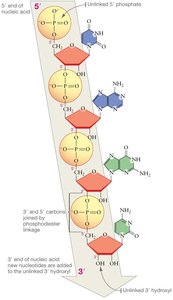
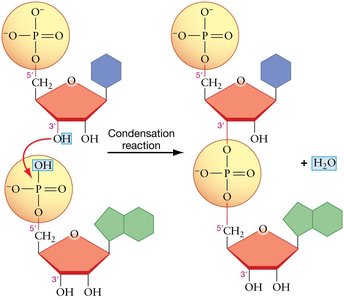
Nucleotides are joined together by phosphodiester bonds between the 3' hydroxyl group of one sugar and the 5' phosphate group of the next. This process forms the sugar-phosphate backbone of nucleic acids and gives the strand directionality (polarity) from the 5' to 3' end.
Energy for Polymerization
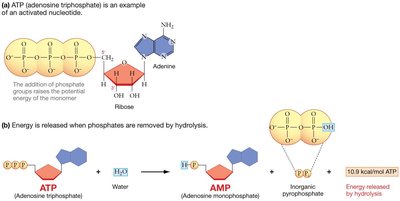
Polymerization requires energy, which is provided by the nucleotide triphosphates (NTPs). The hydrolysis of high-energy phosphate bonds releases energy to drive the reaction.
Example: ATP (adenosine triphosphate) is an activated nucleotide.
Condensation Reaction
The formation of a phosphodiester bond is a condensation reaction, releasing a molecule of water.
DNA Structure
Primary and Secondary Structure
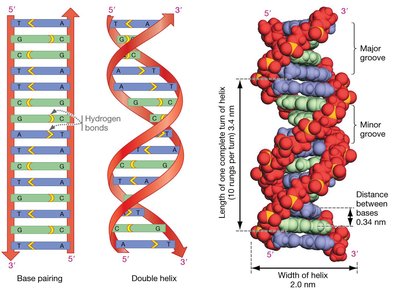
The primary structure of DNA is its sequence of nucleotides. The secondary structure is the famous double helix, consisting of two antiparallel strands held together by complementary base pairing.
Base Pairing Rules
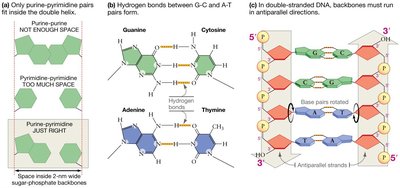
Purines pair with pyrimidines: Adenine (A) pairs with Thymine (T) via two hydrogen bonds; Guanine (G) pairs with Cytosine (C) via three hydrogen bonds.
The number of purines equals the number of pyrimidines in a DNA molecule (Chargaff's rules).
Base pairing is complementary and strands are antiparallel.
Summary Table: DNA vs. RNA
Feature | DNA | RNA |
|---|---|---|
Sugar | Deoxyribose | Ribose |
Bases | A, T, G, C | A, U, G, C |
Strands | Double-stranded (usually) | Single-stranded (usually) |
Function | Genetic information storage | Gene expression, catalysis, regulation |
DNA Replication (Overview)
Process of DNA Replication
DNA replication is the process by which a cell copies its DNA before cell division. The double helix unwinds, and each strand serves as a template for the synthesis of a new complementary strand. This ensures genetic information is accurately passed to daughter cells.
Replication is semiconservative: each new DNA molecule contains one old and one new strand.
Enzymes such as DNA polymerase catalyze the addition of nucleotides.
Importance of Proofreading
Proofreading mechanisms are essential for maintaining genetic fidelity. DNA polymerases have proofreading activity that corrects errors during replication, reducing the mutation rate and ensuring accurate transmission of genetic information.
Additional info:
These notes cover the foundational aspects of nucleic acid structure and function, which are essential for understanding molecular genetics, heredity, and the central dogma of biology. For more advanced details, refer to chapters on DNA replication, repair, and gene expression.
