 Indietro
Ch. 35 Nutrition and Digestion: Essential Concepts for General Biology
Guida di studio - Note intelligenti
 Appunti personalizzati basati sui tuoi materiali, ampliati con definizioni chiave, esempi e contesto.
Nutrition and Digestion
Essential Animal Nutrients
Animals require a variety of nutrients to maintain health, support growth, and fuel metabolic activities. These nutrients are obtained from food and are classified into several major categories.
Carbohydrates: Provide quick energy. Includes sugars (e.g., glucose, sucrose) and polysaccharides (e.g., starch, glycogen, cellulose).
Lipids: Most concentrated energy source. Includes fats and oils, which store more than twice as many Calories per unit weight as carbohydrates or proteins.
Proteins: Essential for building muscle, connective tissue, nails, and hair. Also function as enzymes, membrane receptors, and antibodies.
Minerals: Elements required for bone and teeth formation, muscle contraction, nerve conduction, and other functions (e.g., calcium, magnesium, phosphorus, iron, iodine).
Vitamins: Organic molecules necessary for metabolism, cell function, growth, and development. Divided into water-soluble (e.g., vitamin C, B-complex) and fat-soluble (e.g., vitamins A, D, E, K).
Water: Makes up about 60% of the human body and is essential for all metabolic reactions, temperature regulation, and waste elimination.
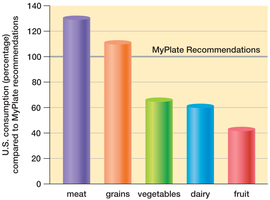
Energy from food powers metabolic activities. The nutrients that provide energy are carbohydrates, lipids, and proteins. The average U.S. diet consists of approximately 50% carbohydrates, 35% fats and oils, and 15% proteins.
Calorie: The amount of energy required to raise the temperature of 1 gram of water by 1ºC.
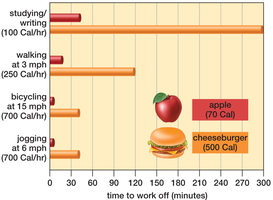
Resting Metabolic Rate: The average human body burns about 70 Calories per hour at rest. Muscle tissue burns more calories than fat, so muscular individuals have higher metabolic rates.
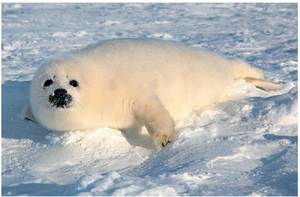
Fat Storage: Excess energy is stored as body fat, which provides insulation and does not attract water. Fat deposits are often located beneath the skin.
Body Mass Index (BMI): A tool for estimating healthy weight based on height and weight. For people with average muscle mass, a BMI between 18.5 and 24.9 is considered healthy.
Essential Nutrients: Certain raw materials must be supplied in the diet, including essential fatty acids, amino acids, minerals, vitamins, and water.
Essential Fatty Acids: Important for cell division, fetal development, and immune response. Sources include fish oils, canola oil, soybean oil, flaxseed, and walnuts.
Essential Amino Acids: Nine (adults) or ten (infants) amino acids must be obtained from protein-rich foods such as meat, milk, eggs, fish, beans, and soybeans.
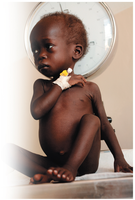
Minerals: Must be obtained from food or water. Examples include calcium, magnesium, phosphorus, sodium, potassium, iron, iodine, zinc, fluorine, chlorine, and chromium.
Vitamins: Water-soluble vitamins (C and B-complex) and fat-soluble vitamins (A, D, E, K) play diverse roles in metabolism and health.
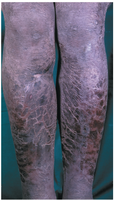
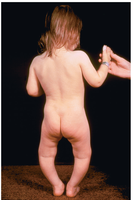
Vitamin Deficiencies: Niacin deficiency causes pellagra; folic acid deficiency impairs cell division; vitamin D deficiency leads to rickets.
Water: Essential for metabolic reactions, temperature regulation, and waste elimination. Sweating and urine are important for maintaining homeostasis.
The Digestive Process
Digestion is the process by which food is physically and chemically broken down to extract nutrients. The animal digestive system consists of compartments and organs that aid in digestion.
Five Tasks of Digestion: Ingestion, mechanical digestion, chemical digestion, absorption, elimination.
Intracellular Digestion: Occurs within individual cells (e.g., sponges).
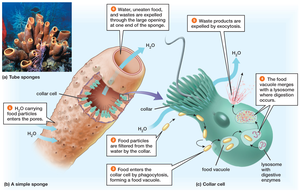
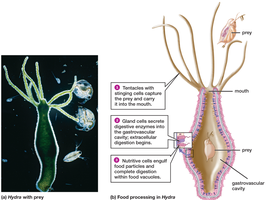
Extracellular Digestion: Most animals have a chamber or tube where enzymes break down food outside cells. Cnidarians have a gastrovascular cavity with a single opening.
Tubular Digestive Systems: Most animals have specialized compartments for sequential food processing (e.g., mouth, esophagus, intestine, anus).
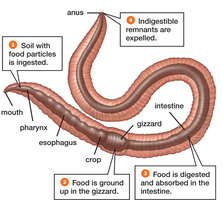
Vertebrate Digestive Systems: Specialized according to diet (carnivores, herbivores, omnivores). Major organs include mouth, esophagus, small intestine, large intestine.
Teeth Adaptations: Teeth are specialized for different diets. Humans have incisors for shearing, small canines, and large molars for grinding. Carnivores have enlarged canines for tearing flesh; herbivores have well-developed incisors for snipping plants.
Small Intestine Length: Herbivores have longer small intestines for extracting nutrients from plants; carnivores have shorter intestines.
Digestion of Food in Humans
Human digestion begins in the mouth and continues through the digestive tract, involving mechanical and chemical processes.
Mouth: Mechanical breakdown by teeth; saliva lubricates food and contains amylase to break down starch.
Pharynx and Esophagus: The tongue forms a bolus and pushes it into the pharynx; peristalsis moves food to the stomach.
Stomach: Churning contractions break up food; gastric glands secrete mucus, hydrochloric acid, and pepsinogen. Acid destroys microbes; pepsin digests proteins; mucus protects the stomach lining.
Small Intestine: Receives chyme, completes digestion, and absorbs nutrients. Segments include duodenum, jejunum, and ileum.
Large Intestine: Absorbs water, forms feces, and houses the microbiome.
Digestive Regulation: Controlled by nervous system and hormones (e.g., gastrin, secretin, cholecystokinin, leptin, ghrelin).
Appetite Regulation: Leptin (from fat cells) regulates fat storage; ghrelin (from stomach) stimulates hunger.
Summary Table: Essential Nutrients and Their Functions
Nutrient | Main Function | Sources |
|---|---|---|
Carbohydrates | Quick energy | Grains, fruits, vegetables |
Lipids | Energy storage, insulation | Oils, butter, nuts, fish |
Proteins | Structure, enzymes, antibodies | Meat, eggs, beans, soy |
Minerals | Bone, teeth, nerve, muscle | Dairy, vegetables, meat |
Vitamins | Metabolism, growth | Fruits, vegetables, dairy |
Water | Metabolism, temperature regulation | Drinking water, food |
Key Equations
BMI Calculation:
Calorie Definition:
