 Indietro
Organic Chemistry and Functional Groups: Study Guide & Practice Test Guidance
Guida di studio - Note intelligenti
 Appunti personalizzati basati sui tuoi materiali, ampliati con definizioni chiave, esempi e contesto.
Q1. Which functional group acts as a base by accepting a hydrogen ion (H+)?
Background
Topic: Functional Groups in Organic Chemistry
This question tests your understanding of how different functional groups behave chemically, specifically which group can accept a hydrogen ion and act as a base.
Key Terms:
Functional group: A specific group of atoms within molecules that are responsible for the characteristic chemical reactions of those molecules.
Base: A substance that can accept hydrogen ions (protons).
Step-by-Step Guidance
Review the properties of each functional group listed in the answer choices.
Recall that a base is a group that can accept a hydrogen ion (H+).
Consider which group has a nitrogen atom with a lone pair that can accept H+.
Eliminate groups that are known to act as acids or are nonpolar.
Try solving on your own before revealing the answer!
Final Answer: B) Amino group
The amino group (−NH2) can accept a hydrogen ion to become −NH3+, acting as a base.
Q2. If a carbonyl group is located at the end of a hydrocarbon skeleton, the molecule is classified as a(n):
Background
Topic: Functional Groups – Carbonyl Group
This question tests your ability to distinguish between aldehydes and ketones based on the location of the carbonyl group.
Key Terms:
Carbonyl group: A functional group consisting of a carbon atom double-bonded to an oxygen atom (−C=O).
Aldehyde: Carbonyl group at the end of the carbon chain.
Ketone: Carbonyl group within the carbon chain.
Step-by-Step Guidance
Recall the definitions of aldehyde and ketone.
Identify which group is at the end of the hydrocarbon skeleton.
Match the description to the correct term.
Try solving on your own before revealing the answer!
Final Answer: D) Aldehyde
An aldehyde has a carbonyl group at the end of the carbon chain, while a ketone has it within the chain.
Q3. Which functional group is nonpolar and has a tetrahedral shape?
Background
Topic: Functional Groups – Structure and Polarity
This question tests your knowledge of the structural geometry and polarity of functional groups.
Key Terms:
Nonpolar: A molecule or group that does not have a significant charge separation.
Tetrahedral: A shape where a central atom is bonded to four other atoms, forming a shape like a pyramid with a triangular base.
Step-by-Step Guidance
Recall which functional group is nonpolar.
Identify which group has a tetrahedral geometry.
Eliminate groups that are polar or have different shapes.
Try solving on your own before revealing the answer!
Final Answer: A) Methyl group
The methyl group (−CH3) is nonpolar and has a tetrahedral shape due to the arrangement of its bonds.
Q4. Two sulfhydryl groups can react to form cross-links that stabilize protein structures. These cross-links are called:
Background
Topic: Protein Structure – Functional Groups
This question tests your understanding of how sulfhydryl groups contribute to protein stability.
Key Terms:
Sulfhydryl group: −SH functional group.
Disulfide bond: A covalent bond formed between two sulfur atoms from sulfhydryl groups.
Step-by-Step Guidance
Recall the role of sulfhydryl groups in proteins.
Identify the type of bond formed between two −SH groups.
Eliminate other types of bonds (hydrogen, peptide, ionic).
Try solving on your own before revealing the answer!
Final Answer: B) Disulfide bonds
Disulfide bonds form between two sulfhydryl groups, stabilizing protein structures.
Q5. Which of the following elements are listed in your notes as essential for life, specifically linked to ATP?
Background
Topic: Elements Essential for Life
This question tests your knowledge of the elements that are crucial for biological molecules, especially ATP.
Key Terms:
ATP: Adenosine triphosphate, the primary energy carrier in cells.
Phosphate: An element and functional group essential for ATP.
Step-by-Step Guidance
Recall the elements listed as essential for life in your notes.
Identify which element is specifically associated with ATP.
Eliminate elements not directly linked to ATP.
Try solving on your own before revealing the answer!
Final Answer: C) Phosphate
Phosphate is a key component of ATP, making it essential for life.
Q6. What is the key difference between a carbonyl group and a carboxyl group?
Background
Topic: Functional Groups – Comparison
This question tests your ability to distinguish between two important functional groups based on their structure and properties.
Key Terms:
Carbonyl group: −C=O
Carboxyl group: −COOH (contains both a carbonyl and a hydroxyl group)
Step-by-Step Guidance
Compare the structures of carbonyl and carboxyl groups.
Identify which group contains an additional oxygen atom.
Eliminate options that do not match the structural difference.
Try solving on your own before revealing the answer!
Final Answer: B) Carboxyl contains an additional oxygen atom bonded to the same carbon.
The carboxyl group has one more oxygen atom than the carbonyl group.
Q7. A straight-chain hydrocarbon consisting of 4 carbons joined entirely by single bonds would be named:
Background
Topic: Hydrocarbon Nomenclature
This question tests your ability to name hydrocarbons based on their structure and bonding.
Key Terms:
Alkane: Hydrocarbon with only single bonds.
Butane: 4-carbon alkane.
Step-by-Step Guidance
Recall the prefixes for the number of carbons (but- for 4).
Identify the suffix for single bonds (−ane).
Eliminate names with double or triple bonds.
Try solving on your own before revealing the answer!
Final Answer: C) Butane
Butane is the name for a 4-carbon straight-chain alkane.
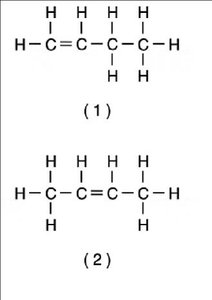
Q8. What does the number prefix in the molecule name "2-Butene" signify?
Background
Topic: Hydrocarbon Nomenclature – Double Bonds
This question tests your understanding of how the location of double bonds is indicated in hydrocarbon names.
Key Terms:
Butene: 4-carbon hydrocarbon with a double bond.
Number prefix: Indicates the position of the double bond.
Step-by-Step Guidance
Recall how double bond positions are numbered in hydrocarbon chains.
Identify what the number "2" refers to in "2-Butene".
Eliminate options that do not relate to double bond location.
Try solving on your own before revealing the answer!
Final Answer: B) The double bond starts at the 2nd carbon atom.
"2-Butene" means the double bond is between the 2nd and 3rd carbon atoms.
Q9. Which functional group can act as an acid because the electronegativity difference between oxygen and hydrogen allows the hydrogen atom to be donated as an H+ ion?
Background
Topic: Functional Groups – Acidic Properties
This question tests your understanding of which functional group can donate a hydrogen ion due to its structure.
Key Terms:
Acid: A substance that can donate a hydrogen ion (H+).
Carboxyl group: −COOH, known for its acidic properties.
Step-by-Step Guidance
Recall which functional group is known to act as an acid.
Consider the electronegativity difference between oxygen and hydrogen.
Eliminate groups that do not donate H+ ions.
Try solving on your own before revealing the answer!
Final Answer: B) Carboxyl
The carboxyl group can donate a hydrogen ion due to the electronegativity difference between oxygen and hydrogen.
Q11–15. Matching: Match each term or functional group in Column A with its correct description in Column B.
Background
Topic: Functional Groups and Hydrocarbon Nomenclature
This section tests your ability to match terms and functional groups to their correct descriptions.
Key Terms:
Monomer: Single building block of a polymer.
Hydrocarbon: Molecule composed only of carbon and hydrogen.
Thiol: Hydrocarbon skeleton with a sulfhydryl group.
Alkene: Suffix indicating a double bond.
Ketone: Carbonyl group inside the carbon chain.
Step-by-Step Guidance
Review the definitions of each term in Column A.
Match each term to its description in Column B based on your notes.
Eliminate descriptions that do not fit the term.
Try solving on your own before revealing the answer!
Final Answer:
11. Monomer – D. A single building block used to form a polymer
12. Hydrocarbon – B. Molecule composed exclusively of carbon and hydrogen atoms
13. Thiol – A. Hydrocarbon skeleton with a sulfhydryl (−SH) group attached
14. Alkene – C. Suffix indicating the presence of a double bond in a carbon skeleton
15. Ketone – E. Molecule where a carbonyl group is located on the inside of the carbon chain
Q16. Name the 6 primary elements for life highlighted in your Chapter 4 notes.
Background
Topic: Elements Essential for Life
This question tests your recall of the main elements necessary for biological molecules.
Key Terms:
Carbon, Oxygen, Nitrogen, Hydrogen, Phosphate, Sulfur
Step-by-Step Guidance
Review your notes for the list of elements essential for life.
Recall which elements are specifically mentioned in Chapter 4.
Write out the names of each element.
Try solving on your own before revealing the answer!
Final Answer:
Carbon, Oxygen, Nitrogen, Hydrogen, Phosphate (Phosphorus), Sulfur
Q17. Identify the functional group represented by the chemical formula −OPO32− and state what key energy molecule it is associated with.
Background
Topic: Functional Groups – Phosphate Group
This question tests your knowledge of the phosphate functional group and its association with energy molecules.
Key Terms:
Phosphate group: −OPO32−
ATP: Adenosine triphosphate
Step-by-Step Guidance
Recall the chemical formula for the phosphate group.
Identify the key energy molecule associated with this group.
Write out the name of the functional group and the molecule.
Try solving on your own before revealing the answer!
Final Answer:
The functional group is the phosphate group (−OPO32−), and it is associated with ATP (adenosine triphosphate).
Q18. List three distinct ways carbon skeletons can vary in structure.
Background
Topic: Carbon Skeleton Variations
This question tests your understanding of the structural diversity of carbon skeletons in organic molecules.
Key Terms:
Length, branching, rings, double/triple bonds, functional groups
Step-by-Step Guidance
Recall the different ways carbon skeletons can vary.
List three distinct structural variations.
Write out each variation clearly.
Try solving on your own before revealing the answer!
Final Answer:
Length of the carbon chain
Branching of the chain
Presence of rings or double/triple bonds
Q19. What functional group is found in both sugars and alcohols and makes organic compounds more soluble in water due to its polarity?
Background
Topic: Functional Groups – Solubility
This question tests your knowledge of which functional group increases solubility in water due to its polarity.
Key Terms:
Hydroxyl group: −OH
Polarity: Uneven distribution of charge
Step-by-Step Guidance
Recall which functional group is present in sugars and alcohols.
Identify the group that increases solubility due to polarity.
Write out the name of the functional group.
Try solving on your own before revealing the answer!
Final Answer:
The hydroxyl group (−OH) is found in both sugars and alcohols and increases solubility in water due to its polarity.
Q20. Draw or write out the chemical formula for an Amino group in its non-ionized and ionized (after acting as a base) forms.
Background
Topic: Functional Groups – Amino Group
This question tests your ability to represent the amino group in both its non-ionized and ionized forms.
Key Terms:
Amino group: −NH2 (non-ionized), −NH3+ (ionized)
Step-by-Step Guidance
Recall the structure of the amino group in its non-ionized form.
Write out the formula for the non-ionized form.
Recall how the group changes after accepting a hydrogen ion.
Write out the formula for the ionized form.
Try solving on your own before revealing the answer!
Final Answer:
Non-ionized: −NH2 Ionized: −NH3+
When the amino group acts as a base, it accepts a hydrogen ion and becomes ionized.
