 Indietro
Organic Molecules: Structure, Function, and Biological Importance
Guida di studio - Note intelligenti
 Appunti personalizzati basati sui tuoi materiali, ampliati con definizioni chiave, esempi e contesto.
Organic Molecules
Introduction to Organic Molecules
Organic molecules, also known as macromolecules, are large compounds essential for life, typically composed of hundreds to thousands of atoms. The unique properties of carbon, including its abundance and ability to form four covalent bonds, make it the foundational element of organic molecules. These molecules are organized as monomers (small subunits) that link together to form polymers (large, repeating chains).
Monomers: Individual subunits, usually connected by covalent bonds.
Polymers: Large molecules made of repeating monomer units.
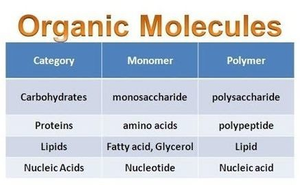
Major Categories of Organic Molecules:
Carbohydrates: Monosaccharides (simple sugars) → Polysaccharides
Lipids: Fatty acids and glycerol → Lipids
Proteins: Amino acids → Polypeptides
Nucleic Acids: Nucleotides → Nucleic acids
Carbohydrates
Monosaccharides
Monosaccharides are the simplest carbohydrates, varying by the number of carbon atoms and their arrangement. Their general formula is a multiple of CH2O. Common examples include:
Triose (3C): C3H6O3 (e.g., glyceraldehyde)
Pentose (5C): C5H10O5 (e.g., ribose)
Hexose (6C): C6H12O6 (e.g., glucose, fructose)
Monosaccharides can exist in linear or ring-shaped forms, with glucose being a prime example of both configurations.
Disaccharides
Disaccharides are formed when two monosaccharides join via dehydration synthesis, releasing a molecule of water. Examples include:
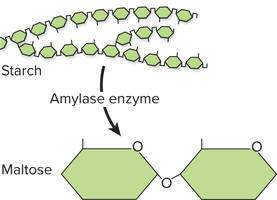
Glucose + Glucose → Maltose
Glucose + Fructose → Sucrose
Polysaccharides
Polysaccharides are long chains of monosaccharide units (often glucose) and serve structural or energy storage roles. Their function depends on their structure and the organism in which they are found.
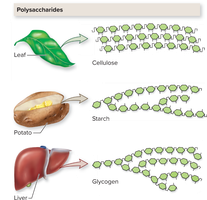
Structural Polysaccharides: Cellulose (plants), Chitin (animals)
Energy Storage Polysaccharides: Starch (plants), Glycogen (animals)
Examples and Applications:
Cellulose: Provides rigidity to plant cell walls; indigestible by most animals, but important as dietary fiber in humans.
Starch: Main energy storage in plants; broken down by amylase in humans.
Glycogen: Energy storage in animal livers and muscles.
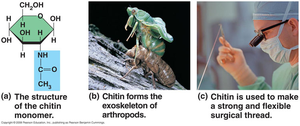
Chitin: Structural component in arthropod exoskeletons and fungal cell walls; used in biodegradable surgical thread.
Lipids
Structure and Types
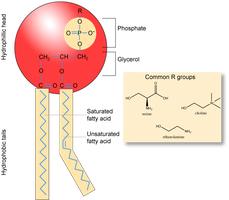
Lipids are hydrophobic molecules primarily composed of fatty acids and glycerol. They include fats, oils, phospholipids, and steroids. Phospholipids are essential for cell membrane structure, forming a bilayer with hydrophilic heads and hydrophobic tails.
Saturated vs. Unsaturated Fatty Acids
The properties of lipids depend on the structure of their fatty acid chains:
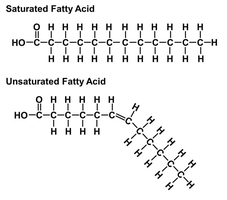
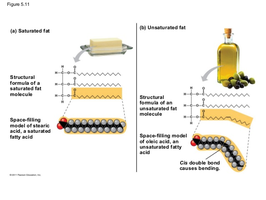
Saturated Fatty Acids: No double bonds; straight chains; solid at room temperature (e.g., animal fats).
Unsaturated Fatty Acids: One or more double bonds; kinks in the chain; liquid at room temperature (e.g., plant oils).
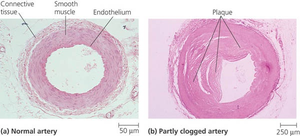
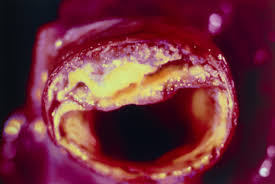
Health Implications: Excessive intake of saturated fats can lead to atherosclerosis, a condition where plaque builds up in arteries, reducing blood flow and increasing blood pressure. Unsaturated fats are recommended for a healthier diet.
Proteins
Amino Acids and Protein Structure
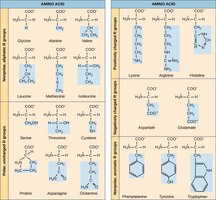
Proteins are polymers of amino acids, of which there are 20 different types. Amino acids vary by their side chains (R groups), which determine their properties (polar, non-polar, acidic, basic, hydrophobic, hydrophilic).
Protein function depends on its complex three-dimensional structure, which is organized into four levels:
Primary Structure: Sequence of amino acids linked by peptide bonds.
Secondary Structure: Hydrogen bonds form alpha helices and beta sheets.
Tertiary Structure: Interactions among R groups create the overall 3D shape.
Quaternary Structure: Association of multiple polypeptide chains.
Denaturation: Extreme temperature or pH can disrupt protein structure, causing loss of function (e.g., cooking an egg denatures albumin).
Nucleic Acids
DNA and RNA Structure
Nucleic acids (DNA and RNA) are polymers of nucleotides. Each nucleotide consists of a pentose sugar, a phosphate group, and a nitrogenous base. DNA contains four bases: adenine (A), thymine (T), cytosine (C), and guanine (G). In RNA, uracil (U) replaces thymine.
Base Pairing: A pairs with T (or U in RNA), and C pairs with G via hydrogen bonds.
Double Helix: DNA forms a double-stranded helix with a sugar-phosphate backbone and paired bases as rungs.
The sequence of nitrogenous bases encodes genetic information, determining both interspecific (between species) and intraspecific (within species) differences.
Summary Table: Organic Molecules
Category | Monomer | Polymer |
|---|---|---|
Carbohydrates | Monosaccharide | Polysaccharide |
Proteins | Amino acid | Polypeptide |
Lipids | Fatty acid, Glycerol | Lipid |
Nucleic Acids | Nucleotide | Nucleic acid |
Key Equations and Concepts
General formula for monosaccharides:
Dehydration synthesis (formation of polymers):
Hydrolysis (breakdown of polymers):
