 Indietro
Organic Molecules: Structure, Function, and Biological Importance
Guida di studio - Note intelligenti
 Appunti personalizzati basati sui tuoi materiali, ampliati con definizioni chiave, esempi e contesto.
Organic Molecules
Overview of Organic Molecules
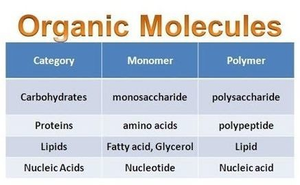
Organic molecules, also known as macromolecules, are fundamental to life and are composed primarily of carbon atoms. Their unique properties stem from carbon's ability to form four covalent bonds, allowing for diverse and complex structures. Organic molecules are classified into four major categories: carbohydrates, lipids, proteins, and nucleic acids.
Monomers: Small, repeating units that serve as building blocks.
Polymers: Large molecules formed by linking monomers together.
Carbon: The Basis of Organic Molecules
Abundance: Carbon is widely available in nature, with three isotopes: 12C, 13C, and 14C.
Electron Configuration: Carbon's four valence electrons allow it to form four covalent bonds, often with hydrogen, resulting in long chains and complex structures.
Bonding: Carbon atoms can bond with other carbons and hydrogens, forming the backbone of organic molecules.
Carbohydrates
Monosaccharides: Simple Sugars
Monosaccharides are the simplest carbohydrates and vary by the number of carbon atoms and their arrangement. Their general formula is a multiple of "CH2O".
Triose: (e.g., glyceraldehyde)
Pentose: (e.g., ribose)
Hexose: (e.g., glucose, fructose)
Structural Variations
Monosaccharides can exist in linear or ring-shaped forms, especially hexoses like glucose.
Disaccharides: Two Monosaccharides Linked
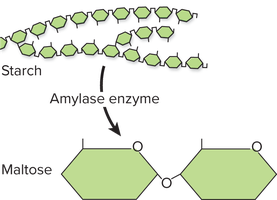
Disaccharides are formed by joining two monosaccharides via dehydration synthesis, which releases a molecule of water.
Examples: Glucose + Glucose → Maltose; Glucose + Fructose → Sucrose
Polysaccharides: Complex Carbohydrates
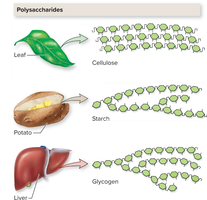
Polysaccharides are long chains of monosaccharide units, primarily glucose. They serve structural and energy storage functions in organisms.
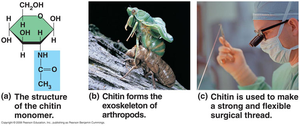
Structural: Cellulose (plants), Chitin (animals)
Energy Storage: Starch (plants), Glycogen (animals)
Cellulose
Major component of plant cell walls; provides rigidity and structure.
Most animals cannot digest cellulose; it acts as dietary fiber in humans.
Starch
Primary energy storage in plants; broken down by amylase enzyme in humans.
Chitin
Forms exoskeletons of arthropods; used medically as biodegradable surgical thread.
Glycogen
Energy storage in animals; stored in the liver and converted to glucose when needed.
Lipids
Structure and Function
Lipids are hydrophobic molecules essential for energy storage, cell membrane structure, and signaling.
Phospholipids: Form the basis of cell membranes (phospholipid bilayer).
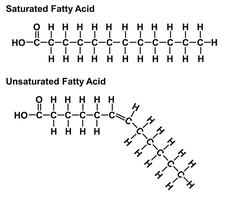
Fatty Acids: Long hydrocarbon chains; can be saturated or unsaturated.
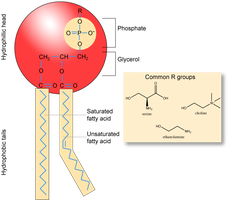
Saturated vs. Unsaturated Fatty Acids
Saturated: No double bonds; straight chains; solid at room temperature (e.g., animal fats).
Unsaturated: One or more double bonds; bent chains; liquid at room temperature (e.g., plant oils).
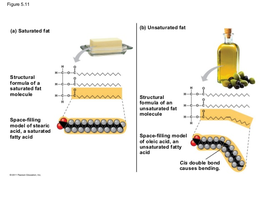
Health Implications
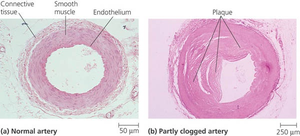
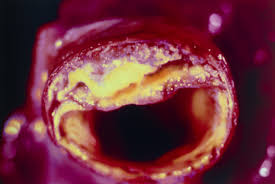
Excessive intake of saturated fats can lead to atherosclerosis, a condition where plaque builds up in arteries, reducing blood flow and increasing blood pressure.
Unsaturated fats are recommended for a healthier diet.
Proteins
Amino Acids: Building Blocks of Proteins
Proteins are polymers of amino acids, which vary in polarity, hydrophobicity, and acidity. There are 20 different amino acids. 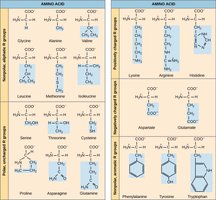
Protein Structure
Proteins have four levels of structural complexity:
Primary: Sequence of amino acids linked by peptide bonds.
Secondary: Hydrogen bonds form helical or pleated sheet structures.
Tertiary: Bonds among R-groups (side chains) create complex 3D shapes.
Quaternary: Multiple polypeptide chains bond together.
Denaturation
Extreme temperature or pH can disrupt protein structure, causing loss of function (denaturation).
Example: Cooking egg whites denatures albumin, turning it solid.
Enzymes
Proteins that act as biological catalysts, speeding up chemical reactions without being consumed.
Enzyme function depends on maintaining proper 3D structure.
Nucleic Acids
DNA and RNA: Information Molecules
Nucleic acids store and transmit genetic information. Their monomers are nucleotides, each composed of a pentose sugar, phosphate group, and nitrogenous base.
DNA: Double helix structure; bases pair as Adenine-Thymine and Cytosine-Guanine.
RNA: Single-stranded; Uracil replaces Thymine.
Structure of DNA
Nucleotides link to form the sugar-phosphate backbone.
Hydrogen bonds between nitrogenous bases create the "steps" of the double helix.
Summary Table: Organic Molecules
Category | Monomer | Polymer |
|---|---|---|
Carbohydrates | Monosaccharide | Polysaccharide |
Proteins | Amino acids | Polypeptide |
Lipids | Fatty acid, Glycerol | Lipid |
Nucleic Acids | Nucleotide | Nucleic acid |
Additional info: This guide expands on the original notes by providing definitions, examples, and structural details for each major category of organic molecules, as well as their biological significance and health implications.
