 Indietro
Origin of Species and Mechanisms of Speciation
Guida di studio - Note intelligenti
 Appunti personalizzati basati sui tuoi materiali, ampliati con definizioni chiave, esempi e contesto.
Origin of Species
Speciation and Biological Diversity
Speciation is the evolutionary process by which populations evolve to become distinct species. It is fundamental to understanding both the unity and diversity of life, as it explains how new species arise and how they differ from their ancestors.
Speciation: The process by which one species splits into two or more species.
Biological diversity: Results from repeated speciation events over time.
Divergence: Occurs when populations accumulate enough differences to become reproductively isolated from their parent species.
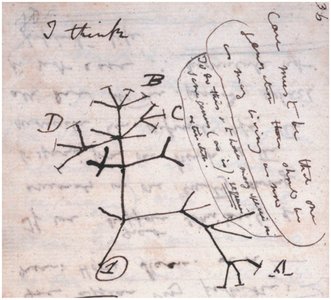
Example: Darwin's early sketches illustrated the branching nature of speciation, forming the basis for the tree of life concept.
Defining a Species
Species Concepts
There are several ways to define a species, each with its own advantages and limitations. The most widely used is the biological species concept, but other concepts are also important in different contexts.
Biological species concept: Defines a species as a group of populations whose members can interbreed and produce fertile offspring, but are reproductively isolated from other groups.
Morphological species concept: Based on observable physical traits; useful for asexual organisms and fossils.
Ecological species concept: Defines species by their ecological niche, focusing on unique adaptations to particular roles in a community.
Phylogenetic species concept: Defines a species as the smallest group of individuals sharing a common ancestor, forming one branch on the tree of life.
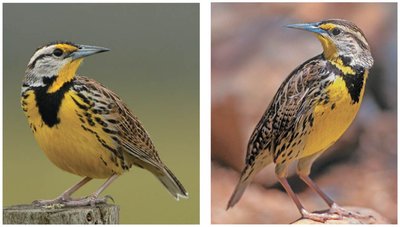
Example: The eastern and western meadowlarks are similar in appearance but are distinct species due to reproductive isolation.
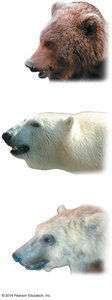
Hybridization: Sometimes, different species can interbreed and produce hybrids, such as the "grolar" bear (grizzly and polar bear hybrid), which challenges the biological species concept.
Reproductive Barriers
Types of Reproductive Barriers
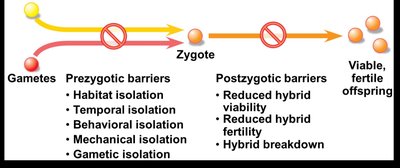
Reproductive barriers prevent gene flow between species and maintain species boundaries. These barriers are categorized as prezygotic (before fertilization) or postzygotic (after fertilization).
Prezygotic barriers: Prevent mating or fertilization between species.
Postzygotic barriers: Prevent the development of viable, fertile offspring after mating has occurred.
Prezygotic Barriers
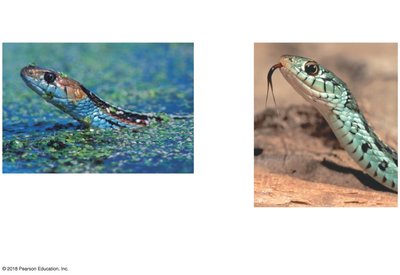
Habitat isolation: Species live in different habitats and do not meet.
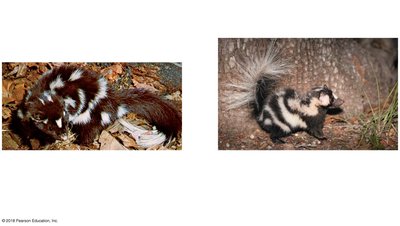
Temporal isolation: Species breed at different times or seasons.
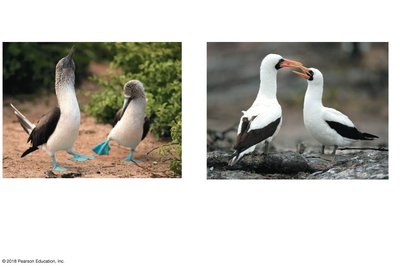
Behavioral isolation: Species have different courtship rituals.
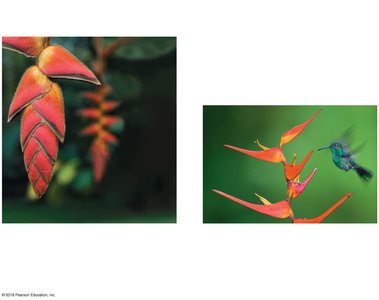
Mechanical isolation: Physical differences prevent mating.
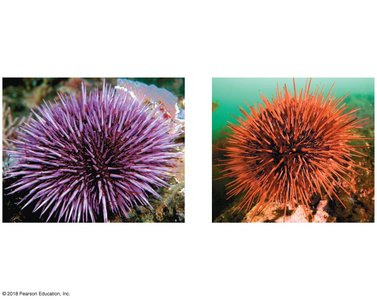
Gametic isolation: Gametes are incompatible.
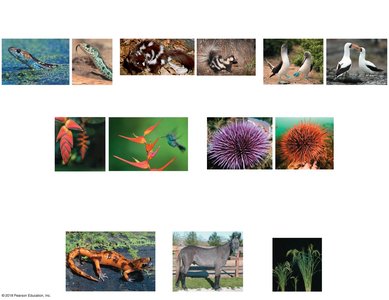
Example: Garter snakes (habitat isolation), spotted skunks (temporal isolation), blue-footed and masked boobies (behavioral isolation), Heliconia flowers and hummingbirds (mechanical isolation), purple and red sea urchins (gametic isolation).
Postzygotic Barriers
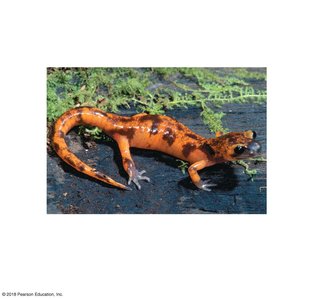
Reduced hybrid viability: Hybrids fail to develop or are frail.
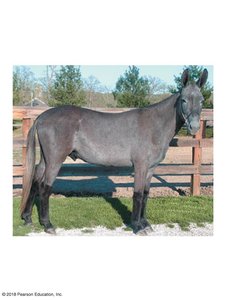
Reduced hybrid fertility: Hybrids are sterile (e.g., mule).
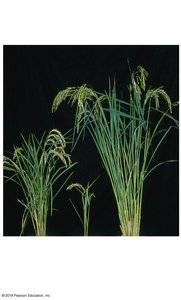
Hybrid breakdown: Hybrids are fertile, but their offspring are feeble or sterile.
Mechanisms of Speciation
Allopatric Speciation
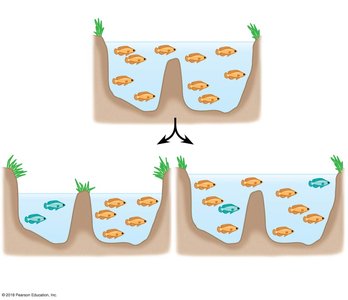
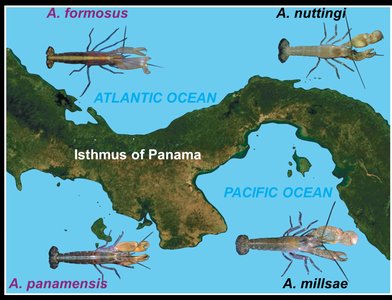
Allopatric speciation occurs when populations are geographically separated, leading to genetic divergence and the formation of new species. Physical barriers such as rivers, mountains, or land masses can fragment populations.
Geographic isolation: Physical separation of populations.
Genetic divergence: Changes in gene pool due to natural selection, mutation, or random events.
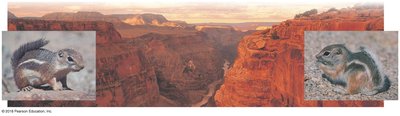
Example: Antelope squirrels on opposite rims of the Grand Canyon, snapping shrimp separated by the Isthmus of Panama.
Sympatric Speciation
Sympatric speciation occurs without geographic isolation, often through mechanisms such as polyploidy, habitat isolation, or sexual selection. This is especially common in plants.
Polyploidy: Duplication of chromosome number due to errors in cell division, leading to reproductive isolation.
Habitat isolation: Populations adapt to different ecological niches within the same area.
Sexual selection: Mating preferences can drive speciation.
Example: Polyploidy in strawberries, hybrid polyploid formation in plants.
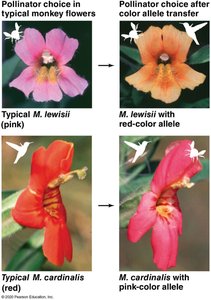
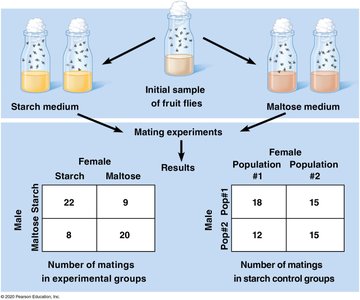
Evolution of Reproductive Barriers
Reproductive barriers can evolve as populations diverge, often due to environmental differences such as food sources, pollinators, or predators. Laboratory experiments and genetic studies have documented the emergence of reproductive isolation.
Example: Fruit fly populations adapting to different food sources develop reproductive isolation; monkey flower species diverge due to pollinator preferences linked to flower color.
Summary Table: Prezygotic and Postzygotic Barriers
Barrier Type | Subtype | Description | Example |
|---|---|---|---|
Prezygotic | Habitat isolation | Different habitats prevent mating | Garter snakes |
Prezygotic | Temporal isolation | Different breeding times | Spotted skunks |
Prezygotic | Behavioral isolation | Different courtship rituals | Boobies |
Prezygotic | Mechanical isolation | Physical incompatibility | Heliconia flowers |
Prezygotic | Gametic isolation | Gametes cannot fuse | Sea urchins |
Postzygotic | Reduced hybrid viability | Hybrids fail to develop or are frail | Salamanders |
Postzygotic | Reduced hybrid fertility | Hybrids are sterile | Mule |
Postzygotic | Hybrid breakdown | Hybrids' offspring are feeble or sterile | Rice plants |
Key Learning Objectives
Distinguish between microevolution and speciation.
Compare the definitions, advantages, and disadvantages of different species concepts.
Describe five types of prezygotic barriers and three types of postzygotic barriers.
Explain how geologic processes can fragment populations and lead to speciation.
Explain how reproductive barriers might evolve in isolated populations.
Explain how sympatric speciation can occur, with examples in plants and animals.
