 Indietro
Ch.27 Origins and Diversification of Eukaryotes and Protists
Guida di studio - Note intelligenti
 Appunti personalizzati basati sui tuoi materiali, ampliati con definizioni chiave, esempi e contesto.
Origins and Diversification of Eukaryotes
Introduction to the Tree of Life
The Tree of Life is a phylogenetic framework that represents the evolutionary relationships among all living organisms. Based on genetic evidence, all life is classified into three domains: Bacteria, Archaea, and Eukarya. Eukaryotes are distinguished by the presence of a nucleus and other membrane-bound organelles.
Domain Bacteria: Prokaryotic, lack a nucleus.
Domain Archaea: Prokaryotic, genetically distinct from bacteria.
Domain Eukarya: Eukaryotic, possess a nucleus and organelles.
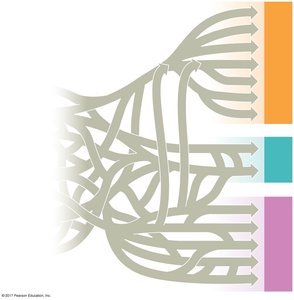
Domain Eukarya and Its Kingdoms
Domain Eukarya includes four major kingdoms: Fungi, Plantae, Animalia, and the informal group Protists. Eukaryotic cells are characterized by a nucleus that stores and protects DNA, as well as other membrane-bound organelles.
Kingdom Fungi: Mostly multicellular, decomposers.
Kingdom Plantae: Multicellular, photosynthetic.
Kingdom Animalia: Multicellular, heterotrophic.
"Kingdom Protista": Mostly unicellular, highly diverse.
Diversification and Classification of Protists
What Are Protists?
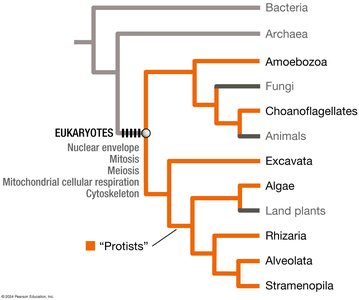
Protists are a highly diverse group of mostly unicellular eukaryotic organisms. They are distinct from Bacteria and Archaea due to the presence of a nucleus and membrane-bound organelles. With advances in systematics, protists are now recognized as a paraphyletic group, meaning they include some but not all descendants of their most recent common ancestor.
Paraphyletic group: Includes a common ancestor and some, but not all, descendants.
Protists: All eukaryotes except land plants, fungi, and animals.
Medical and Ecological Importance of Protists
Medical Importance
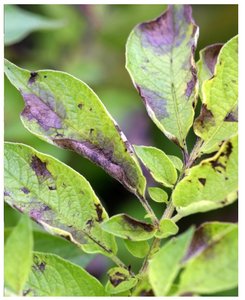
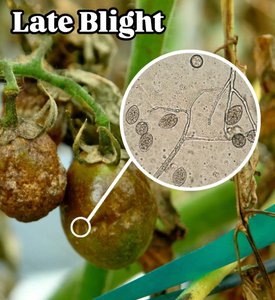
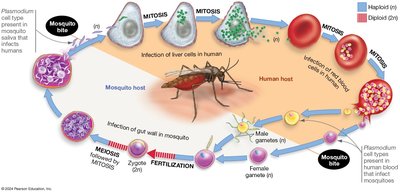
Protists are responsible for several significant human diseases and historical events. For example, the Irish Potato Famine was caused by the protist Phytophthora infestans, and malaria is caused by species of Plasmodium.
Irish Potato Famine: Caused by Phytophthora infestans, leading to mass starvation and migration.
Malaria: Caused by five species of Plasmodium, affecting over 200 million people annually.
Ecological Importance
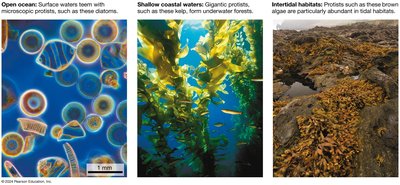
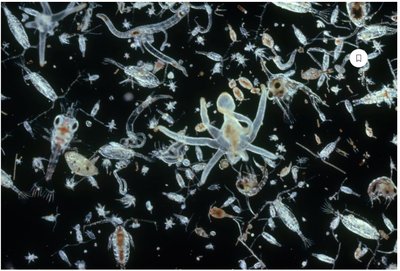
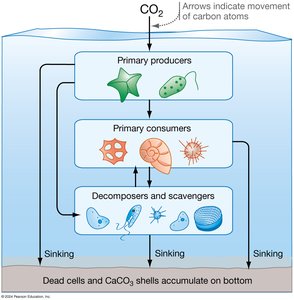
Protists play crucial roles in aquatic ecosystems as both primary producers and consumers. They are abundant in plankton and are essential for the marine carbon cycle.
Phytoplankton: Photosynthetic protists (e.g., diatoms, dinoflagellates) that form the base of aquatic food webs.
Zooplankton: Heterotrophic protists and small animals that feed on phytoplankton.
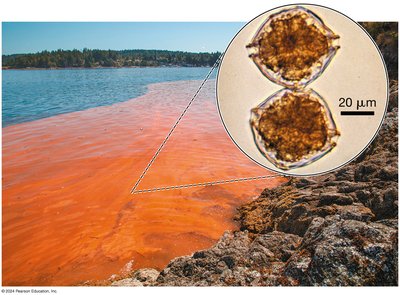
Harmful algal blooms: Caused by dinoflagellates, can produce toxins and lead to oxygen depletion (eutrophication).
Marine carbon cycle: Protists remove CO2 via photosynthesis and contribute to carbon sequestration in the deep ocean.
Evolutionary Innovations in Protists
Key Morphological Innovations
Modern eukaryotes possess several key features that distinguish them from prokaryotes, including mitochondria, a nucleus, endomembrane systems, and a cytoskeleton. The origin of these organelles is explained by the endosymbiosis theory.
Mitochondria: Organelles responsible for ATP production via cellular respiration.
Nucleus and endomembrane system: Compartmentalize genetic material and cellular processes.
Cytoskeleton: Provides structural support and facilitates movement.
Endosymbiosis Theory
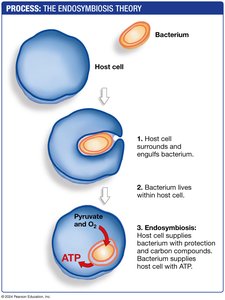
The endosymbiosis theory proposes that mitochondria and chloroplasts originated from free-living bacteria that were engulfed by ancestral eukaryotic cells. This mutualistic relationship led to the evolution of complex eukaryotic cells.
Primary endosymbiosis: Engulfment of an aerobic bacterium (mitochondria) or a photosynthetic cyanobacterium (chloroplast).
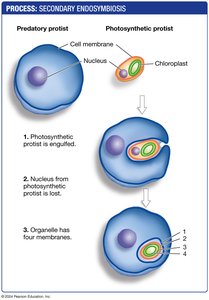
Secondary endosymbiosis: Engulfment of a photosynthetic eukaryote by another eukaryote, resulting in organelles with more than two membranes.
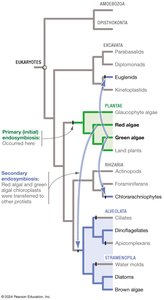
Structural and Functional Diversity of Protists
Modes of Nutrition
Protists exhibit remarkable nutritional diversity, including photoautotrophy, heterotrophy, and mixotrophy.
Photoautotrophs: Use light energy to synthesize organic compounds (contain chloroplasts).
Heterotrophs: Absorb organic molecules or ingest larger food particles.
Mixotrophs: Combine photosynthesis and heterotrophic nutrition.
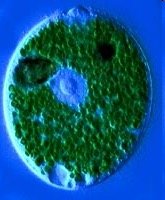
Feeding Mechanisms
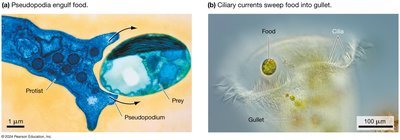
Protists use various methods to obtain food, including ingestive feeding (using pseudopodia or cilia), absorptive feeding, and photosynthesis.
Pseudopodia: Extensions of the cell membrane used by amoebas to engulf food.
Ciliary sweeps: Ciliates use coordinated cilia to direct food into their gullet.
Absorptive feeding: Some protists absorb dissolved organic molecules directly from the environment.
Cell Coverings
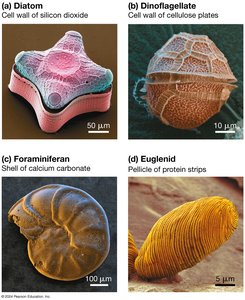
Protists display a variety of cell coverings, which can be composed of silica, cellulose, calcium carbonate, or protein strips.
Diatoms: Glass-like cell walls (frustules) made of silica.
Dinoflagellates: Cell walls of cellulose plates.
Foraminiferans: Chalky, chambered shells of calcium carbonate.
Euglenids: Flexible pellicle made of protein strips.
Reproduction in Protists
Alternation of Generations
Many multicellular protists exhibit alternation of generations, a reproductive cycle that alternates between multicellular diploid (sporophyte) and multicellular haploid (gametophyte) stages.
Sporophyte: Multicellular diploid stage that produces haploid spores by meiosis.
Gametophyte: Multicellular haploid stage that produces gametes by mitosis.
Example: Kelp (a brown alga) undergoes alternation of generations.
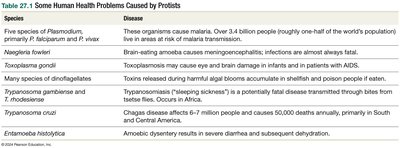
Summary Table: Human Health Problems Caused by Protists
Species | Disease |
|---|---|
Five species of Plasmodium | Malaria: Over 3.4 billion people at risk; transmitted by mosquitoes. |
Naegleria fowleri | Brain-eating amoeba; causes fatal meningoencephalitis. |
Toxoplasma gondii | Toxoplasmosis; may cause eye and brain damage, especially in immunocompromised individuals. |
Dinoflagellates | Toxins from harmful algal blooms can accumulate in shellfish and poison people. |
Trypanosoma gambiense & T. rhodesiense | Sleeping sickness; transmitted by tsetse flies, fatal if untreated. |
Trypanosoma cruzi | Chagas disease; affects millions, causes thousands of deaths annually. |
Entamoeba histolytica | Amoebic dysentery; severe diarrhea and dehydration. |
Key Concepts to Know
Protists possess a nucleus and membrane-bound organelles, unlike prokaryotes.
Protists display diverse modes of nutrition: photoautotrophy, heterotrophy, and mixotrophy.
Endosymbiosis is a key evolutionary process that led to the origin of mitochondria and chloroplasts in eukaryotes.
Protists are important for understanding the evolution of plants, fungi, and animals.
There are four major supergroups of eukaryotes; animals and fungi are closely related, while plants form a separate lineage.
The life cycle of Plasmodium (malaria parasite) involves both sexual and asexual stages in mosquitoes and humans.
Protists are well-suited to be disease agents due to their rapid reproduction and adaptability.
