 Indietro
Osmoregulation and Excretion in Animals
Guida di studio - Note intelligenti
 Appunti personalizzati basati sui tuoi materiali, ampliati con definizioni chiave, esempi e contesto.
Osmoregulation: The Regulation of Water and Solutes
Definition and Importance
Osmoregulation is the process by which organisms control the concentration of water and solutes in their bodies. This regulation is essential for maintaining cellular function and overall homeostasis.
Total water content is regulated by controlling the volume of extracellular fluid (ECF).
Osmolarity refers to the concentration of solutes in the ECF, measured in osmoles (Osm), where 1.0 Osm = 1 mole of dissolved particles per liter.
Organisms also regulate the concentrations of specific solutes, such as Na+, K+, Ca2+, Cl-.
Elimination of nitrogenous wastes (ammonia, urea, uric acid) is a key aspect of osmoregulation.
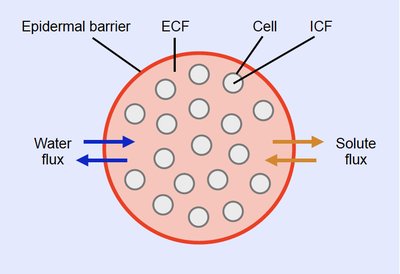
Osmoregulation Terminology
Excretion: Removal of unwanted substances from ECF.
Secretion: General movement of substances out of ECF.
Absorption: Movement of substances into ECF.
Reabsorption: Return of substances previously in ECF.
Filtration: Forcing solution through a biological sieve.
Osmotic Stress and Osmolarity
Osmotic stress occurs when the concentration of dissolved substances is abnormal.
Hyperosmotic: Higher solute concentration outside the cell.
Hyposmotic: Lower solute concentration outside the cell.
Isosmotic: Equal solute concentration inside and outside the cell.
Nitrogenous Wastes: Types and Properties
Overview
Nitrogenous wastes are the end products of protein metabolism. The type of waste produced depends on the organism's environment and evolutionary adaptations.
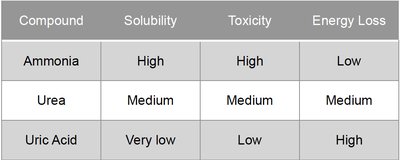
Ammonia: Highly soluble and toxic, requires large amounts of water for excretion.
Urea: Moderately soluble and toxic, requires moderate energy to produce.
Uric Acid: Low solubility and toxicity, requires high energy to produce, suitable for water conservation.
Compound | Solubility | Toxicity | Energy Loss |
|---|---|---|---|
Ammonia | High | High | Low |
Urea | Medium | Medium | Medium |
Uric Acid | Very low | Low | High |
Osmoregulation in Aquatic Organisms
Osmoconformers vs. Osmoregulators
Aquatic animals may be osmoconformers or osmoregulators, depending on their relationship with the environment.
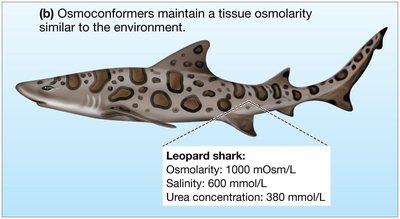
Osmoconformers: Maintain tissue osmolarity similar to the environment (e.g., many marine invertebrates and sharks).
Osmoregulators: Actively regulate internal osmolarity, differing from their environment (e.g., freshwater fish, marine bony fish).
Osmoregulation in Marine Sharks
Marine sharks are isosmotic with seawater but differ in ion composition.
Shark ECF osmolarity ≈ seawater (1050 mOsm).
Shark ECF has lower Na+ than seawater; other osmolytes include urea and TMAO.
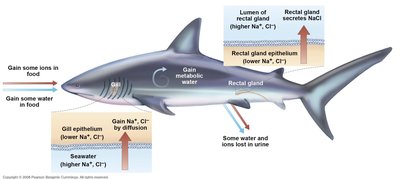
Water influx is limited and excreted via urine.
NaCl influx occurs mainly through gills; efflux via rectal gland.
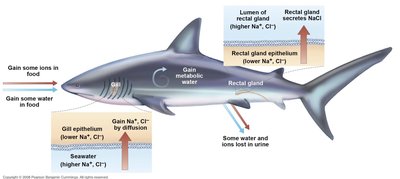
Rectal Gland Function in Sharks
The rectal gland is the primary organ for NaCl excretion, utilizing active transport mechanisms.
Na+/K+-ATPase pumps Na+ out and K+ in, creating gradients for ion movement.
Chloride channels and cotransporters facilitate Cl- and K+ movement.
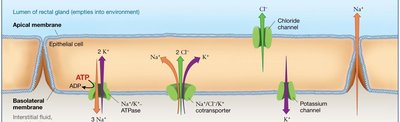
Osmoregulation in Ray-Finned Fish
Freshwater Fish
Freshwater fish face constant water influx and ion loss at the gills.
Produce large amounts of dilute urine to eliminate excess water.
Avoid drinking water; rely on food and active gill uptake for ions.
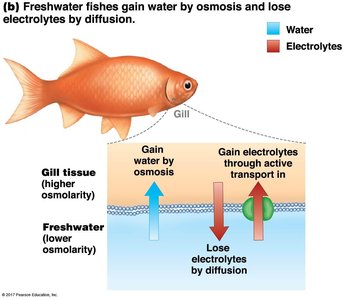
Marine Fish
Marine fish experience water loss and ion gain at the gills.
Produce small amounts of urine to conserve water.
Drink seawater to gain water; actively excrete ions at gills.
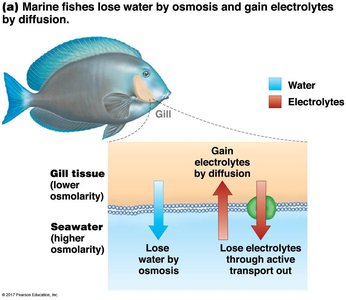
Osmoregulation in Terrestrial Organisms
Challenges and Adaptations
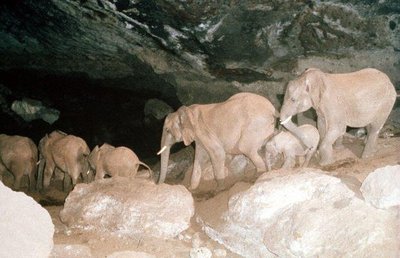
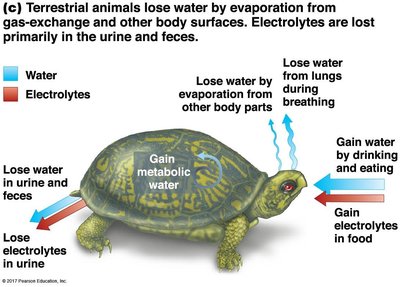
Terrestrial animals must minimize water loss and maintain ion balance.
Water loss occurs mainly through evaporation from respiratory surfaces and body surfaces.
Herbivores may lack NaCl and must seek sources.
Nitrogenous waste elimination must conserve water and avoid toxicity.
Osmoregulation in Insects
Minimizing Water Loss
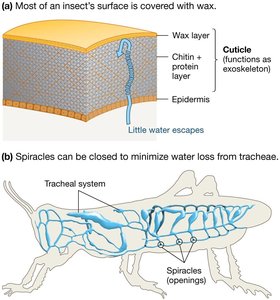
Insects have evolved structures and behaviors to reduce water loss.
Cuticle: Wax and chitin-protein layers create a water-resistant barrier.
Spiracles: Openings in the tracheal system that can be closed to minimize water loss.
Insect Excretory System: Malpighian Tubules
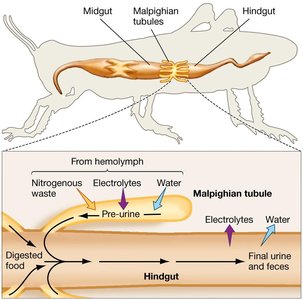
The Malpighian tubules are the primary excretory organs in insects.
Produce a filtrate (pre-urine) by actively pumping K+ into the tubule lumen; water follows by osmosis.
Electrolytes and nitrogenous wastes diffuse into the lumen.
Pre-urine empties into the hindgut, where 80-95% of water and electrolytes are reabsorbed.
Summary Table: Nitrogenous Waste Properties
Compound | Solubility | Toxicity | Energy Loss |
|---|---|---|---|
Ammonia | High | High | Low |
Urea | Medium | Medium | Medium |
Uric Acid | Very low | Low | High |
Key Equations
Osmolarity calculation:
For any regulated variable:
Conclusion
Osmoregulation is a fundamental physiological process that enables animals to survive in diverse environments by maintaining water and solute balance and safely eliminating nitrogenous wastes. Adaptations vary widely among aquatic and terrestrial organisms, reflecting evolutionary solutions to environmental challenges. Understanding these mechanisms is essential for comprehending animal physiology and ecology.
