 Indietro
Osmosis, Tonicity, and Water Movement in Cells – Step-by-Step Study Guidance
Guida di studio - Note intelligenti
 Appunti personalizzati basati sui tuoi materiali, ampliati con definizioni chiave, esempi e contesto.
Q42a. Is the solution outside of the cell hypertonic or hypotonic?
Background
Topic: Osmosis and Tonicity
This question tests your understanding of how to compare the concentration of solutes (like salt) and solvents (like water) inside and outside a cell to determine whether the external solution is hypertonic or hypotonic relative to the cell.
Key Terms:
Hypertonic solution: A solution with a higher concentration of solute (and lower concentration of water) compared to another solution.
Hypotonic solution: A solution with a lower concentration of solute (and higher concentration of water) compared to another solution.
Isotonic solution: Solutions with equal concentrations of solute and solvent.
Step-by-Step Guidance
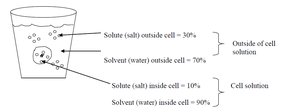
Identify the solute (salt) and solvent (water) concentrations inside the cell and outside the cell from the diagram or description.
Compare the solute concentration outside the cell to the solute concentration inside the cell.
If the outside solution has a higher solute concentration than inside, it is hypertonic. If it has a lower solute concentration, it is hypotonic.
Alternatively, compare the water concentrations: higher water outside means hypotonic, lower water outside means hypertonic.
Try solving on your own before revealing the answer!
Final Answer:
The solution outside the cell is hypertonic because it has a higher solute (salt) concentration (30%) compared to inside the cell (10%). This means water will tend to move out of the cell.
Q42b. Which direction will the water move due to osmosis?
Background
Topic: Osmosis
This question tests your understanding of the movement of water across a selectively permeable membrane from areas of higher water concentration to areas of lower water concentration.
Key Terms and Concepts:
Osmosis: The diffusion of water across a selectively permeable membrane.
Water moves from regions of higher water concentration (lower solute) to regions of lower water concentration (higher solute).
Step-by-Step Guidance
Determine which side of the membrane (inside or outside the cell) has a higher water concentration.
Recall that water moves toward the side with higher solute concentration (lower water concentration).
Draw or imagine an arrow showing the net movement of water from the area of higher water concentration to lower water concentration.
Try solving on your own before revealing the answer!
Final Answer:
Water will move out of the cell due to osmosis, from the area of higher water concentration (inside the cell) to the area of lower water concentration (outside the cell).
Q43a. What type of solution is outside of the cell?
Background
Topic: Tonicity and Osmosis
This question asks you to classify the external solution as hypertonic, hypotonic, or isotonic based on the solute and solvent concentrations inside and outside the cell.
Key Terms:
Hypertonic: Higher solute concentration outside the cell.
Hypotonic: Lower solute concentration outside the cell.
Isotonic: Equal solute concentrations inside and outside the cell.
Step-by-Step Guidance
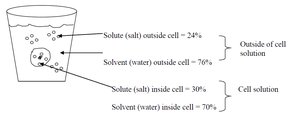
Look at the solute (salt) and solvent (water) percentages inside and outside the cell.
Compare the solute concentrations: if outside is higher, it's hypertonic; if lower, it's hypotonic.
Alternatively, compare water concentrations: higher water outside means hypotonic, lower water outside means hypertonic.
Try solving on your own before revealing the answer!
Final Answer:
The solution outside the cell is hypotonic because it has a lower solute (salt) concentration (24%) compared to inside the cell (30%).
Q43b. Which direction will the water move due to osmosis?
Background
Topic: Osmosis
This question tests your understanding of the direction of water movement across a cell membrane when the cell is in a hypotonic solution.
Key Terms and Concepts:
Osmosis: Water moves from areas of higher water concentration to areas of lower water concentration.
In a hypotonic solution, water moves into the cell.
Step-by-Step Guidance
Identify which side (inside or outside the cell) has a higher water concentration.
Recall that water moves toward the side with higher solute concentration (lower water concentration).
Draw or imagine an arrow showing the net movement of water into or out of the cell.
Try solving on your own before revealing the answer!
Final Answer:
Water will move into the cell due to osmosis, from the area of higher water concentration (outside the cell) to the area of lower water concentration (inside the cell).
Q43c. Will the cell shrink or swell?
Background
Topic: Effects of Osmosis on Cell Volume
This question tests your understanding of what happens to a cell's volume when water moves into or out of the cell due to osmosis.
Key Terms:
Swelling: Occurs when water enters the cell (in a hypotonic solution).
Shrinking: Occurs when water leaves the cell (in a hypertonic solution).
Step-by-Step Guidance
Recall the direction of water movement from the previous question.
Think about what happens to the cell's volume when water enters the cell.
Decide if the cell will shrink or swell based on the net movement of water.
Try solving on your own before revealing the answer!
Final Answer:
The cell will swell because water is moving into the cell from the hypotonic solution outside.
