 Indietro
Osmosis, Water Balance, and Tonicity in Cells
Guida di studio - Note intelligenti
 Appunti personalizzati basati sui tuoi materiali, ampliati con definizioni chiave, esempi e contesto.
Osmosis and Water Balance
Introduction to Osmosis
Osmosis is a fundamental process in biology, describing the movement of water across a selectively permeable membrane. Understanding osmosis is essential for explaining how cells maintain water balance and respond to their environment.
Osmosis: The diffusion of water from an area of high water concentration to an area of low water concentration across a membrane.
Tonicity: The ability of an extracellular solution to cause a cell to gain or lose water, depending on the concentration of solutes that cannot pass through the cell membrane.
Osmoregulation: The process by which cells regulate their solute concentrations and maintain water balance.
Types of Osmotic Solutions
Cells can be placed in three types of solutions, each affecting water movement and cell structure differently.
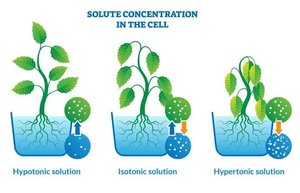
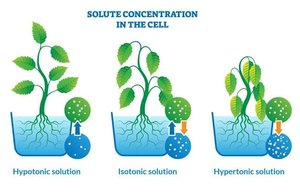
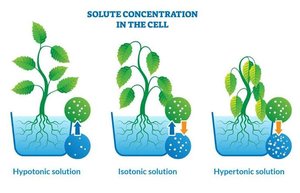
Hypotonic Solution: The solution has a lower solute concentration than the cell, causing water to enter the cell.
Isotonic Solution: The solution has an equal solute concentration to the cell, resulting in no net movement of water.
Hypertonic Solution: The solution has a higher solute concentration than the cell, causing water to leave the cell.
Effects of Osmosis on Animal and Plant Cells
Hypotonic Solution
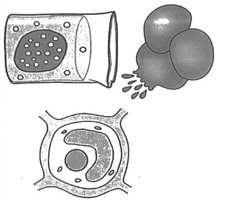
In a hypotonic environment, water enters the cell, leading to swelling.
Animal Cells: May lyse (burst) due to excessive water intake, as they lack a cell wall.
Plant Cells: Become turgid as their central vacuole fills with water, generating turgor pressure that keeps plants upright.
Turgor Pressure: The force exerted by water inside the central vacuole against the cell wall.
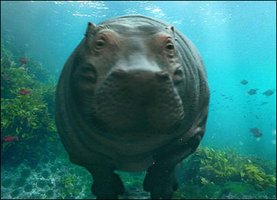
Mnemonic: "HypO = hippO" — cells swell up like a hippo in hypotonic solutions.
Isotonic Solution
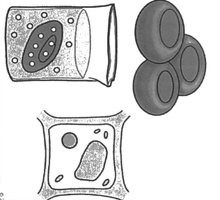
In an isotonic environment, water moves in and out of the cell equally, maintaining equilibrium.
Animal Cells: Remain in homeostasis; this is their preferred environment.
Plant Cells: Become flaccid as the central vacuole is not full, leading to minor wilting.
Mnemonic: "I SO happy" — cells are in equilibrium and homeostasis.

Hypertonic Solution
In a hypertonic environment, water leaves the cell, causing shrinkage.
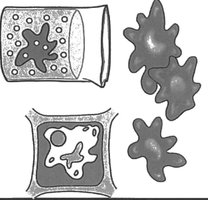
Animal Cells: Shrivel and become smaller due to water loss.
Plant Cells: Undergo plasmolysis, where the cell membrane detaches from the cell wall, resulting in major wilting.
Mnemonic: "hyper = smaller" — cells shrivel in hypertonic solutions.
Comparative Table: Effects of Osmotic Solutions
Summary Table
Solution Type | Water Movement | Animal Cell Effect | Plant Cell Effect |
|---|---|---|---|
Hypotonic | Into cell | Swells, may burst | Turgid, upright |
Isotonic | Equal in/out | No change | Flaccid, minor wilting |
Hypertonic | Out of cell | Shrivels | Plasmolysis, major wilting |

Water Potential and Its Calculation
Water Potential
Water potential is a physical property that predicts the direction water will flow. It is influenced by solute concentration and physical pressure.
Water flows: From areas of high water potential to low water potential.
Formula:
Solute Potential (\Psi_s): An increase in solutes reduces water potential; expressed as a negative number.
Pressure Potential (\Psi_p): Physical pressure on a solution; can be positive or negative.
Calculating Solute Potential
The solute potential formula is:
i: Ionization constant (number of particles formed; 1 for sucrose, 2 for NaCl)
C: Molar concentration (mol/L)
R: Pressure constant (0.0831 liter bar/mol K)
T: Temperature in Kelvin (K = ℃ + 273)
Practice Problem Example
Calculate the solute potential of a 0.3M sugar solution at 27℃ in open air:
Water potential:
Osmosis in Real Life and Adaptations
Osmosis in Everyday Life
Gargling salt water for swollen gums demonstrates osmosis: water leaves the swollen cells, reducing swelling.
Paramecium adaptation: Paramecium live in hypotonic solutions and use a contractile vacuole to remove excess water.

Summary
Osmosis is vital for cell water balance.
Tonicity determines cell response to external solutions.
Water potential predicts water movement and is calculated using solute and pressure potentials.
Plant and animal cells respond differently to osmotic environments due to structural differences.
Key Equations
Additional info:
Plant cells possess a cell wall and central vacuole, preventing bursting in hypotonic solutions.
Animal cells lack a cell wall and are more susceptible to lysis in hypotonic environments.
