 Indietro
Overview of Animal Diversity and Evolutionary Trends (Ch. 32)
Guida di studio - Note intelligenti
 Appunti personalizzati basati sui tuoi materiali, ampliati con definizioni chiave, esempi e contesto.
Animal Diversity and Evolutionary Trends
Features Unifying the Animal Kingdom
The Animal Kingdom, or Kingdom Animalia, is defined by several key features that distinguish animals from other life forms. Understanding these features is essential for recognizing evolutionary relationships and the placement of animals within the broader tree of life.
Eukaryotic: Animals possess cells with membrane-bound organelles and a true nucleus.
Multicellular: Animals are composed of multiple cells that form tissues and organs.
Heterotrophic: Animals obtain energy by consuming other organisms, rather than producing their own food.
Ingestive: Most animals ingest food, as opposed to absorbing nutrients directly.
Animalia fits within the Unikonta supergroup of Eukaryotes, which also includes fungi and certain protists. Animals are most closely related to choanoflagellates, based on molecular and morphological evidence.
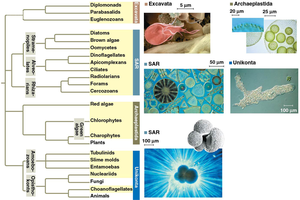
Derived Features and Evolutionary Significance
Within the Animal Kingdom, various groups possess unique derived features that have evolutionary significance. These features help classify animals and understand their evolutionary history.
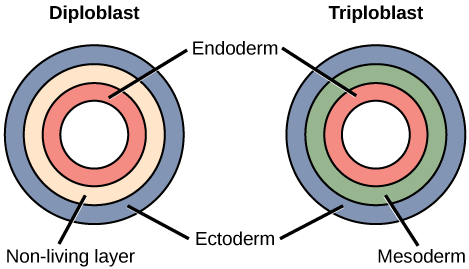
Tissue Layers: Animals may be diploblastic (two tissue layers) or triploblastic (three tissue layers).
Symmetry: Animals exhibit asymmetry, radial symmetry, or bilateral symmetry.
Digestive System: Animals may have incomplete (one opening) or complete (two openings) digestive systems.
Developmental Patterns: Animals are classified as protostomes or deuterostomes based on embryonic development.
Evolutionary Trends in Kingdom Animalia
Major evolutionary trends in animals include the development of tissues, digestive systems, symmetry, and body cavities. These trends are important for understanding animal classification and phylogeny.
Tissues: The presence and organization of tissues mark significant evolutionary steps.
Digestive System: The transition from incomplete to complete digestive systems allows for more efficient nutrient processing.
Symmetry: The evolution from asymmetry to radial and then bilateral symmetry is linked to increased complexity and mobility.
Body Cavities: The development of coeloms (body cavities) provides space for organ development and function.
Animal Phylogeny and Classification
Animals are placed within a larger phylogenetic tree alongside other kingdoms and domains. The phylogeny reflects evolutionary relationships and defining characteristics.
Poriferans: Lack true tissues, asymmetrical, no digestive system.
Eumetazoans: Possess tissue layers; include diploblastic and triploblastic animals.
Bilaterians: Most animals; triploblastic, bilateral symmetry, complete digestive systems.
Diploblast vs. Triploblast
Animals are classified based on the number of germ layers formed during embryonic development. Diploblasts have two layers, while triploblasts have three.
Diploblast: Ectoderm and endoderm.
Triploblast: Ectoderm, mesoderm, and endoderm.
Digestive Systems
Animals possess either incomplete or complete digestive systems, which impact their feeding and digestion strategies.
Incomplete Digestive System: One opening serves as both mouth and anus; gastrovascular cavity.
Complete Digestive System: Separate mouth and anus; allows for more efficient digestion and absorption.
Symmetry in Animals
Animal body plans are characterized by different types of symmetry, which influence their structure and nervous system organization.
Asymmetry: No symmetry (e.g., sponges).
Radial Symmetry: Symmetry around a central axis; top and bottom only (e.g., cnidarians).
Bilateral Symmetry: Distinct dorsal/ventral and anterior/posterior sides; associated with cephalization and complex nervous systems.
Body Cavities
Body cavities (coeloms) are important for organ development and function. Animals are classified as coelomates, pseudocoelomates, or acoelomates based on their body cavity structure.
Coelomate: True coelom lined by mesoderm.
Pseudocoelomate: Body cavity not fully lined by mesoderm.
Acoelomate: No body cavity; space filled with tissue.
Protostome vs. Deuterostome Development
Animals are divided into protostomes and deuterostomes based on embryonic development patterns.
Feature | Protostome | Deuterostome |
|---|---|---|
Cleavage | Spiral, determinate | Radial, indeterminate |
Coelom Formation | Schizocoelous | Enterocoelous |
Blastopore Fate | Develops into mouth | Develops into anus |
Determinate cleavage means cell fate is set early; indeterminate cleavage allows for potential to develop into a complete organism.
Phylogeny of Living Animals
The phylogenetic tree of animals shows relationships among major groups, highlighting evolutionary innovations such as tissues, symmetry, and digestive systems.
Poriferans: Sister group to all other animals.
Eumetazoans: Have tissue layers.
Bilaterians: Include Deuterostomia, Lophotrochozoa, and Ecdysozoa.
Lophotrochozoans, Ecdysozoans, and Deuterostomes
These are major clades within Bilateria, each with unique features.
Lophotrochozoa: Defined by lophophore feeding structure or trochophore larva.
Ecdysozoa: Characterized by molting (ecdysis) of exoskeleton.
Deuterostomia: Includes echinoderms and chordates; deuterostome development.
Chordate Characteristics
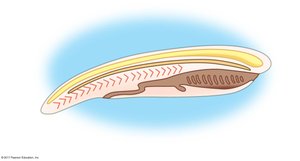
Chordates are a major group within Deuterostomia, defined by several key features present at some stage of development.
Notochord: Flexible rod providing support.
Dorsal, hollow nerve cord: Develops into central nervous system.
Pharyngeal slits or clefts: Openings in the pharynx.
Post-anal tail: Tail extending beyond the anus.
Example: Animal Adaptations
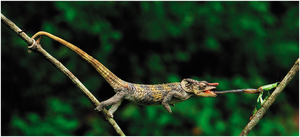
Animals display a wide range of adaptations for feeding, movement, and survival. For example, some reptiles have specialized tongues for capturing prey.
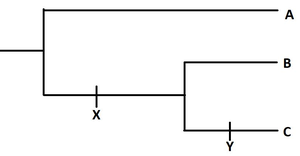
Phylogenetic Trees and Classification
Phylogenetic trees are used to illustrate evolutionary relationships among animal groups. Key nodes represent common ancestors and evolutionary innovations.
Additional info: The notes above expand on brief points from the original materials, providing academic context and definitions for clarity. The images included are directly relevant to the explanation of each paragraph, visually reinforcing key concepts such as phylogeny, tissue layers, animal adaptations, and chordate features.
