 Indietro
Oxidative Phosphorylation and Chemiosmosis in Cellular Respiration Part 2
Guida di studio - Note intelligenti
 Appunti personalizzati basati sui tuoi materiali, ampliati con definizioni chiave, esempi e contesto.
Oxidative Phosphorylation and Chemiosmosis in Cellular Respiration
Overview of ATP Production in Cellular Respiration
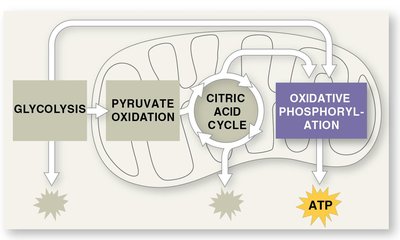
Cellular respiration is the process by which cells extract energy from glucose to produce ATP, the main energy currency of the cell. The majority of ATP is generated during the final stage, oxidative phosphorylation, which is tightly coupled to the electron transport chain (ETC) and chemiosmosis.
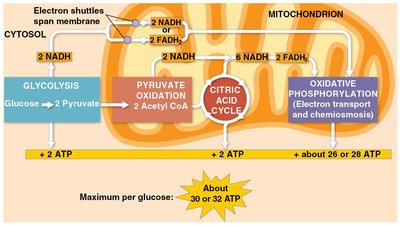
Substrate-level phosphorylation produces a small amount of ATP directly in glycolysis and the citric acid cycle (4 out of 32 ATP per glucose).
NADH and FADH2 are electron carriers that store most of the energy extracted from glucose and deliver electrons to the ETC.
Electron Transport Chain (ETC)
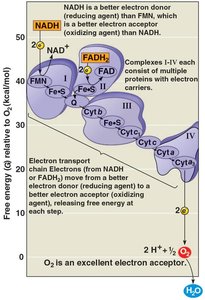
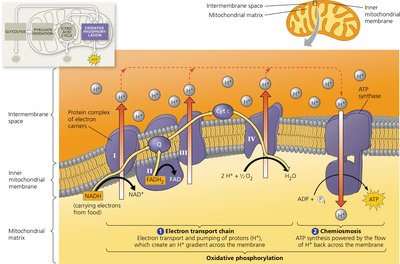
The electron transport chain is a series of protein complexes embedded in the inner mitochondrial membrane (in eukaryotes) or the plasma membrane (in prokaryotes). It is responsible for the stepwise transfer of electrons from NADH and FADH2 to oxygen, the final electron acceptor.
Location: Inner mitochondrial membrane (eukaryotes); plasma membrane (prokaryotes).
Structure: Composed mainly of multiprotein complexes, including cytochromes (proteins with heme groups containing iron).
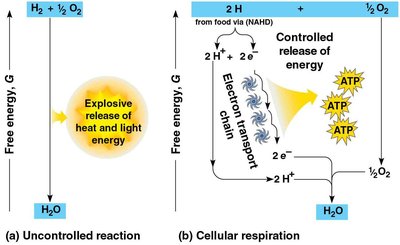
Function: Electrons move through the chain, releasing energy in small steps, which is used to pump protons (H+) across the membrane.
Redox reactions: Electron carriers alternate between reduced and oxidized states as they pass electrons down the chain.
Final electron acceptor: Oxygen, which combines with electrons and protons to form water.
Oxidative Phosphorylation: Coupling Electron Transport to ATP Synthesis
Oxidative phosphorylation refers to the production of ATP using energy derived from the redox reactions of the electron transport chain. This process is powered by chemiosmosis, the movement of protons down their electrochemical gradient through ATP synthase.
ATP synthase: A multisubunit enzyme complex embedded in the inner mitochondrial membrane that synthesizes ATP from ADP and inorganic phosphate (Pi) as protons flow through it.
Proton gradient: The ETC pumps H+ ions from the mitochondrial matrix to the intermembrane space, creating both a chemical (pH) and electrical (charge) gradient, collectively called the proton-motive force.
Chemiosmosis: The process by which the energy stored in the H+ gradient is used to drive ATP synthesis as protons flow back into the matrix through ATP synthase.
Mechanism of ATP Synthase
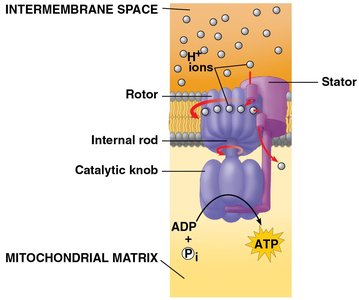
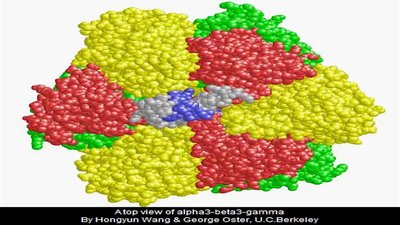
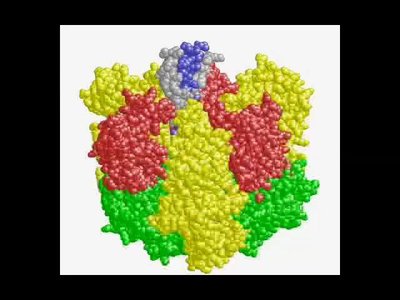
ATP synthase operates as a rotary motor. As protons flow through the enzyme, they bind to the rotor, causing it to spin. This mechanical rotation induces conformational changes in the catalytic sites, enabling the phosphorylation of ADP to ATP.
Structure: Four main parts, each composed of multiple polypeptides.
Rotor: The rotating part that is turned by the flow of protons.
Stator and catalytic knob: Stationary parts that help convert mechanical energy into chemical energy (ATP synthesis).
Summary of Energy Flow and ATP Yield
During cellular respiration, energy flows in the following sequence:
Glucose → NADH/FADH2 → Electron Transport Chain → Proton-motive force → ATP
About 34% of the energy in a glucose molecule is transferred to ATP (about 32 ATP per glucose); the rest is lost as heat.
Key Equations
Overall equation for aerobic cellular respiration:
ATP synthesis by ATP synthase:
Table: Comparison of Substrate-Level and Oxidative Phosphorylation
Feature | Substrate-Level Phosphorylation | Oxidative Phosphorylation |
|---|---|---|
Location | Cytosol (glycolysis), mitochondrial matrix (citric acid cycle) | Inner mitochondrial membrane |
ATP Yield per Glucose | 4 ATP (2 from glycolysis, 2 from citric acid cycle) | About 28 ATP |
Mechanism | Direct transfer of phosphate group to ADP | ATP synthase uses H+ gradient (chemiosmosis) |
Practice Questions
Which of the following is not an immediate net product of the typical mitochondrial electron transport chain?
a) ATP
b) water
c) NAD+
d) FAD
e) a proton electrochemical gradient
If your cells were in need of ATP, what could help you?
a) substrate-level phosphorylation
b) ATP synthase
c) glycolysis
d) all the answers are correct
The immediate energy source that drives ATP synthesis by ATP synthase during oxidative phosphorylation is the
a) oxidation of glucose and other organic compounds.
b) flow of electrons down the electron transport chain
c) H+ concentration gradient across the membrane holding ATP synthase
d) transfer of phosphate to ADP
ATP synthase at the inner mitochondrial membrane makes ATP and water from ADP and phosphate by coupling this to which other process?
a) allowing H+ to move down its electrochemical gradient
b) allowing H+ to move against its electrochemical gradient
c) synthesis of H+
d) active transport of H+
e) active transport of Na+
The final electron acceptor of the electron transport chain that functions in aerobic oxidative phosphorylation is
a) oxygen
b) water
c) NADH
d) pyruvate
If you removed the inner membrane of the mitochondrion, could the cell produce any ATP from glucose?
a) yes, by glycolysis
b) yes, by the citric acid cycle
c) yes, using the ATP synthase
d) yes, by electron transport
How are photosynthesis and cellular respiration connected?
a) The first produces energy using water, and the second does so using carbon dioxide.
b) The first produces glucose, full of energy, and the second extracts that energy.
c) The first uses beta oxidation, and the second uses glycolysis.
d) The first produces carbon dioxide, and the second makes sugars.
In mitochondria, exergonic redox reactions
a) are the source of energy driving prokaryotic ATP synthesis.
b) provide the energy that establishes the proton gradient.
c) reduce carbon atoms to carbon dioxide.
d) are coupled via phosphorylated intermediates to endergonic processes.
When electrons flow along the electron transport chains of mitochondria, which of the following changes occurs?
a) The pH of the matrix increases.
b) ATP synthase pumps protons by active transport.
c) The electrons gain free energy.
d) NAD+ is oxidized.
