 Indietro
Oxidative Phosphorylation, Electron Transport, and Cellular Respiration
Guida di studio - Note intelligenti
 Appunti personalizzati basati sui tuoi materiali, ampliati con definizioni chiave, esempi e contesto.
Oxidative Phosphorylation and Electron Transport
Overview of Cellular Respiration
Cellular respiration is the process by which cells extract energy from organic molecules, primarily glucose, through a series of metabolic pathways. The main stages include glycolysis, pyruvate oxidation, the citric acid cycle, and oxidative phosphorylation. - Key Point 1: Cellular respiration occurs in both the cytosol and mitochondria of eukaryotic cells. - Key Point 2: The process involves the transfer of electrons and the production of ATP, the cell's energy currency. - Key Point 3: The flow of electrons and the movement of carbon atoms are central to understanding each pathway. 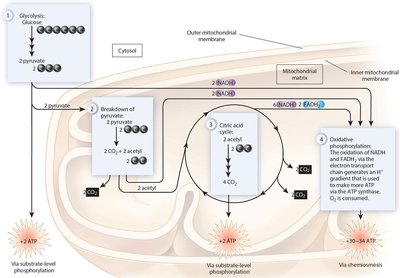
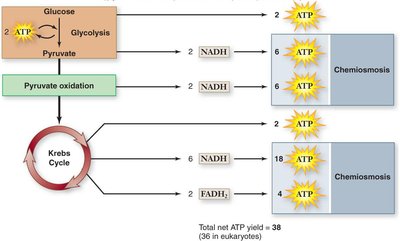
Oxidative Phosphorylation (Chapter 9.4)
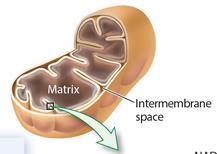
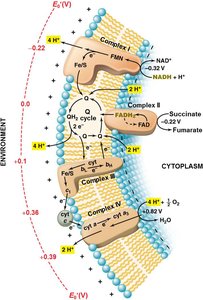
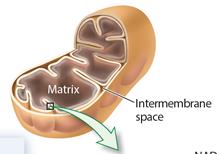
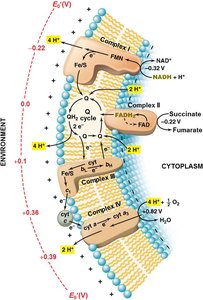
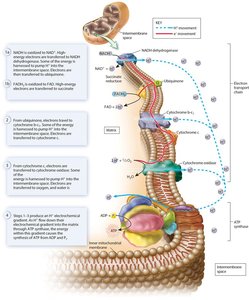
Oxidative phosphorylation is the final stage of cellular respiration, where the energy from NADH and FADH2 is used to generate a proton gradient across the inner mitochondrial membrane, driving ATP synthesis. - Key Point 1: NADH and FADH2 are oxidized, releasing high-energy electrons into the electron transport chain (ETC). - Key Point 2: The ETC consists of a series of protein complexes (I-IV) embedded in the inner mitochondrial membrane. - Key Point 3: The energy released from electron transfer is used to pump H+ ions, creating a proton motive force. - Key Point 4: ATP synthase utilizes the H+ gradient to synthesize ATP from ADP and inorganic phosphate (Pi) via chemiosmosis. 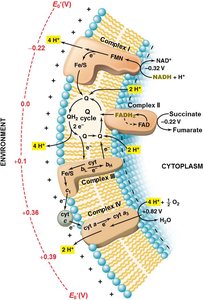
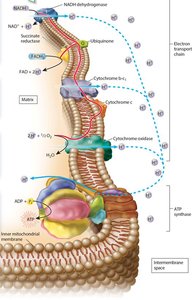
Function of ATP Synthase
ATP synthase is a multi-subunit enzyme that converts the energy of the proton gradient into chemical energy stored in ATP. - Key Point 1: Protons flow through ATP synthase, causing conformational changes that drive ATP formation. - Key Point 2: The rotation of the γ subunit is essential for the catalytic activity of ATP synthase. 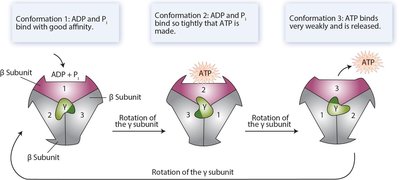
Inputs and Outputs of Oxidative Phosphorylation
- Inputs: NADH, FADH2, O2, ADP, Pi - Outputs: NAD+, FAD, H2O, ATP
Electron Transport Chain (ETC)
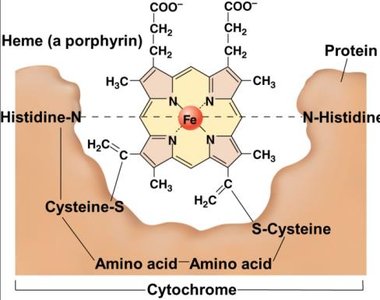
The ETC is a series of protein complexes and electron carriers that transfer electrons from NADH and FADH2 to oxygen, the terminal electron acceptor. - Key Point 1: Complex I oxidizes NADH, pumping H+ into the intermembrane space. - Key Point 2: Complex II oxidizes FADH2 but does not pump H+. - Key Point 3: Ubiquinone (Q) shuttles electrons between complexes I/II and III. - Key Point 4: Cytochrome c transfers electrons from complex III to IV. - Key Point 5: Complex IV reduces O2 to H2O and pumps H+. 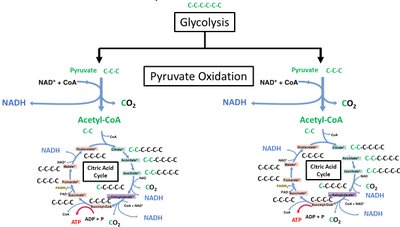
Proton Motive Force and Chemiosmosis
The proton motive force is the electrochemical gradient of H+ across the inner mitochondrial membrane, which powers ATP synthesis. - Key Point 1: Chemiosmosis refers to the movement of H+ ions down their gradient through ATP synthase. - Key Point 2: Each NADH results in the pumping of approximately 12 H+, while each FADH2 pumps about 8 H+. - Key Point 3: ATP yield: 3 ATP per NADH, 2 ATP per FADH2. 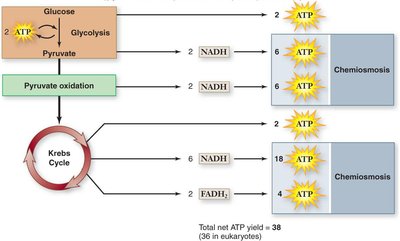
Anaerobic Respiration (Chapter 9.5)
Anaerobic respiration occurs when oxygen is not available as the terminal electron acceptor. Other molecules, such as nitrate or sulfate, may serve this role. - Key Point 1: Anaerobic respiration uses an electron transport chain but with a different terminal electron acceptor. - Key Point 2: Less ATP is produced compared to aerobic respiration.
Fermentation
Fermentation is an anaerobic process that allows cells to generate ATP without an electron transport chain. - Key Point 1: Electron donor is an organic compound (e.g., glucose). - Key Point 2: Electron acceptor is an organic compound (e.g., pyruvate or its derivatives). - Key Point 3: ATP is produced only by substrate-level phosphorylation during glycolysis.
Comparison of Fermentation, Aerobic Respiration, and Anaerobic Respiration
Process | Electron Donor | Electron Acceptor | ATP Production | Location |
|---|---|---|---|---|
Fermentation | Organic (glucose) | Organic (pyruvate/intermediate) | Substrate-level phosphorylation | Cytosol |
Aerobic Respiration | Organic (glucose) | O2 | Substrate-level & chemiosmosis | Cytosol & mitochondria |
Anaerobic Respiration | Organic (glucose) | Other (e.g., NO3-, SO42-) | Substrate-level & chemiosmosis | Cytosol & mitochondria |
Key Questions and Concepts
- What is the terminal electron acceptor in aerobic respiration? Oxygen (O2) - Does electron transport directly generate ATP? No, it creates the H+ gradient used by ATP synthase. - Is a membrane required for electron transport? Yes, the inner mitochondrial membrane is essential. - Why is less ATP made per FADH2? FADH2 enters the ETC at complex II, which does not pump H+, resulting in fewer protons and less ATP.
Summary Table: ATP Yield in Cellular Respiration
Stage | ATP Yield |
|---|---|
Glycolysis | 2 ATP (substrate-level) |
Pyruvate Oxidation | 0 ATP |
Citric Acid Cycle | 2 ATP (substrate-level) |
Oxidative Phosphorylation | ~34 ATP (chemiosmosis) |
Total (Aerobic) | ~38 ATP (prokaryotes), 36 ATP (eukaryotes) |
Additional info:
The electron transport chain is a highly conserved mechanism across all domains of life, and its efficiency is critical for cellular energy production. The chemiosmotic theory, proposed by Peter Mitchell, revolutionized our understanding of ATP synthesis. Cytochromes and ubiquinone are essential electron carriers, and their chemical properties (such as hydrophobicity) ensure proper localization and function within the membrane.
