 Indietro
Passive Transport and Osmosis: Membrane Transport Mechanisms
Guida di studio - Note intelligenti
 Appunti personalizzati basati sui tuoi materiali, ampliati con definizioni chiave, esempi e contesto.
Passive Transport Through a Membrane
Diffusion
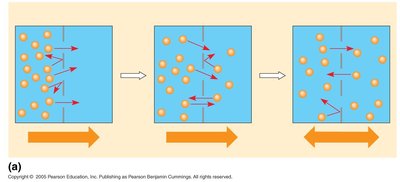
Diffusion is a fundamental process by which molecules move from areas of higher concentration to areas of lower concentration, driven by their kinetic energy and random motion. This process does not require cellular energy and is a key mechanism for the movement of substances across cell membranes.
Definition: Diffusion is the net movement of molecules down their concentration gradient.
Equilibrium: Diffusion continues until equilibrium is reached, where concentrations are equal on both sides of the membrane.
Passive Transport: Diffusion across a cell membrane is a form of passive transport, requiring no energy input from the cell.
Example: Oxygen and carbon dioxide gases diffuse across cell membranes in the lungs and tissues.
Facilitated Diffusion
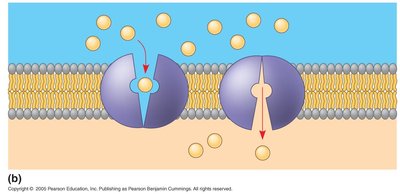
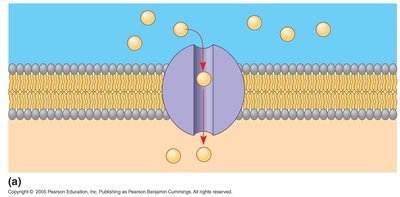
Facilitated diffusion is a type of passive transport in which specific proteins in the cell membrane help move substances across the membrane. This process is essential for molecules that cannot directly diffuse through the lipid bilayer due to size or polarity.
Carrier Proteins: These proteins bind to a specific solute and change shape to transport it across the membrane.
Channel Proteins: These proteins form pores in the membrane, allowing solutes to pass through without binding.
Example: Glucose transport into cells is mediated by carrier proteins; ions such as Na+ and K+ move through channel proteins.
Aquaporins and Osmosis
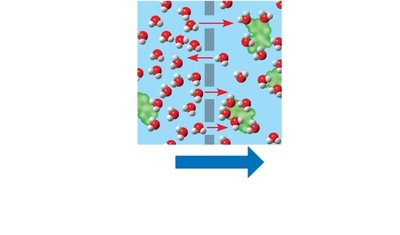
Aquaporins are specialized channel proteins that facilitate the rapid movement of water molecules across cell membranes. Osmosis is the diffusion of water across a selectively permeable membrane, driven by differences in solute concentration.
Aquaporins: Allow water to move efficiently through the membrane, especially in cells where rapid water movement is necessary.
Osmosis: Water moves from areas of higher free water concentration (lower solute concentration) to areas of lower free water concentration (higher solute concentration).
Example: Kidney cells use aquaporins to regulate water balance in the body.
Tonicity and Effects on Cells
Tonicity: Isotonic, Hypotonic, and Hypertonic Solutions
Tonicity describes the relative concentration of solutes in the environment compared to inside the cell, affecting the movement of water and the cell's physical state.
Isotonic: The environment has the same solute concentration as the cell; water moves equally in both directions, and the cell remains normal.
Hypotonic: The environment has a lower solute concentration than the cell; water enters the cell, causing it to swell (animal cells may lyse, plant cells become turgid).
Hypertonic: The environment has a higher solute concentration than the cell; water leaves the cell, causing it to shrink (animal cells shrivel, plant cells become plasmolyzed).
Solution Type | Animal Cell Effect | Plant Cell Effect |
|---|---|---|
Isotonic | Normal | Flaccid |
Hypotonic | Lysed | Turgid (normal) |
Hypertonic | Shriveled | Plasmolyzed |
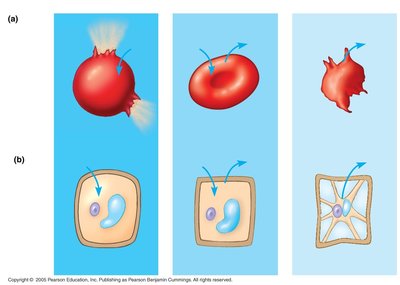
Cellular Responses to Tonicity
Cells respond to changes in their environment by adjusting their internal water content. Plant cells rely on turgor pressure for structural support, while animal cells must avoid excessive swelling or shrinking.
Turgid: Plant cells in a hypotonic environment become turgid, which is their normal, healthy state.
Plasmolyzed: Plant cells in a hypertonic environment lose water and their plasma membrane pulls away from the cell wall.
Crenate: Animal cells in a hypertonic environment shrink and become crenated.
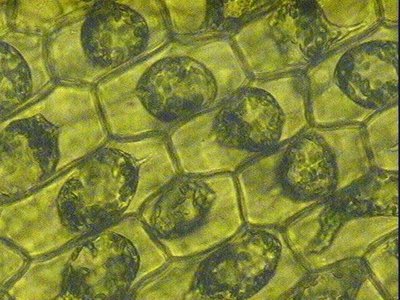
Osmoregulation in Single-Celled Organisms
Contractile Vacuoles
Some single-celled organisms, such as protists, use contractile vacuoles to regulate their internal water balance. These structures collect excess water and expel it from the cell, preventing lysis in hypotonic environments.
Filling Vacuole: The vacuole fills with water absorbed from the cytoplasm.
Contracting Vacuole: The vacuole contracts, expelling water to the outside.
Example: Paramecium uses contractile vacuoles to survive in freshwater environments.
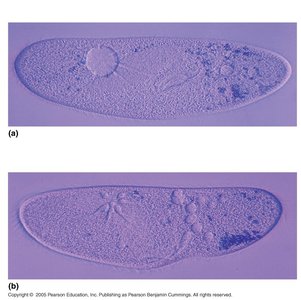
Key Equations
Osmosis and Water Potential
Water potential () determines the direction of water movement. It is affected by solute concentration and pressure.
Equation:
= solute potential
= pressure potential
Water moves from regions of higher water potential to regions of lower water potential.
Summary Table: Types of Passive Transport
Type | Mechanism | Energy Required? | Example |
|---|---|---|---|
Simple Diffusion | Direct movement across membrane | No | O2, CO2 |
Facilitated Diffusion | Via carrier/channel proteins | No | Glucose, ions |
Osmosis | Water movement via aquaporins | No | Water in kidney cells |
Additional info: Academic context was added to clarify the mechanisms and effects of passive transport, osmosis, and tonicity, as well as to provide relevant examples and equations for General Biology students.
