 Indietro
Patterns of Inheritance and Human Genetics: Guided Study Notes
Guida di studio - Note intelligenti
 Appunti personalizzati basati sui tuoi materiali, ampliati con definizioni chiave, esempi e contesto.
Q1. How would Dr. Smith explain the following genetic terms to Mark and Jeanna?
Background
Topic: Basic Genetics Vocabulary
This question is testing your understanding of foundational genetics terms that are essential for discussing inheritance patterns and genetic counseling.
Key Terms:
Alleles: Different forms of a gene found at the same place on a chromosome.
Dominant Allele: An allele that expresses its trait even if only one copy is present.
Recessive Allele: An allele that only expresses its trait if two copies are present (no dominant allele present).
Genotype: The genetic makeup of an individual (the combination of alleles).
Phenotype: The observable traits or characteristics of an individual.
Homozygous: Having two identical alleles for a particular gene.
Heterozygote: Having two different alleles for a particular gene.
Step-by-Step Guidance
Start by defining what a gene is and where alleles are found (on chromosomes).
Explain that alleles can be dominant or recessive, and how this affects trait expression.
Describe the difference between genotype (the alleles present) and phenotype (the traits observed).
Clarify the terms homozygous (same alleles) and heterozygous (different alleles).
Try solving on your own before revealing the answer!
Final Answer:
Alleles: Variants of a gene found at the same locus on homologous chromosomes.
Dominant Allele: An allele that masks the effect of a recessive allele in heterozygotes.
Recessive Allele: An allele whose effect is masked by a dominant allele; only expressed when homozygous.
Genotype: The combination of alleles an individual has for a gene (e.g., AA, Aa, or aa).
Phenotype: The physical or observable expression of a trait (e.g., brown eyes, sickle cell disease).
Homozygous: Having two identical alleles for a gene (e.g., AA or aa).
Heterozygote: Having two different alleles for a gene (e.g., Aa).
Q2. How can offspring inherit a gene? Explain using meiosis, gamete production, and fertilization.
Background
Topic: Mendelian Inheritance and Meiosis
This question tests your understanding of how genes are passed from parents to offspring through the processes of meiosis and fertilization.
Key Concepts:
Meiosis: The process by which gametes (sperm and egg) are formed, reducing chromosome number by half.
Gametes: Reproductive cells (sperm and egg) that carry only one allele for each gene.
Fertilization: The fusion of two gametes, restoring the diploid number and combining alleles from both parents.
Step-by-Step Guidance
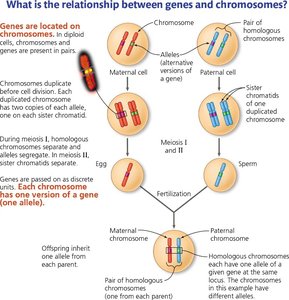
Recall that each parent has two alleles for each gene, but only passes one to each gamete due to meiosis.
During meiosis, homologous chromosomes (and thus alleles) separate, so each gamete gets only one allele per gene.
At fertilization, the offspring receives one allele from each parent, restoring the pair of alleles for each gene.
Use a diagram or Punnett square to visualize how alleles combine in the offspring.
Try solving on your own before revealing the answer!
Final Answer:
During meiosis, each parent’s alleles for a gene separate so that each gamete contains only one allele. When fertilization occurs, the offspring inherits one allele from each parent, resulting in two alleles for each gene. This explains how traits can be passed from parents to offspring and why siblings can have different combinations of alleles.
Q3. Jeanna's genotype is HbA/HbS. a) What are the dominant and recessive alleles? b) Describe Mendel's law of segregation. c) Predict the outcome of a cross between two AS (HbA/HbS) parents using a Punnett square.
Background
Topic: Mendelian Genetics, Sickle Cell Inheritance
This question tests your understanding of dominant and recessive alleles, Mendel’s laws, and how to use Punnett squares to predict inheritance patterns.
Key Terms and Formulas:
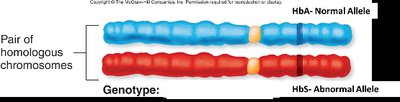
Dominant allele (HbA): Normal hemoglobin allele.
Recessive allele (HbS): Sickle cell allele.
Mendel’s Law of Segregation: Each individual has two alleles for each gene, which segregate during gamete formation so that each gamete receives only one allele.
Punnett Square: A tool to predict the probability of offspring genotypes from parental genotypes.
Step-by-Step Guidance
Identify which allele is dominant (HbA) and which is recessive (HbS).
State Mendel’s law of segregation and how it applies to the inheritance of these alleles.
Set up a Punnett square with both parents having genotype AS (HbA/HbS).
Fill in the Punnett square to show all possible combinations of alleles in the offspring.
Determine the genotypic and phenotypic ratios, but stop before stating the final numbers.
Try solving on your own before revealing the answer!
Final Answer:
a) HbA is the dominant allele; HbS is the recessive allele. b) Mendel’s law of segregation states that the two alleles for a gene separate during gamete formation, so each gamete receives only one allele. c) The Punnett square for two AS parents predicts a 1:2:1 genotypic ratio (AA:AS:SS) and a 3:1 phenotypic ratio (normal:affected). This means there is a 25% chance of a child with sickle cell disease, 50% chance of a carrier, and 25% chance of a child with normal hemoglobin.
Q4. Explain the difference between incomplete dominance, codominance, pleiotropy, polygenic inheritance, and sex linkage. Give an example for each.
Background
Topic: Non-Mendelian Inheritance Patterns
This question tests your understanding of inheritance patterns that do not follow simple Mendelian rules.
Key Terms:
Incomplete Dominance: Heterozygotes have an intermediate phenotype.
Codominance: Both alleles are fully expressed in heterozygotes.
Pleiotropy: One gene affects multiple traits.
Polygenic Inheritance: Multiple genes influence a single trait.
Sex Linkage: Genes located on sex chromosomes (X or Y).
Step-by-Step Guidance
Define each inheritance pattern and provide a brief example (e.g., flower color for incomplete dominance, blood type for codominance).
Explain how each pattern differs from simple dominance/recessiveness.
Identify which pattern applies to sickle cell disease (codominance).
Describe how sex linkage affects inheritance, especially for X-linked traits.
Try solving on your own before revealing the answer!
Final Answer:
Incomplete Dominance: Heterozygotes show an intermediate phenotype (e.g., red + white flowers = pink).
Codominance: Both alleles are expressed (e.g., AB blood type, sickle cell trait).
Pleiotropy: One gene affects multiple traits (e.g., sickle cell gene affects blood cells, organs).
Polygenic Inheritance: Many genes contribute to a trait (e.g., skin color, height).
Sex Linkage: Traits determined by genes on sex chromosomes (e.g., hemophilia, color blindness).
