 Indietro
Patterns of Inheritance: Genes, Chromosomes, and Pedigrees
Guida di studio - Note intelligenti
 Appunti personalizzati basati sui tuoi materiali, ampliati con definizioni chiave, esempi e contesto.
PATTERNS OF INHERITANCE
Key Genetic Terms and Concepts
Understanding inheritance requires familiarity with several fundamental genetic terms. These concepts are essential for interpreting how traits are passed from parents to offspring.
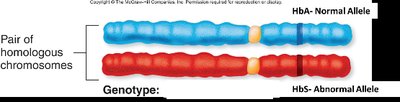
Alleles: Variants of a gene found at the same locus on homologous chromosomes. Each individual inherits two alleles for each gene, one from each parent.
Dominant Allele: An allele that masks the expression of another allele at the same locus. Its trait is expressed in the phenotype when present.
Recessive Allele: An allele whose trait is only expressed when two copies are present (homozygous).
Genotype: The genetic makeup of an individual, represented by the alleles present (e.g., HbA/HbS).
Phenotype: The observable characteristics or traits of an individual, resulting from the genotype.
Homozygous: Having two identical alleles for a particular gene (e.g., HbA/HbA or HbS/HbS).
Heterozygote: Having two different alleles for a gene (e.g., HbA/HbS).
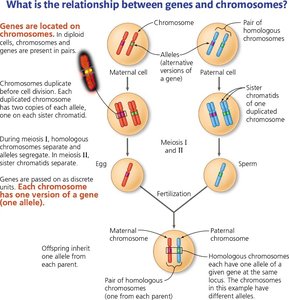
Inheritance Mechanisms: Meiosis, Gametes, and Fertilization
Genes are inherited through the process of meiosis, which produces gametes (egg and sperm) containing half the number of chromosomes. Fertilization restores the diploid number, combining genetic material from both parents.
Meiosis: Reduces chromosome number by half, ensuring offspring inherit one allele from each parent.
Gametes: Egg and sperm cells, each carrying a single set of chromosomes.
Fertilization: Fusion of gametes, resulting in a zygote with paired homologous chromosomes.
Inheritance: Offspring receive one allele for each gene from each parent, determining their genotype and phenotype.
Mendelian Patterns of Inheritance
Mendel's laws describe how traits are inherited in predictable patterns. The law of segregation states that alleles separate during gamete formation, and Punnett squares are used to predict offspring genotypes.
Law of Segregation: Each parent passes one allele for each gene to their offspring.
Punnett Square: A diagram used to predict the probability of offspring genotypes from parental crosses.
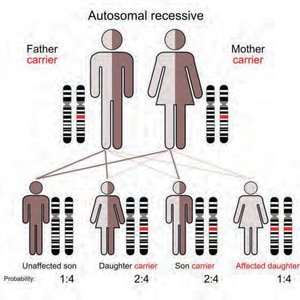
Example: If both parents are heterozygous (AS), the possible genotypes for their children are AA, AS, and SS.
Non-Mendelian Patterns of Inheritance
Not all traits follow simple Mendelian rules. Several other inheritance patterns exist:
Incomplete Dominance: The phenotype is intermediate between the two alleles (e.g., pink flowers from red and white parents).
Codominance: Both alleles are fully expressed (e.g., AB blood type).
Pleiotropy: One gene affects multiple traits (e.g., sickle cell disease affects blood, organs, and immunity).
Polygenic Inheritance: Multiple genes contribute to a single trait (e.g., skin color).
Sex Linkage: Traits are associated with genes on sex chromosomes (e.g., hemophilia, color blindness).
Pedigree Analysis and Modes of Inheritance
Pedigrees are diagrams that trace the inheritance of traits through generations. They help identify whether a trait is autosomal or sex-linked, and whether it is dominant or recessive.
Autosomal Recessive: Trait appears in both sexes, often skips generations, and is more frequent among children of consanguine marriages.
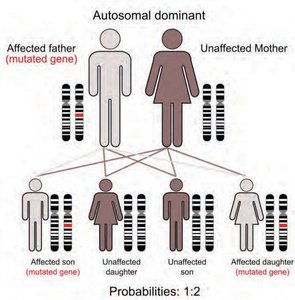
Autosomal Dominant: Trait appears in both sexes, does not skip generations, and affected offspring must have an affected parent.
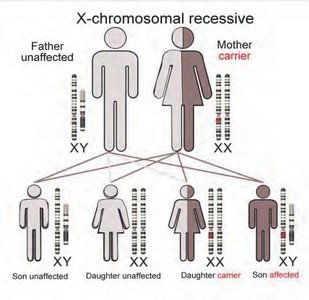
X-Linked Recessive: More males affected, trait skips generations, never passed from father to son.
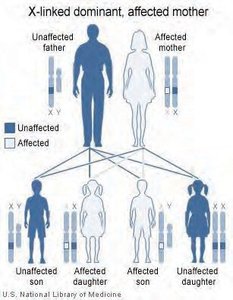
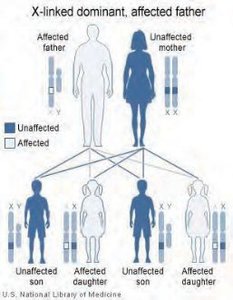
X-Linked Dominant: Mothers pass their X to both sons and daughters; fathers pass their X to daughters only.
Examples of Inherited Diseases
Several human diseases are inherited in different patterns:
Tay Sachs: Autosomal recessive; caused by two copies of a recessive allele. Affected individuals cannot break down certain lipids in brain cells.
Cystic Fibrosis: Autosomal recessive; affects respiratory and digestive systems.
Huntington's Disease: Autosomal dominant; caused by one copy of a dominant allele. Symptoms appear later in life.
Sickle Cell Disease: Autosomal recessive; caused by two abnormal alleles (HbS).
Pedigree Symbols and Interpretation
Pedigrees use standardized symbols:
Circle: Female
Square: Male
Shaded: Affected individual
Half-shaded: Carrier
Horizontal line: Mating
Vertical line: Offspring
Factors Affecting Distribution of Recessive Diseases
Recessive diseases are not evenly distributed due to:
Population structure: Certain populations have higher carrier frequencies.
Consanguinity: Mating between relatives increases the chance of recessive traits.
Genetic drift: Random changes in allele frequencies in small populations.
Chromosome Theory of Inheritance
The chromosome theory states that genes are located on chromosomes, and inheritance patterns are determined by the behavior of chromosomes during meiosis.
Each chromosome carries one version of a gene (one allele).
Homologous chromosomes: One from each parent, carrying different alleles.
Sex Chromosome Inheritance
Sex chromosomes determine gender and carry sex-linked traits.
Males: XY genotype; pass X chromosome to daughters, Y to sons.
Females: XX genotype; pass X chromosome to all offspring.
Practice Problems and Pedigree Analysis
Pedigree analysis is used to determine modes of inheritance and predict probabilities of affected offspring. Practice problems often involve assigning genotypes and calculating probabilities using Punnett squares and pedigree charts.
Probability calculations: Use Punnett squares and pedigree information to determine the likelihood of inheriting a trait.
Genotype assignment: Use dominant and recessive allele notation to assign genotypes to individuals in pedigrees.
Summary Table: Modes of Inheritance
Mode | Key Features | Example Disease |
|---|---|---|
Autosomal Recessive | Trait skips generations, both sexes affected | Tay Sachs, Cystic Fibrosis, Sickle Cell Disease |
Autosomal Dominant | Trait does not skip generations, both sexes affected | Huntington's Disease |
X-Linked Recessive | More males affected, never father to son | Hemophilia |
X-Linked Dominant | Affected mothers pass to both sexes, fathers to daughters only | Hypophosphatemic rickets |
