 Indietro
Patterns of Inheritance: Mendelian Genetics and Beyond
Guida di studio - Note intelligenti
 Appunti personalizzati basati sui tuoi materiali, ampliati con definizioni chiave, esempi e contesto.
Patterns of Inheritance
Introduction to Genetics
Genetics is the scientific study of heredity, which is the transmission of traits from one generation to the next. Th e field began with early hypotheses about inheritance and was revolutionized by the experiments of Gregor Mendel in the 19th century.
Heredity: The passing of traits from parents to offspring.
Trait: A variation in the physical appearance of a heritable characteristic.
Gene: A unit of heredity that is transferred from a parent to offspring and determines some characteristic of the offspring.
Historical Perspectives
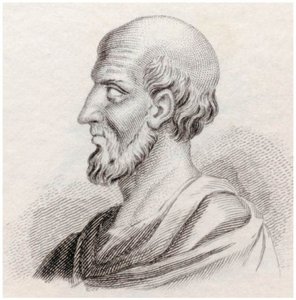
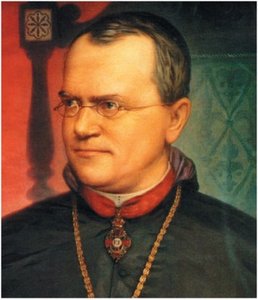
Ancient Greek physician Hippocrates proposed the idea of "pangenes," but it was Mendel who established the foundation of modern genetics through his work with pea plants.
Mendel’s Laws of Inheritance
Mendel’s Experimental Approach
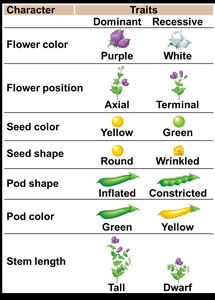
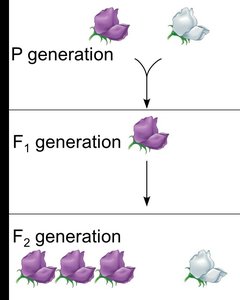
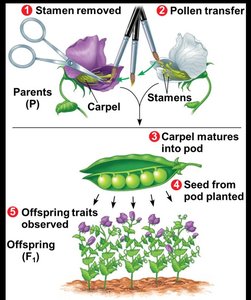
Mendel used true-breeding varieties of pea plants and controlled cross-fertilization to study inheritance patterns. True-breeding plants produce offspring identical to themselves when self-fertilized.
Mendel’s Four Hypotheses (Modern Terminology)
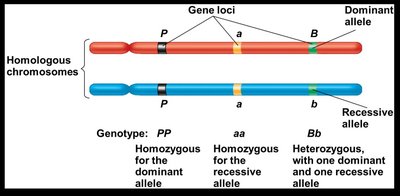
There are alternative versions of genes, called alleles, that account for variations in inherited characters.
For each character, an organism inherits two alleles, one from each parent.
If the alleles differ, the dominant allele determines the organism’s appearance, and the recessive allele has no noticeable effect.
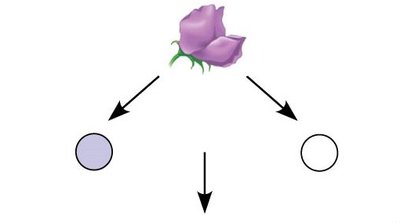
A sperm or egg carries only one allele for each inherited character because allele pairs separate during gamete formation (Law of Segregation).
Monohybrid Crosses and Punnett Squares
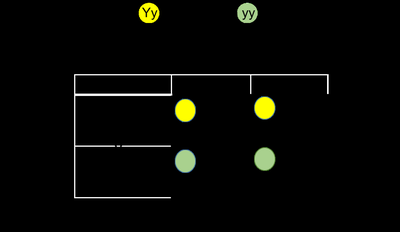
A monohybrid cross examines the inheritance of a single trait. The Punnett square is a tool used to predict the probability of offspring genotypes and phenotypes.
Genotype: The genetic makeup of an organism (e.g., PP, Pp, pp).
Phenotype: The observable traits of an organism.
Dihybrid Crosses and the Law of Independent Assortment
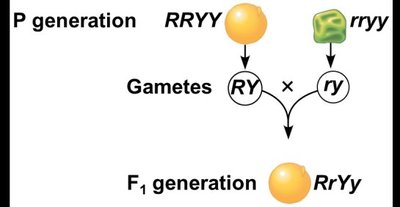
A dihybrid cross involves two characters and demonstrates that allele pairs segregate independently during gamete formation (Law of Independent Assortment).
Probability in Genetics
Genetic outcomes can be predicted using the rules of probability:
Rule of Multiplication: Probability of two independent events both occurring is the product of their individual probabilities.
Rule of Addition: Probability of an event that can occur in alternative ways is the sum of the probabilities of each way.
Genetic Patterns in Families
Pedigree Analysis
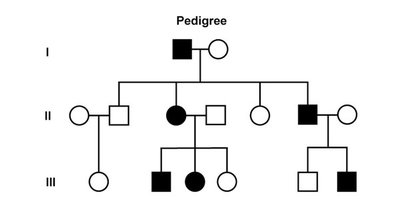
Pedigrees are diagrams that show the inheritance of a trait in a family over several generations. They are useful for tracking genetic disorders and predicting inheritance patterns.


Carriers and Autosomal Disorders
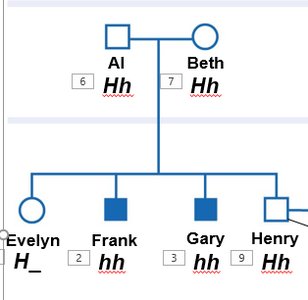
A carrier is an individual who has one recessive allele for a disorder but does not show symptoms. Autosomal disorders can be dominant or recessive, and their frequency in a population is not necessarily related to dominance.
Example: Albinism
Albinism is a recessive genetic disorder. A cross between two carriers (Aa x Aa) yields a 1:2:1 genotypic ratio and a 3:1 phenotypic ratio (normal:albinism).
Variations on Mendel’s Laws
Incomplete Dominance
In incomplete dominance, the phenotype of heterozygotes is intermediate between the two homozygotes. For example, in hypercholesterolemia, heterozygotes have a mild form of the disease.
Codominance and Multiple Alleles
In codominance, both alleles are fully expressed in heterozygotes. The ABO blood group system in humans is an example, with three alleles (IA, IB, i) producing four phenotypes (A, B, AB, O).
Pleiotropy
Pleiotropy occurs when one gene influences multiple phenotypic traits. Sickle-cell disease is a classic example, affecting hemoglobin structure and causing multiple symptoms.
Polygenic Inheritance
Many traits, such as skin color and height, are controlled by multiple genes (polygenic inheritance), resulting in a range of phenotypes.
The Chromosomal Basis of Inheritance
Chromosome Theory of Inheritance
This theory states that genes occupy specific loci on chromosomes, and chromosomes undergo segregation and independent assortment during meiosis, explaining Mendel’s laws at the molecular level.
Linked Genes and Crossing Over
Genes located on the same chromosome (linked genes) tend to be inherited together but can be separated by crossing over during meiosis, producing recombinant offspring. The frequency of recombination can be used to map gene positions on chromosomes.
Sex Chromosomes and Sex-Linked Genes
Sex Determination
In mammals, sex is determined by the presence of XX (female) or XY (male) chromosomes. Other systems exist in different organisms, and in some species, environmental factors like temperature can determine sex.
Sex-Linked Inheritance
Genes located on sex chromosomes, especially the X chromosome, show unique inheritance patterns. X-linked recessive disorders are more common in males, as they have only one X chromosome. Examples include hemophilia, red-green color blindness, and Duchenne muscular dystrophy.
Y Chromosome and Human Evolution
The Y chromosome is passed from father to son with little recombination, making it useful for tracing recent human evolutionary history.
Additional info: This guide covers the core concepts of Mendelian genetics, extensions to Mendel’s laws, and the chromosomal basis of inheritance, as outlined in a typical General Biology curriculum.
