Indietro
Patterns of Inheritance: Mendelian Genetics and Beyond
Guida di studio - Note intelligenti
 Appunti personalizzati basati sui tuoi materiali, ampliati con definizioni chiave, esempi e contesto.
Patterns of Inheritance
Introduction to Heredity and Genetics
Heredity is the transmission of traits from one generation to the next, while genetics is the scientific study of how inherited alleles contribute to those traits. The foundational principles of inheritance were first described by Gregor Mendel, whose experiments with pea plants revealed predictable patterns in the way traits are passed down. Modern genetics has expanded on Mendel’s work, showing that gene products, multiple genes, and environmental factors all shape an organism’s phenotype.
Mendel’s Experiments and the Logic of Inheritance
Controlled Crosses and Terminology
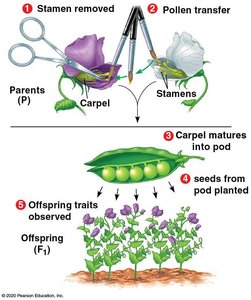
Mendel used controlled crosses to transfer pollen between pea plants, allowing him to observe how traits were inherited in offspring. He distinguished between a character (a heritable feature, such as flower color) and a trait (a specific variant, such as purple or white flowers). Generations are labeled as follows:
P generation: Parental plants
F1 generation: First filial generation, offspring of the P generation
F2 generation: Offspring from crosses among F1 individuals
True-breeding plants consistently produce the same trait, while hybrids result from crosses between different varieties. Mendel’s concept of discrete inheritance explains why traits can disappear and reappear in subsequent generations: alleles retain their identity rather than blending permanently.
Genes, Alleles, and Homologous Chromosomes
Basic Genetic Concepts
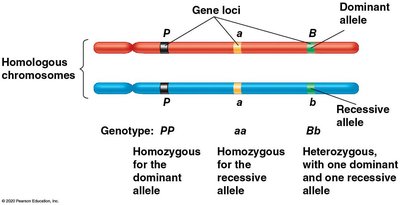
Alleles are different versions of a gene found at the same locus on homologous chromosomes. A diploid organism inherits one allele from each parent. Key terms include:
Homozygous: Identical alleles at a locus (e.g., PP or pp)
Heterozygous: Different alleles at a locus (e.g., Pp)
Genotype: The combination of alleles an organism possesses
Phenotype: The observable trait or characteristic
Complete dominance: The heterozygote displays the dominant phenotype
Law of Segregation and Monohybrid Crosses
Principles and Predictions
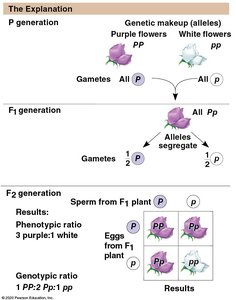
The law of segregation states that two alleles for a gene separate during gamete formation, so each gamete receives only one allele. In a monohybrid cross (e.g., Pp × Pp), each parent produces two types of gametes (P and p), each with a probability of ½. The Punnett square is used to predict the genotypes and phenotypes of offspring:
Genotype ratio: 1 PP : 2 Pp : 1 pp
Phenotype ratio (with complete dominance): 3 purple : 1 white
Probability predicts the expected outcomes over many offspring, but actual ratios may vary in small samples.
Testcross: Determining an Unknown Genotype
Purpose and Interpretation
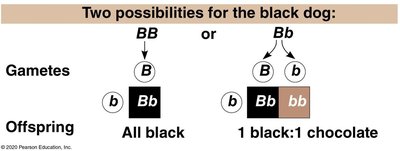
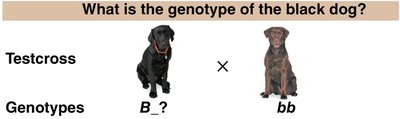
A testcross is used to determine the genotype of an individual with a dominant phenotype by crossing it with a homozygous recessive individual. The results reveal whether the unknown genotype is homozygous dominant or heterozygous:
If all offspring display the dominant trait, the unknown is likely homozygous dominant (BB).
If offspring show a 1:1 ratio of dominant to recessive traits, the unknown is heterozygous (Bb).
Law of Independent Assortment and Dihybrid Crosses
Genetic Variation and Ratios
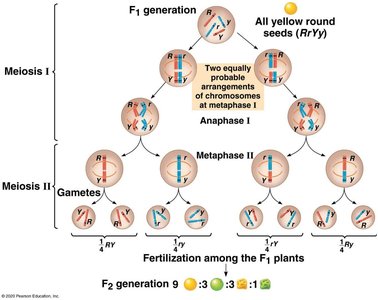
The law of independent assortment states that alleles of different genes segregate independently during gamete formation. For genes on different chromosomes, a dihybrid (RrYy) produces four types of gametes (RY, Ry, rY, ry) in equal proportions. A dihybrid cross (RrYy × RrYy) yields a 9:3:3:1 phenotype ratio with complete dominance at both loci. Linked genes may not follow this ratio.
Chromosome Theory: Physical Basis of Mendel’s Laws
Chromosomes and Meiosis
The chromosome theory of inheritance places genes at specific loci on chromosomes. Mendel’s law of segregation corresponds to the separation of homologous chromosomes during meiosis I, while independent assortment is explained by the random orientation of chromosome pairs at metaphase I. This provides a physical explanation for Mendel’s observations.
Beyond Simple Dominance: Incomplete Dominance
Intermediate Phenotypes
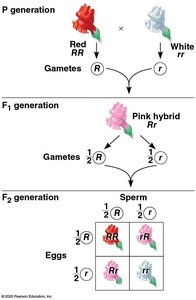
Incomplete dominance occurs when the heterozygote’s phenotype is intermediate between the two homozygotes. For example, in snapdragons, crossing red (RR) and white (rr) flowers produces pink (Rr) offspring. When pink hybrids are crossed, the F2 generation shows a 1:2:1 ratio of red:pink:white. Importantly, alleles still segregate and retain their identity, so intermediate phenotypes do not support the idea of permanent blending.
Genetic Ancestry: Evidence and Limitations
Tracing Lineages with Genetic Markers
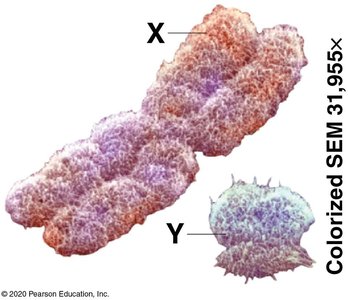
Y-chromosome markers are used to track paternal lineages, as fathers transmit Y chromosomes to sons. Mitochondrial DNA (mtDNA) is used to trace maternal lineages, since it is typically inherited through the egg. While shared ancestry can explain similarities in genetic markers, identifying a specific historical ancestor requires more evidence than just a shared marker. For example, the attribution of a widespread Y-chromosome lineage to Genghis Khan is speculative and not a demonstrated identity.