 Indietro
Pedigrees and Probability of Inheritance: Patterns, Analysis, and Practice
Guida di studio - Note intelligenti
 Appunti personalizzati basati sui tuoi materiali, ampliati con definizioni chiave, esempi e contesto.
Pedigree Analysis and Symbols
Introduction to Pedigrees
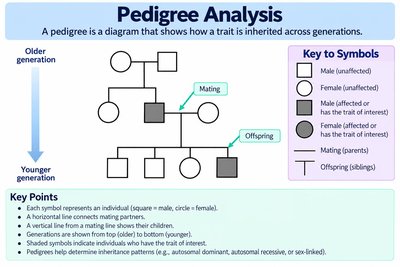
Pedigrees are diagrams used in genetics to track the inheritance of traits across generations. They are essential tools for identifying inheritance patterns, such as autosomal dominant, autosomal recessive, and sex-linked traits.
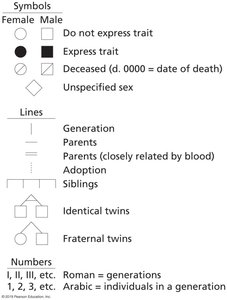
Pedigree symbols represent individuals and their relationships (squares = males, circles = females).
Horizontal lines indicate mating, while vertical lines show offspring.
Pedigrees help determine inheritance patterns and are used in genetic counseling and research.
Autosomal vs. Sex-Linked Inheritance
Chromosome Basics and Trait Location
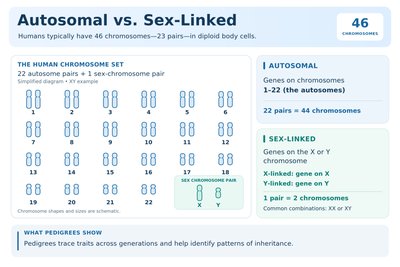
Humans have 46 chromosomes: 22 pairs of autosomes and 1 pair of sex chromosomes (X and Y). The location of a gene determines its inheritance pattern.
Autosomal genes are found on chromosomes 1–22 and affect both sexes equally.
Sex-linked genes are located on the X or Y chromosome and often show distinct inheritance patterns.
X-linked traits can be dominant or recessive; Y-linked traits are only passed from father to son.
Patterns of Inheritance in Pedigrees
Autosomal Dominant Traits
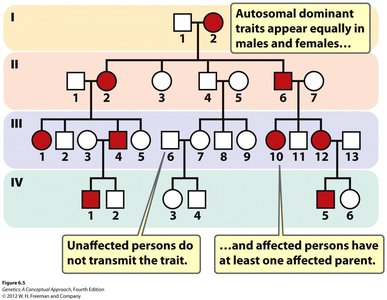
Autosomal dominant traits appear in every generation and affect males and females equally. Affected individuals usually have at least one affected parent.
Unaffected persons do not transmit the trait.
Examples: Huntington's disease, Marfan syndrome.
Autosomal Recessive Traits
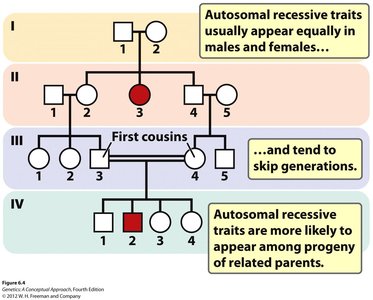
Autosomal recessive traits often skip generations and are more likely to appear among offspring of related parents (consanguinity).
Affected individuals may have unaffected parents who are carriers.
Examples: Cystic fibrosis, sickle cell anemia.
X-Linked Recessive Traits
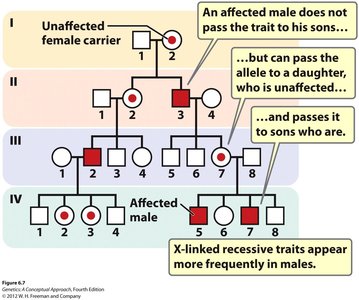
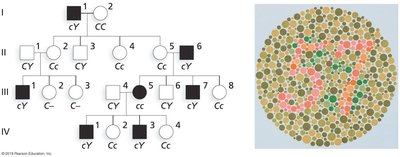
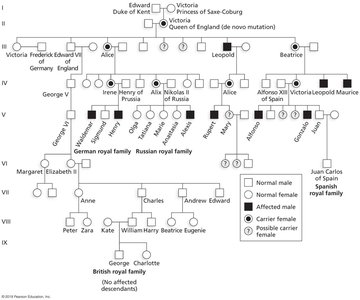
X-linked recessive traits are more frequent in males, as males have only one X chromosome. Affected males cannot pass the trait to their sons, but can pass the allele to daughters, who may be carriers.
Examples: Red-green color blindness, hemophilia A.
Carrier females can transmit the trait to sons.
X-Linked Dominant Traits
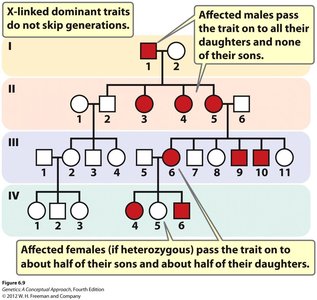
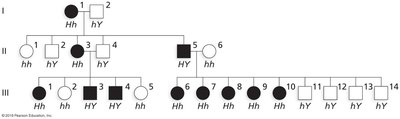
X-linked dominant traits do not skip generations. Affected males pass the trait to all daughters but none of their sons. Affected females (if heterozygous) pass the trait to about half of their sons and daughters.
Examples: Congenital hypertrichosis (CGH).
Y-Linked Traits
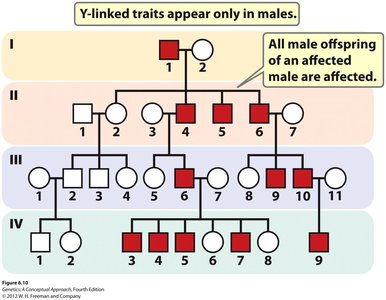
Y-linked traits are transmitted exclusively from father to son and only affect males. All male offspring of an affected male are affected.
Y chromosome contains few genes, mostly related to male sex determination.
Mitochondrial Inheritance
Mitochondrial traits are inherited only from the mother, as mitochondria are passed through the egg. If a female has a mitochondrial trait, all her offspring inherit it; if a male has the trait, none of his offspring inherit it.
Only one allele is present per individual; dominance is not an issue.
Pedigree Interpretation and Outsider Rules
Outsider Rules for Pedigree Analysis
In pedigrees, "outsiders" are individuals whose parents' genotypes are unknown. Assumptions are made to simplify analysis:
For dominant pedigrees: affected outsiders are assumed to be heterozygotes; unaffected outsiders are homozygous recessive.
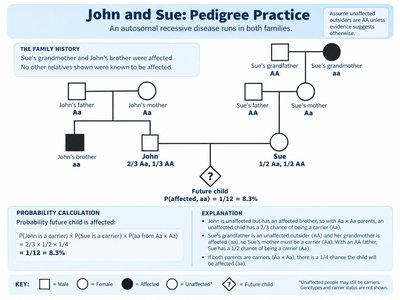
For recessive pedigrees: unaffected outsiders are assumed to be homozygous dominant.
These rules are based on the rarity of mutant alleles.
Distinguishing Modes of Inheritance
Autosomal vs. X-Linked Traits
To distinguish between autosomal recessive and X-linked recessive traits in males:
X-linked recessive traits are only passed to sons from mothers, not from fathers.
Autosomal traits affect both sexes equally and can be inherited from either parent.
Probability Calculations in Pedigrees
Calculating Probabilities of Inheritance
Pedigrees can be used to calculate the probability that an individual will inherit a trait. The product rule is used for independent events:
Product Rule:
Assign genotypes based on pedigree and outsider rules.
Calculate carrier probabilities and affected probabilities for each parent.
Practice Problems: Autosomal Recessive Disease
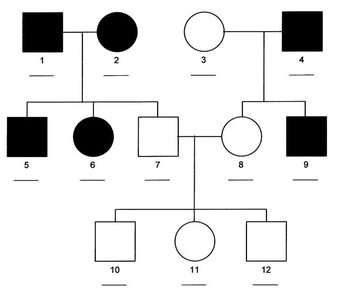
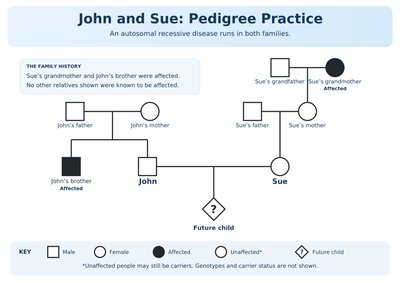
Example: John and Sue want to know the probability of having a child with an autosomal recessive disease.
Pedigree analysis and probability calculation show the chance of an affected child.
Practice Problems: Hair Color Inheritance
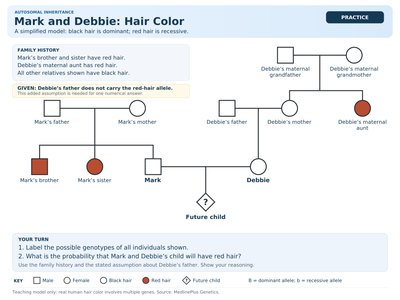
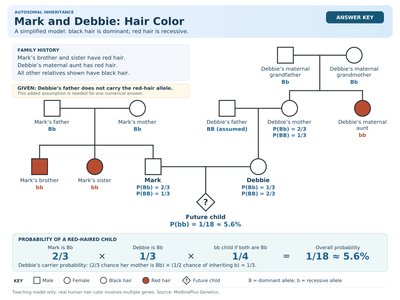
Example: Mark and Debbie, both with black hair, want to know the probability of having a red-haired child.
Red hair is recessive; black hair is dominant. Pedigree analysis and probability calculation are used.
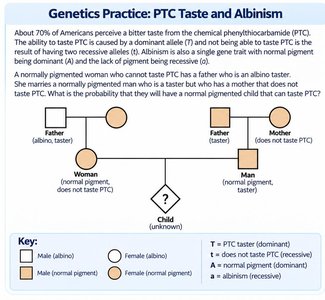
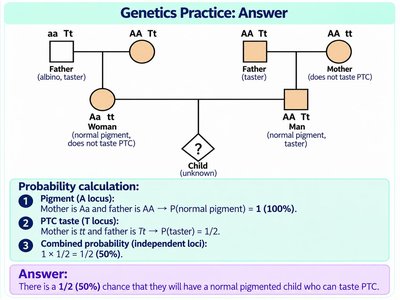
Practice Problems: Two Traits (PTC Taste and Albinism)
Example: Probability of a child being normal pigmented and able to taste PTC.
Use independent probability for two traits:
Summary Table: Modes of Inheritance
Mode of Inheritance | Key Features | Example Traits |
|---|---|---|
Autosomal Dominant | Appears in every generation; affects both sexes equally; affected individuals have at least one affected parent | Huntington's disease |
Autosomal Recessive | May skip generations; affects both sexes equally; more common among related parents | Cystic fibrosis |
X-Linked Dominant | Does not skip generations; affected males pass trait to all daughters, none to sons | Congenital hypertrichosis |
X-Linked Recessive | More frequent in males; affected males cannot pass trait to sons | Hemophilia A, color blindness |
Y-Linked | Only affects males; all sons of affected male are affected | SRY gene traits |
Mitochondrial | Inherited only from mother; all offspring of affected female inherit trait | Leber's hereditary optic neuropathy |
Additional info: Probability calculations and pedigree interpretation are fundamental skills in genetics, allowing prediction of trait inheritance and risk assessment for genetic diseases.
