 Indietro
Photosynthesis and Cellular Respiration: The Continuous Cycle
Guida di studio - Note intelligenti
 Appunti personalizzati basati sui tuoi materiali, ampliati con definizioni chiave, esempi e contesto.
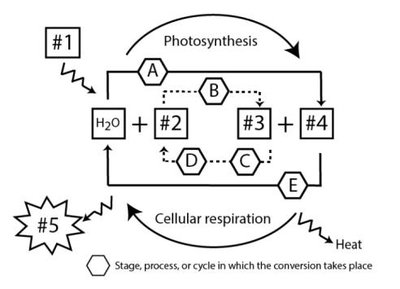
Q33. Using this diagram or a similar version of it, thoroughly explain why photosynthesis and cellular respiration form a continuous cycle. Discuss the individual molecules/components, their relationships, and in what phases of the process the conversions take place. Be sure to assign titles to missing numbers and letters.
Background
Topic: Photosynthesis and Cellular Respiration
This question tests your understanding of how photosynthesis and cellular respiration are interconnected, forming a cycle that sustains life. It requires you to identify key molecules and processes, and explain how energy and matter flow between these two fundamental biological pathways.
Key Terms and Concepts:
Photosynthesis: The process by which plants convert light energy into chemical energy (glucose).
Cellular Respiration: The process by which cells break down glucose to release energy (ATP).
Key molecules: , , , Glucose ()
Stages: Light reactions, Calvin cycle, Glycolysis, Citric acid cycle, Oxidative phosphorylation
Key Formulas:
Photosynthesis:
Cellular Respiration:
Step-by-Step Guidance
Identify the main molecules involved in the cycle: , , , and glucose. These are labeled as #2, #3, and #4 in the diagram.
Recognize the stages of photosynthesis (A: Light reactions, B: Calvin cycle) and cellular respiration (C: Oxidation of pyruvate, D: Citric acid cycle, E: Oxidative phosphorylation) as shown in the diagram.
Understand that photosynthesis uses light energy (#1) to convert (#2) and into glucose (#3) and (#4). This occurs in the chloroplasts.
Cellular respiration takes glucose (#3) and (#4) and breaks them down to produce (#2), , and ATP (energy), occurring in the mitochondria.
Note how the products of photosynthesis are the reactants for cellular respiration, and vice versa, forming a continuous loop. The stages (A-E) represent the specific processes where these conversions take place.
Assign the missing numbers and letters based on the diagram and your understanding of the cycle. Consider how each molecule moves through the cycle and which stage it is involved in.
Try solving on your own before revealing the answer!
Final Answer:
Photosynthesis and cellular respiration form a continuous cycle because the products of one process are the reactants of the other. In the diagram:
#1 = Light
#2 = CO2
#3 = Glucose
#4 = O2
#5 = Heat
A = Light reactions
B = Calvin cycle
C = Oxidation of pyruvate
D = Citric acid cycle
E = Oxidative phosphorylation
Photosynthesis (A and B) uses light (#1), CO2 (#2), and H2O to produce glucose (#3) and O2 (#4). Cellular respiration (C, D, E) uses glucose (#3) and O2 (#4) to produce CO2 (#2), H2O, and ATP (energy), with heat (#5) released. This cycle ensures that energy and matter are continuously recycled in living systems.
