 Indietro
Photosynthesis and Ecosystem Dynamics: Chapter 8 & 35 Study Guide
Guida di studio - Note intelligenti
 Appunti personalizzati basati sui tuoi materiali, ampliati con definizioni chiave, esempi e contesto.
Photosynthesis
Key Terms and Structures
Photosynthesis is the process by which plants, algae, and some bacteria convert light energy into chemical energy, producing sugars and oxygen. Understanding the structures and molecules involved is essential for grasping the mechanisms of this process.
Pigment: Molecules that absorb specific wavelengths of light; chlorophyll a is the primary pigment in plants.
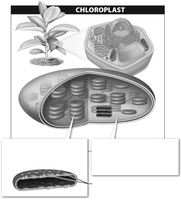
Chloroplast: The organelle where photosynthesis occurs, containing thylakoids and stroma.
Thylakoid: Membrane-bound discs within chloroplasts where the "photo" reactions take place.
Stroma: The fluid surrounding thylakoids; site of the Calvin cycle.
Photosystem: Complexes of pigments and proteins that capture light energy.
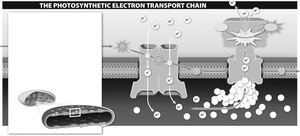
ATP Synthase: Enzyme that synthesizes ATP during the electron transport chain.
NADPH: Electron carrier produced in the "photo" reactions, used in the Calvin cycle.
Calvin Cycle: Series of reactions in the stroma that fix carbon dioxide and produce sugars.
Electron Transport Chain: Sequence of proteins in the thylakoid membrane that transfer electrons and generate ATP and NADPH.
C3, C4, CAM Photosynthesis: Variations in the photosynthetic pathway adapted to different environmental conditions.
Light Absorption and Pigments
Light absorption is fundamental to photosynthesis. Pigments such as chlorophyll a absorb light energy, which excites electrons and initiates the "photo" reactions.
Photon: An energy packet of light; longer wavelengths carry less energy.
Chlorophyll a: Absorbs red and blue light, reflecting green, which is why plants appear green.
Accessory pigments: Become visible in autumn when chlorophyll production halts.
The "Photo" and "Synthesis" Reactions
Photosynthesis consists of two sets of reactions:
"Photo" reactions: Occur in the thylakoid membranes; light energy is used to excite electrons, produce ATP and NADPH, and split water to release oxygen.
"Synthesis" reactions (Calvin cycle): Occur in the stroma; ATP and NADPH are used to fix carbon dioxide and produce G3P, which is converted to sugars.
Inputs and Outputs of Photosynthesis
Inputs:
Light energy: Captured by pigments from sunlight.
Water: Absorbed from soil; split during "photo" reactions to provide electrons and produce oxygen.
Carbon dioxide: Taken from the atmosphere; fixed in the Calvin cycle to form sugars.
Outputs:
Sugar: Produced from G3P in the Calvin cycle; used for energy and growth.
Oxygen: Released as a byproduct of water splitting in the "photo" reactions.
Photosynthetic Electron Transport Chain
The electron transport chain in the thylakoid membrane is central to the "photo" reactions. Excited electrons move through protein complexes, powering proton pumps and ATP synthase.
Role of electrons: Excited by light, transferred through the chain, replaced by electrons from water.
Oxygen production: Water is split, releasing O2 and providing electrons.
Proton (H+) pumps: Move protons into the thylakoid interior, creating a gradient used by ATP synthase to generate ATP.
The Calvin Cycle
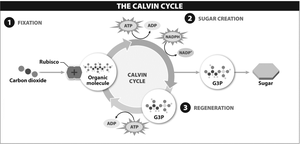
The Calvin cycle is the "synthesis" phase of photosynthesis, occurring in the stroma. It uses ATP and NADPH from the "photo" reactions to fix carbon dioxide and produce G3P.
Step 1: Fixation
CO2 is attached to a five-carbon molecule (RuBP) by the enzyme Rubisco.
Step 2: Sugar Creation
ATP and NADPH are used to convert the fixed carbon into G3P, a three-carbon sugar.
Step 3: Regeneration
Some G3P is used to regenerate RuBP, allowing the cycle to continue.
G3P to Glucose: Two G3P molecules combine to form glucose and other sugars.
Energy use: The Calvin cycle consumes energy (ATP and NADPH) rather than producing it.
Variations in Photosynthesis: C3, C4, and CAM
Plants have evolved different photosynthetic pathways to adapt to environmental challenges, especially water loss.
C3 Photosynthesis: Standard pathway; most plants use this. Efficient in cool, moist environments.
C4 Photosynthesis: Separates initial CO2 fixation and Calvin cycle into different cell types; reduces photorespiration and water loss. Requires more energy.
CAM Photosynthesis: Stomata open at night to fix CO2; minimizes water loss but limits growth rate.
Photosynthesis and Cellular Respiration
Photosynthesis: Performed by plants, algae, and some bacteria.
Cellular Respiration: Performed by all living organisms, including plants.
Significance and Applications
Big picture: Photosynthesis is the foundation of most ecosystems, providing energy and organic matter for all life.
Photosynthesizing parts: Green tissues (leaves) contain chloroplasts and perform photosynthesis.
Light quality: Plants cannot use green light efficiently; filtering only green wavelengths will reduce photosynthesis.
Ecosystem Structure and Energy Flow (Chapter 35.1/35.2)
Biotic and Abiotic Components
An ecosystem consists of living (biotic) and non-living (abiotic) components.
Biotic: All living organisms (plants, animals, microbes).
Abiotic: Physical and chemical factors (water, sunlight, soil, temperature).
Energy and Biomass in Ecosystems
Energy flows through ecosystems via trophic levels, and biomass decreases at higher levels.
Energy: Originates from the sun, captured by producers (plants).
Biomass: Total mass of living organisms; decreases from producers to consumers.
Trophic levels:
Producers: Plants and algae
Primary consumers: Herbivores
Secondary consumers: Carnivores
Size of levels: Lower levels have more biomass and energy; higher levels are smaller due to energy loss.
Ecological Pyramids
Ecological pyramids visually represent the distribution of energy and biomass among trophic levels.
Producers: Largest base
Consumers: Successively smaller levels
Summary Table: Photosynthetic Pathways
Pathway | Main Features | Environmental Adaptation | Energy Trade-off |
|---|---|---|---|
C3 | Standard Calvin cycle | Cool, moist | Most efficient |
C4 | CO2 fixation in separate cells | Hot, dry | Requires more ATP |
CAM | CO2 fixation at night | Very dry | Slow growth |
Summary Table: Ecosystem Components
Component | Definition | Example |
|---|---|---|
Biotic | Living | Plants, animals |
Abiotic | Non-living | Water, sunlight |
Additional info: Academic context was added to clarify the Calvin cycle steps, electron transport chain, and ecosystem energy flow, as well as to expand on the differences between C3, C4, and CAM photosynthesis.
