 Indietro
Photosynthesis and The Cell Cycle: Mini-Textbook Study Notes
Guida di studio - Note intelligenti
 Appunti personalizzati basati sui tuoi materiali, ampliati con definizioni chiave, esempi e contesto.
Photosynthesis
Overview of Photosynthesis
Photosynthesis is a fundamental biological process by which plants, algae, and some bacteria convert solar energy into chemical energy, primarily in the form of glucose. This process occurs within specialized organelles called chloroplasts, which are most abundant in the mesophyll cells of plant leaves. - Key Point 1: Chloroplasts are the site of photosynthesis and are found mainly in leaf mesophyll cells. - Key Point 2: Carbon dioxide (CO2) enters and oxygen (O2) exits the leaf through stomata, while veins transport water and sugars.
The Two Stages of Photosynthesis
Photosynthesis consists of two main stages: the light reactions and the Calvin cycle. - Light Reactions: Occur in the thylakoid membranes, producing ATP, NADPH, and O2 from water and light energy. - Calvin Cycle: Occurs in the stroma, using ATP, NADPH, and CO2 to synthesize organic molecules. The Calvin cycle is light-independent.
The Cell Cycle
Cell Division and Its Roles
Cell division is essential for reproduction, growth, and repair in living organisms. It can occur via asexual or sexual reproduction. - Asexual Reproduction: Produces genetically identical offspring (clones) from a single parent. - Sexual Reproduction: Produces offspring with unique genetic combinations.
Examples of Asexual Reproduction
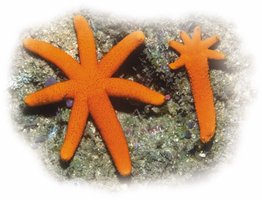
- Yeast cells: Reproduce asexually by budding, producing genetically identical daughter cells. 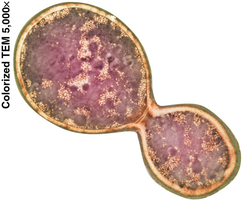 - Sea stars: Can reproduce asexually via fragmentation and regeneration.
Sexual Reproduction
- Key Point: Sexual reproduction results in genetic diversity among offspring. 
Binary Fission in Prokaryotes
Prokaryotic cells reproduce asexually by binary fission, a process in which the cell divides in half after duplicating its single circular chromosome. - Key Steps: 1. Chromosome duplication and separation 2. Elongation and movement of chromosome copies 3. Division into two daughter cells 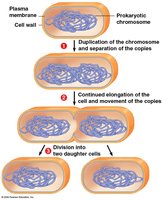 - Why Asexual? Offspring inherit DNA from a single parent and are genetically identical.
Cellular Organization of Genetic Material
The genetic material in cells is organized as follows: - Genome: All DNA in a cell; can be a single molecule (prokaryotes) or multiple molecules (eukaryotes). - Chromosomes: DNA molecules packaged with proteins (chromatin) that condense during cell division. - Somatic Cells: Have two sets of chromosomes. - Gametes: Have half as many chromosomes as somatic cells. 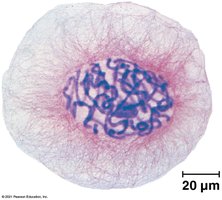
Chromosome Duplication and Distribution
Before cell division, chromosomes are duplicated, forming two sister chromatids joined at the centromere. During division, chromatids separate and become individual chromosomes. 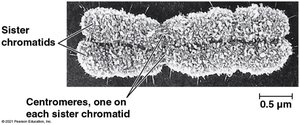
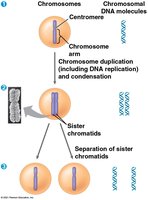
Eukaryotic Cell Division: Mitosis and Cytokinesis
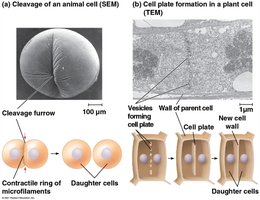
Eukaryotic cell division consists of: - Mitosis: Division of genetic material in the nucleus. - Cytokinesis: Division of the cytoplasm. Gametes are produced by meiosis, which yields non-identical daughter cells with half the chromosome number.
The Cell Cycle: Phases and Regulation
The cell cycle alternates between the mitotic (M) phase and interphase. - Interphase: Consists of G1 (growth), S (DNA synthesis), and G2 (preparation for division). Chromosomes are duplicated only during S phase. 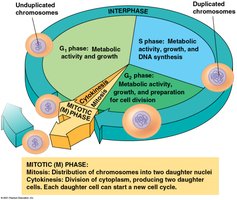
Stages of Mitosis
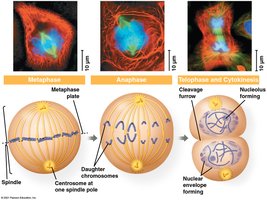
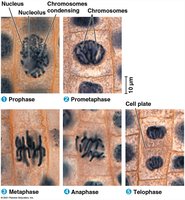
Mitosis is conventionally divided into five stages: - Prophase - Prometaphase - Metaphase - Anaphase - Telophase 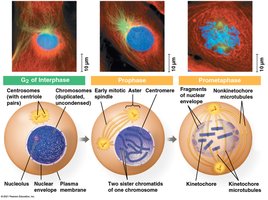
Detailed Stages
Prophase: Chromatin condenses, nucleoli disappear, mitotic spindle forms. Prometaphase: Nuclear envelope fragments, spindle microtubules attach to kinetochores. Metaphase: Chromosomes align at the metaphase plate. Anaphase: Sister chromatids separate and move to opposite poles. Telophase: Nuclear envelopes reform, chromosomes decondense. Cytokinesis: Cytoplasm divides, forming two daughter cells. 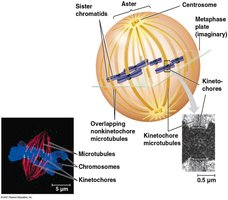
Regulation of the Cell Cycle
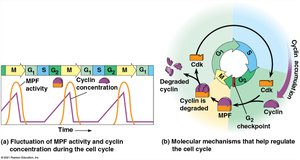
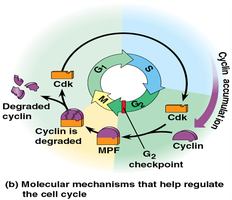
The cell cycle is regulated by a molecular control system involving cyclins and cyclin-dependent kinases (Cdks). - Cyclins: Proteins with cyclically fluctuating concentrations. - Cdk: Enzymes that must bind cyclins to be active. - MPF (Maturation-Promoting Factor): A cyclin-Cdk complex that triggers passage past the G2 checkpoint into M phase. 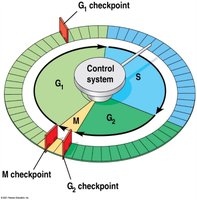
Cell Cycle Checkpoints
Checkpoints in G1, G2, and M phases ensure proper cell cycle progression. - G1 Checkpoint: Determines if cell will proceed to division or enter G0 (resting state). - M Checkpoint: Ensures chromosomes are properly attached to spindle before anaphase. 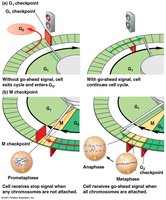
Loss of Cell Cycle Controls in Cancer Cells
Cancer cells evade normal cell cycle controls, leading to uncontrolled division and tumor formation. - Benign Tumors: Remain at original site. - Malignant Tumors: Invade tissues and can metastasize to other parts of the body. 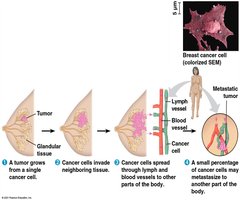
Summary Table: Cell Cycle Phases
Phase | Main Events |
|---|---|
G1 | Cell growth, metabolic activity |
S | DNA synthesis, chromosome duplication |
G2 | Preparation for cell division |
Mitosis | Division of nucleus |
Cytokinesis | Division of cytoplasm |
Key Equations
DNA Replication: Chromosome Number in Mitosis: (somatic cells) Chromosome Number in Meiosis: (gametes)
Additional info:
- The cell cycle is tightly regulated to prevent errors in DNA replication and chromosome segregation. - Loss of regulation can lead to cancer and other diseases.
