 Indietro
Photosynthesis: Capturing Light Energy to Power Life
Guida di studio - Note intelligenti
 Appunti personalizzati basati sui tuoi materiali, ampliati con definizioni chiave, esempi e contesto.
Photosynthesis: Overview and Importance
Introduction to Photosynthesis
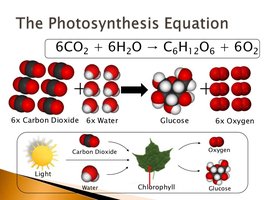
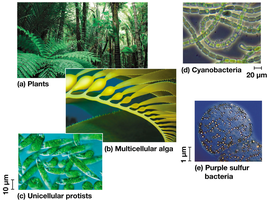
Photosynthesis is the process by which plants, algae, and some prokaryotes convert light energy into chemical energy, producing organic molecules such as glucose. This process is fundamental for life on Earth, as it provides the energy and organic matter that sustain most ecosystems.
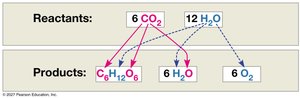
Photosynthesis Equation: The overall chemical reaction is summarized as:
Producers and Consumers: Autotrophs (such as plants) produce organic molecules from inorganic sources, while heterotrophs (such as animals) obtain organic molecules by consuming other organisms.
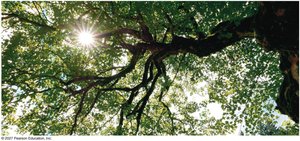
Global Impact: Photosynthesis nourishes almost the entire biosphere, directly or indirectly.
Feeding the Biosphere
Autotrophs and Heterotrophs
Autotrophs are organisms that sustain themselves without consuming other living beings. Most plants are photoautotrophs, using sunlight to synthesize organic molecules from carbon dioxide and water. Heterotrophs, including animals and decomposers, rely on consuming organic material produced by autotrophs.
Chloroplasts: The Site of Photosynthesis
Structure and Function
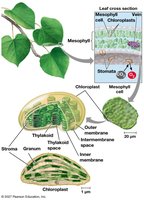
Photosynthesis occurs mainly in the leaves of plants, within organelles called chloroplasts. Chloroplasts contain an outer and inner membrane, enclosing a dense fluid called the stroma. Inside are stacks of thylakoids, which contain the pigment chlorophyll that captures light energy.
Stomata: Microscopic pores in leaves that allow gas exchange (CO2 in, O2 out).
Veins: Transport water and nutrients to the leaf and carry away sugars.
The Photosynthesis Equation and Redox Reactions
Tracking Atoms and Electron Flow
Photosynthesis is a redox process, reversing the electron flow of cellular respiration. Water is split, providing electrons and protons, and oxygen is released as a by-product. Carbon dioxide is reduced to form glucose.
Redox Process: CO2 is reduced to sugar; H2O is oxidized to O2.
Endergonic Reaction: Requires energy input from sunlight.

Stages of Photosynthesis
Light Reactions and the Calvin Cycle
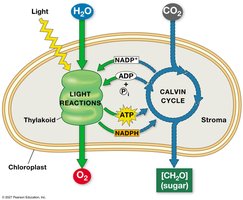
Photosynthesis consists of two main stages: the light reactions and the Calvin cycle.
Light Reactions: Occur in the thylakoid membranes. Light energy is used to split water, releasing O2, and to generate ATP and NADPH.
Calvin Cycle: Occurs in the stroma. Uses ATP and NADPH to convert CO2 into sugars.
The Nature of Sunlight
Electromagnetic Spectrum and Visible Light
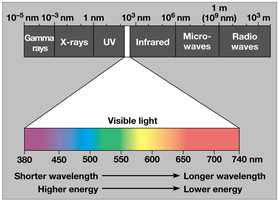
Light is a form of electromagnetic energy. The electromagnetic spectrum includes all wavelengths of electromagnetic radiation, but only a small range (visible light, 380–740 nm) is used in photosynthesis.
Wavelength: Distance between crests of waves; shorter wavelengths have higher energy.
Photons: Discrete packets of light energy.
Photosynthetic Pigments
Light Absorption and Pigment Types
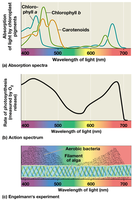
Pigments are molecules that absorb specific wavelengths of light. Chlorophyll a is the main pigment in plants, while chlorophyll b and carotenoids are accessory pigments that broaden the spectrum of light used for photosynthesis.
Absorption Spectrum: Shows which wavelengths are absorbed by each pigment.
Action Spectrum: Shows the effectiveness of different wavelengths in driving photosynthesis.
Carotenoids: Also protect the plant by dissipating excess light energy.
Light Reactions: Electron Flow and ATP/NADPH Production
Photosystems and Electron Transport
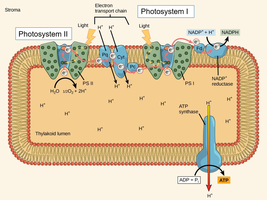
Light reactions occur in the thylakoid membrane and involve two types of photosystems (PSII and PSI). Light energy excites electrons, which are transferred through an electron transport chain, generating ATP (by chemiosmosis) and NADPH.
Photosystem II (P680): Absorbs light at 680 nm, splits water, and transfers electrons to the electron transport chain.
Photosystem I (P700): Absorbs light at 700 nm, receives electrons from the chain, and reduces NADP+ to NADPH.
ATP Synthase: Uses the proton gradient to synthesize ATP from ADP and Pi.
The Calvin Cycle: Sugar Synthesis
Phases of the Calvin Cycle
The Calvin cycle uses ATP and NADPH from the light reactions to fix carbon dioxide and produce glyceraldehyde-3-phosphate (G3P), a three-carbon sugar. The cycle has three main phases:
Carbon Fixation: CO2 is attached to ribulose bisphosphate (RuBP) by the enzyme rubisco.
Reduction: ATP and NADPH are used to convert 3-phosphoglycerate into G3P.
Regeneration: Some G3P is used to regenerate RuBP, enabling the cycle to continue.
For every three CO2 molecules fixed, one G3P is produced, and the cycle consumes nine ATP and six NADPH.
Photosynthesis and Life on Earth
Ecological and Biological Significance
Photosynthesis is essential for life, providing the energy and organic molecules needed by nearly all organisms. Plants store excess sugar as starch, and the process also produces oxygen, which is vital for aerobic respiration.
Summary Table: Comparison of Light Reactions and Calvin Cycle
Process | Location | Inputs | Outputs | Main Functions |
|---|---|---|---|---|
Light Reactions | Thylakoid membrane | Light, H2O, ADP, NADP+ | O2, ATP, NADPH | Convert light energy to chemical energy |
Calvin Cycle | Stroma | CO2, ATP, NADPH | G3P (sugar), ADP, NADP+ | Fix carbon and synthesize sugars |
