Indietro
Photosynthesis: Capturing Light Energy to Power Life
Guida di studio - Note intelligenti
 Appunti personalizzati basati sui tuoi materiali, ampliati con definizioni chiave, esempi e contesto.
Photosynthesis: Capturing Light Energy to Power Life
Big Idea and Overview
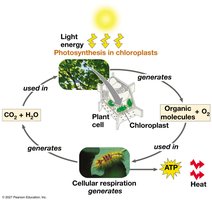
Photosynthesis is the process by which plants, algae, and some prokaryotes convert solar energy into chemical energy, producing sugars that fuel life on Earth. This process not only sustains autotrophs but also indirectly supports heterotrophs, forming the foundation of the biosphere.
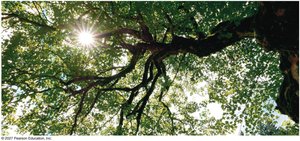
Photosynthesis Feeds the Biosphere
Autotrophs and Heterotrophs
Autotrophs are organisms that produce their own organic molecules from inorganic sources (e.g., CO2 and H2O). They are the primary producers in ecosystems.
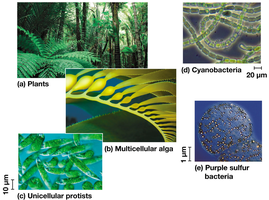
Photoautotrophs use sunlight to drive the synthesis of organic compounds. Examples include plants, multicellular algae, unicellular protists, cyanobacteria, and some prokaryotes.
Heterotrophs obtain organic molecules by consuming other organisms or their byproducts. This group includes animals, fungi, and many bacteria.
Chloroplasts: The Sites of Photosynthesis
Leaf Structure and Chloroplast Anatomy
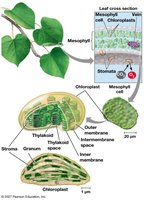
Photosynthesis primarily occurs in the leaves of plants, within specialized organelles called chloroplasts. Chloroplasts are found mainly in the mesophyll cells of leaves. Gas exchange occurs through stomata, and veins transport water and sugars.
Chloroplast Structure: Surrounded by a double membrane, containing a dense fluid called the stroma.
Thylakoids: Flattened sacs that may be stacked into grana; contain chlorophyll pigments.
The Photosynthesis Equation and Redox Nature
Overall Chemical Equation
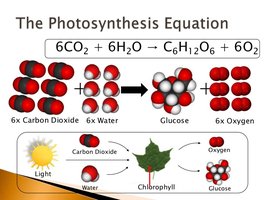
The process of photosynthesis can be summarized by the following equation:
Tracking Atoms and Redox Changes
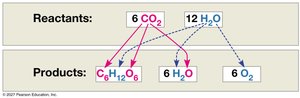
Chloroplasts split water, releasing O2 as a byproduct and incorporating hydrogen into sugars.
Photosynthesis is a redox process: CO2 is reduced to sugar, and H2O is oxidized to O2.
The process is endergonic, requiring energy input from light.

Stages of Photosynthesis
Light Reactions and the Calvin Cycle
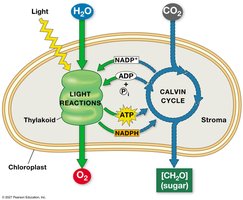
Light Reactions: Occur in the thylakoid membranes. Split water, release O2, produce ATP and NADPH via photophosphorylation.
Calvin Cycle: Occurs in the stroma. Uses ATP and NADPH to convert CO2 into sugars through carbon fixation, reduction, and regeneration of RuBP.
The Nature of Sunlight
Electromagnetic Spectrum and Visible Light
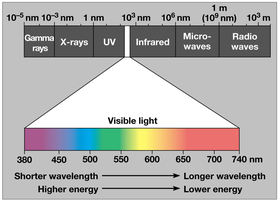
Light is electromagnetic energy, traveling in waves with varying wavelengths.
The visible spectrum (380–740 nm) is the range of light used in photosynthesis.
Shorter wavelengths have higher energy per photon.
Photosynthetic Pigments
Types and Functions
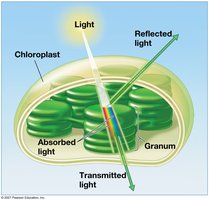
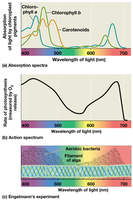
Pigments absorb specific wavelengths of light; unabsorbed wavelengths are reflected or transmitted (e.g., green light by chlorophyll).
Chlorophyll a: Main pigment in light reactions.
Chlorophyll b: Accessory pigment, broadens absorption spectrum.
Carotenoids: Accessory pigments, absorb violet/blue-green light, provide photoprotection.
The Light Reactions: Mechanism and Electron Flow
Photosystems and Electron Transport
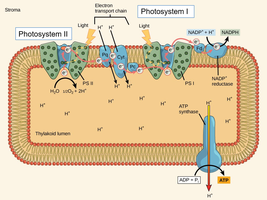
Photosystems: Complexes of proteins and pigments in the thylakoid membrane. Two types: Photosystem II (P680) and Photosystem I (P700).
Linear Electron Flow: Involves both photosystems, produces ATP, NADPH, and O2.
Cyclic Electron Flow: Uses only Photosystem I, produces ATP but not NADPH or O2.
Comparison: Chemiosmosis in Chloroplasts and Mitochondria
ATP Synthesis by Chemiosmosis
Both organelles use electron transport chains to pump protons and generate ATP via ATP synthase.
In chloroplasts, the proton gradient is across the thylakoid membrane; in mitochondria, across the inner mitochondrial membrane.
Chloroplasts convert light energy to chemical energy; mitochondria convert chemical energy from food to ATP.
The Calvin Cycle: Synthesis of Sugar
Phases of the Calvin Cycle
Phase 1: Carbon Fixation – CO2 is attached to RuBP by the enzyme rubisco, forming 3-phosphoglycerate.
Phase 2: Reduction – ATP and NADPH are used to convert 3-phosphoglycerate into G3P (glyceraldehyde-3-phosphate).
Phase 3: Regeneration of RuBP – Some G3P is used to regenerate RuBP, enabling the cycle to continue.
For every three CO2 molecules fixed, one G3P is produced (net gain), and the cycle consumes 9 ATP and 6 NADPH.
Photosynthesis: Essential for Life
Ecological and Biological Importance
Photosynthesis stores solar energy in organic molecules, fueling nearly all life on Earth.
Plants store excess sugars as starch in various organs.
Photosynthesis and cellular respiration form a cycle that maintains atmospheric O2 and CO2 balance.