 Indietro
Photosynthesis: Conversion of Light Energy to Chemical Energy
Guida di studio - Note intelligenti
 Appunti personalizzati basati sui tuoi materiali, ampliati con definizioni chiave, esempi e contesto.
Photosynthesis: Overview and Importance
Big Idea and Biological Significance
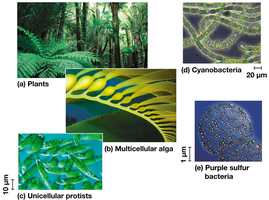
Photosynthesis is the process by which plants, algae, and some prokaryotes convert solar energy into chemical energy, producing organic molecules such as sugars. This process sustains almost all life on Earth by providing food and oxygen, directly or indirectly nourishing the biosphere.
Autotrophs: Organisms that produce their own food from inorganic substances (e.g., plants, algae, cyanobacteria).
Heterotrophs: Organisms that obtain organic molecules by consuming other organisms.
Photosynthesis occurs in the chloroplasts of plant cells, mainly in the leaves.
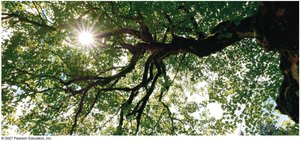
Photosynthesis Equation and Redox Nature
Overall Chemical Reaction
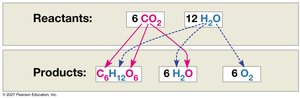
The overall process of photosynthesis can be summarized by the following equation:
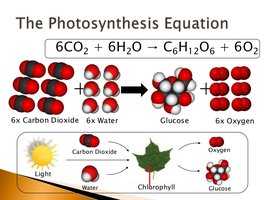
Reactants: Carbon dioxide (CO2) and water (H2O)
Products: Glucose (C6H12O6) and oxygen (O2)
Light energy is required to drive this endergonic (energy-consuming) process.
Photosynthesis is a redox process:
CO2 is reduced to form glucose.
H2O is oxidized to form O2.

Photosynthesis Feeds the Biosphere
Producers and Consumers
Autotrophs, especially photoautotrophs, are the primary producers of the biosphere. They convert inorganic molecules into organic compounds using sunlight. Heterotrophs, including animals and decomposers, rely on these organic molecules for energy and carbon.
Chloroplast Structure and Function
Sites of Photosynthesis
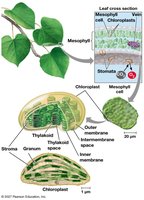
Chloroplasts are specialized organelles where photosynthesis takes place. They are mainly found in the mesophyll cells of leaves. Chloroplasts have a double membrane and contain an internal system of thylakoids, which are stacked into grana. The fluid surrounding the thylakoids is called the stroma.
Stomata: Microscopic pores that allow gas exchange (CO2 in, O2 out).
Veins: Transport water and nutrients to the leaf and carry sugars away.
Tracking Atoms Through Photosynthesis
Origin of Oxygen and Hydrogen
During photosynthesis, water is split to provide electrons and protons, and oxygen is released as a by-product. The hydrogen from water is incorporated into sugar molecules, while the oxygen is released as O2.
Stages of Photosynthesis
Light Reactions and Calvin Cycle
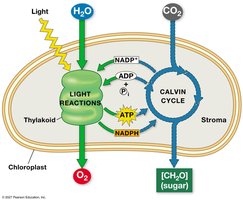
Photosynthesis consists of two main stages:
Light Reactions: Occur in the thylakoid membranes; convert light energy into chemical energy (ATP and NADPH), and release O2.
Calvin Cycle: Occurs in the stroma; uses ATP and NADPH to fix CO2 and produce sugars.
The Nature of Sunlight
Electromagnetic Spectrum and Visible Light
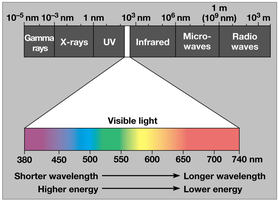
Light is a form of electromagnetic energy. The electromagnetic spectrum includes all wavelengths of electromagnetic radiation, but only visible light (380–740 nm) is used in photosynthesis.
Shorter wavelengths have higher energy per photon.
Visible light drives the light reactions in chloroplasts.
Photosynthetic Pigments
Light Absorption and Pigment Types
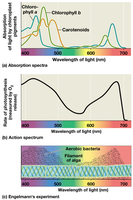
Pigments are molecules that absorb specific wavelengths of light. The main pigments in chloroplasts are:
Chlorophyll a: The primary pigment involved in light reactions.
Chlorophyll b: An accessory pigment that broadens the spectrum of light used.
Carotenoids: Accessory pigments that absorb additional wavelengths and provide photoprotection.
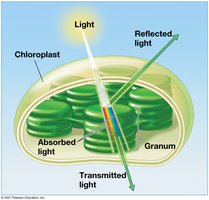
Photosystems and Light Harvesting
Structure and Function of Photosystems
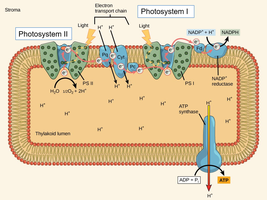
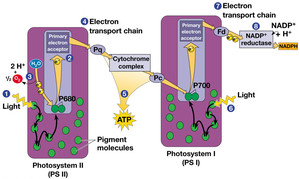
A photosystem consists of a reaction-center complex surrounded by light-harvesting complexes. When pigments absorb light, energy is transferred to the reaction center, where an excited electron is transferred to a primary electron acceptor.
Photosystem II (PSII): Contains P680 chlorophyll a, absorbs light at 680 nm.
Photosystem I (PSI): Contains P700 chlorophyll a, absorbs light at 700 nm.
Linear Electron Flow in Light Reactions
Electron Transport and ATP/NADPH Production
During the light reactions, electrons flow linearly from water through PSII and PSI to NADP+, forming NADPH. This process also generates a proton gradient used to synthesize ATP via chemiosmosis.
Water is split, providing electrons and releasing O2.
Electrons move through an electron transport chain, generating ATP and NADPH.
The Calvin Cycle
Carbon Fixation and Sugar Synthesis
The Calvin cycle uses ATP and NADPH from the light reactions to fix CO2 and produce glyceraldehyde 3-phosphate (G3P), a sugar precursor. The cycle has three phases:
Carbon Fixation: CO2 is attached to ribulose bisphosphate (RuBP) by the enzyme rubisco.
Reduction: ATP and NADPH are used to convert 3-phosphoglycerate into G3P.
Regeneration: RuBP is regenerated to continue the cycle.
For every three CO2 molecules fixed, one G3P is produced, and the cycle consumes nine ATP and six NADPH molecules.
Photosynthesis and Life on Earth
Ecological and Evolutionary Importance
Photosynthesis is essential for life, providing the energy and organic molecules required by nearly all organisms. Plants store excess sugars as starch, and these reserves support growth, reproduction, and survival during periods without sunlight.
Additional info: The notes above integrate and expand upon the provided content, ensuring a comprehensive, self-contained study guide for college-level General Biology students.
