 Indietro
Photosynthesis: Converting Light Energy to Chemical Energy
Guida di studio - Note intelligenti
 Appunti personalizzati basati sui tuoi materiali, ampliati con definizioni chiave, esempi e contesto.
Photosynthesis
Overview of Photosynthesis
Photosynthesis is the process by which photoautotrophic organisms, such as plants, algae, and some bacteria, convert light energy into chemical energy stored in organic molecules. This process is essential for life on Earth, as it provides the oxygen we breathe and the food we eat.
Photosynthesis Equation: The overall chemical equation for photosynthesis is:
Location: Photosynthesis occurs in the chloroplasts of plant cells.
Energy Transformation: Light energy is converted into chemical energy stored in glucose. This is an endergonic process ().
Redox Reactions: Water is oxidized to oxygen, and carbon dioxide is reduced to sugar.
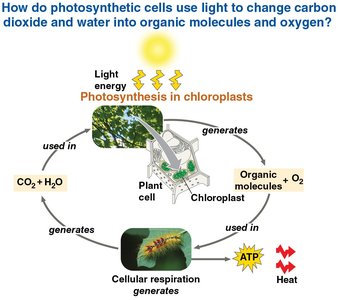
Photosynthesis vs. Cellular Respiration
Photosynthesis: Occurs in chloroplasts; converts CO2 and H2O into glucose and O2 using light energy.
Cellular Respiration: Occurs in the cytosol and mitochondria; breaks down glucose and O2 to produce CO2, H2O, and ATP.
Energy Flow: Energy enters ecosystems as sunlight and leaves as heat; matter cycles between photosynthesis and respiration.
Chloroplast Structure and Function
Chloroplast Anatomy
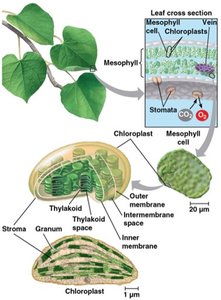
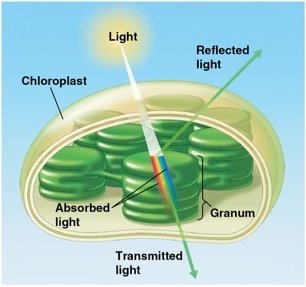
Chloroplasts are the organelles where photosynthesis takes place. They contain an outer and inner membrane, with an internal system of thylakoid membranes stacked into grana. The stroma is the fluid-filled space surrounding the thylakoids.
Thylakoids: Site of the light reactions; contain chlorophyll.
Stroma: Site of the Calvin cycle (light-independent reactions).
Stomata: Pores on the leaf surface that allow gas exchange (CO2 in, O2 out).
Photosynthetic Organisms
Types of Photoautotrophs
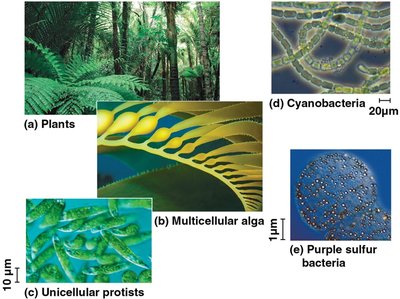
Photoautotrophs are organisms that use light as an energy source to synthesize organic molecules from inorganic carbon dioxide.
Plants: The most familiar photoautotrophs.
Algae: Both unicellular and multicellular forms.
Cyanobacteria: Photosynthetic prokaryotes.
Some Protists and Bacteria: Capable of photosynthesis.
Photosynthesis: The Two Stages
Light Reactions
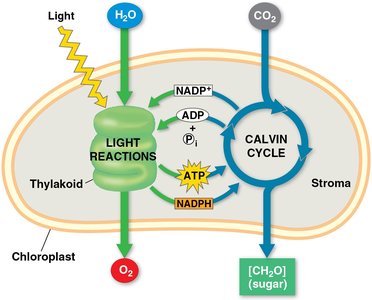
The light reactions occur in the thylakoid membranes and require light energy. Their main functions are to split water, release oxygen, and produce ATP and NADPH.
Inputs: Light, H2O, ADP, NADP+
Outputs: O2, ATP, NADPH
Photophosphorylation: The process of generating ATP from ADP and inorganic phosphate using light energy.
The Calvin Cycle (Light-Independent Reactions)
The Calvin cycle occurs in the stroma and uses ATP and NADPH from the light reactions to fix carbon dioxide and produce sugar (G3P).
Inputs: CO2, ATP, NADPH
Outputs: G3P (used to make glucose), ADP, NADP+
Key Enzyme: Rubisco catalyzes the fixation of CO2 to RuBP.
The Nature of Sunlight and Pigments
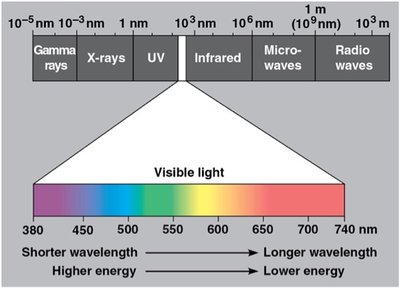
Electromagnetic Spectrum
Light is a form of electromagnetic energy. The visible spectrum (about 380–740 nm) is used in photosynthesis. Shorter wavelengths have higher energy.
Pigments in Photosynthesis
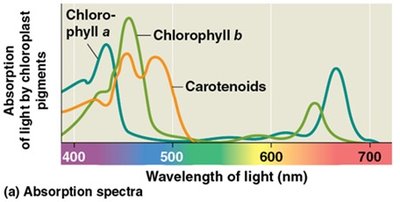
Pigments absorb specific wavelengths of light. Chlorophyll a is the main pigment, while chlorophyll b and carotenoids are accessory pigments that broaden the spectrum of light used for photosynthesis.
Chlorophyll a: Absorbs violet-blue and red light; reflects green.
Chlorophyll b: Absorbs blue and orange light; reflects green.
Carotenoids: Absorb blue-green light; provide photoprotection.
Photosystems and Electron Flow
Photosystems
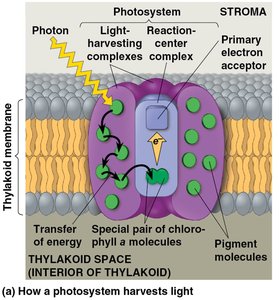
Photosystems are complexes of proteins and pigments in the thylakoid membrane that harvest light energy and convert it to chemical energy.
Photosystem II (PSII): Absorbs light at 680 nm (P680); acts first in the light reactions.
Photosystem I (PSI): Absorbs light at 700 nm (P700); acts second.
Linear Electron Flow: Electrons move from water through PSII and PSI to NADP+, forming NADPH and ATP.
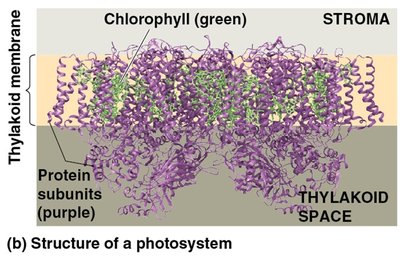
Linear Electron Flow: Steps 1–5
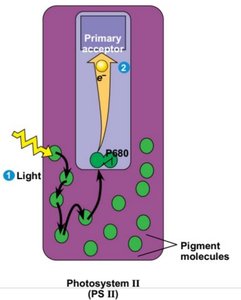
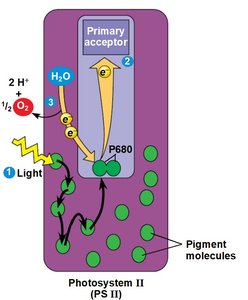
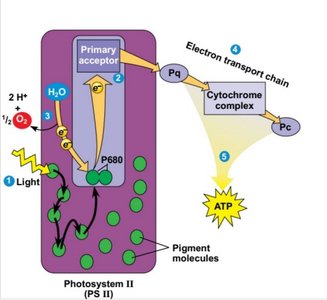
1. Light excites pigments in PSII, transferring energy to P680.
2. P680's excited electron is transferred to the primary electron acceptor.
3. Water is split, providing electrons to P680+ and releasing O2.
4. Electrons move down the electron transport chain, pumping H+ into the thylakoid space.
5. ATP is produced as H+ flows back into the stroma through ATP synthase (chemiosmosis).
Linear Electron Flow: Steps 6–8
6. Light excites P700 in PSI; its electron is transferred to the primary acceptor.
7. Electrons pass through a second electron transport chain to NADP+ reductase.
8. NADP+ is reduced to NADPH, which is used in the Calvin cycle.
Alternative Mechanisms: C3, C4, and CAM Plants
C3 Plants
Most plants use the C3 pathway, where rubisco fixes CO2 directly into a three-carbon compound (3-PGA). However, in hot, dry conditions, photorespiration can occur, reducing efficiency.
Photorespiration: Rubisco binds O2 instead of CO2, leading to loss of fixed carbon and energy.
C4 Plants
C4 plants minimize photorespiration by first fixing CO2 into a four-carbon compound in mesophyll cells, which is then transported to bundle-sheath cells where CO2 is released for the Calvin cycle. This adaptation is common in plants like corn and sugarcane.
CAM Plants
CAM plants (e.g., cacti, pineapple) open their stomata at night to fix CO2 into organic acids, which release CO2 during the day for the Calvin cycle. This adaptation conserves water in arid environments.
Summary Table: Photosynthesis and Respiration
Process | Location | Inputs | Outputs | Energy Transformation |
|---|---|---|---|---|
Photosystem II (PSII) | Thylakoid membrane | Light, H2O, ADP + Pi | O2, H+ gradient, ATP | Light → ATP |
Photosystem I (PSI) | Thylakoid membrane | Light, e- from PSII, NADP+ | NADPH | Light → NADPH |
Calvin Cycle | Stroma | CO2, ATP, NADPH | G3P (sugar), ADP, NADP+ | ATP + NADPH → Sugar |
Key Takeaways
Photosynthesis converts light energy into chemical energy, producing oxygen and organic molecules.
Light reactions generate ATP and NADPH; the Calvin cycle uses these to fix carbon into sugars.
Stomata regulate gas exchange, balancing CO2 uptake and water loss.
C4 and CAM plants have adaptations to minimize photorespiration in hot, dry climates.
