 Indietro
Photosynthesis: Light Dependent and Independent Reactions
Guida di studio - Note intelligenti
 Appunti personalizzati basati sui tuoi materiali, ampliati con definizioni chiave, esempi e contesto.
Photosynthesis: Light Dependent and Independent Reactions
Overview of Cellular Components
All cells share fundamental structures and functions, which are essential for life and energy transformation. These include the cell membrane, cytosol, ribosomes, and a DNA-based genome. Cells must obtain and transform energy to sustain their activities.
Cell Membrane: Boundary that regulates entry and exit of substances.
Cytosol: Fluid matrix where metabolic reactions occur.
Ribosomes: Sites of protein synthesis.
DNA-based Genome: Genetic material for inheritance and cellular function.
Energy and Carbon Sources in Organisms
Organisms are classified based on their energy and carbon sources. These classifications are fundamental to understanding metabolic diversity.
Autotrophs: Synthesize their own organic molecules from inorganic sources.
Photoautotrophs: Use light energy to convert CO2 into organic compounds.
Chemoautotrophs (Chemolithotrophs): Use inorganic chemicals as energy sources.
Heterotrophs: Obtain organic molecules by consuming other organisms.
Photoheterotrophs: Use light for energy but require organic carbon.
Chemoheterotrophs: Use organic compounds for both energy and carbon.
Prokaryotes are found in all four classifications, while eukaryotes are found in two.
Photosynthetic Diversity
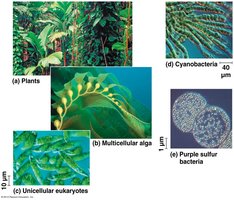
Photosynthesis occurs in various organisms, including plants, algae, and some bacteria. Cyanobacteria perform photosynthesis in a single cell without chloroplasts or mitochondria.
Photoautotrophs: Include plants, algae, and cyanobacteria.
Photosynthetic Pathways: Not all organisms perform photosynthesis identically.
Photosynthesis and Cellular Respiration
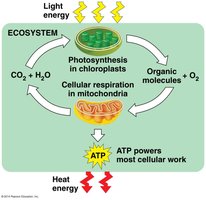
Photosynthesis and cellular respiration are interconnected processes in the ecosystem. Photosynthesis converts light energy into chemical energy, while respiration releases energy from organic molecules.
Photosynthesis: Occurs in chloroplasts; produces organic molecules and O2.
Cellular Respiration: Occurs in mitochondria; uses organic molecules and O2 to produce ATP.
Redox Reactions in Photosynthesis
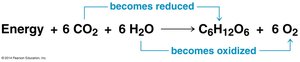
Photosynthesis involves redox reactions, where electrons are transferred between molecules. Water is oxidized (loses electrons), and oxygen is reduced (gains electrons).
Oxidation: Loss of electrons (e.g., water in photosynthesis).
Reduction: Gain of electrons (e.g., oxygen in photosynthesis).
Photosynthesis: Light Dependent Reactions
The light-dependent reactions occur in the thylakoid membranes of chloroplasts and convert light energy into chemical energy (ATP and NADPH).
Major Players: Photosystems II & I, reaction center, photolysis, cytochrome b6f complex, electron carriers (plastoquinone, plastocyanin, ferredoxin), ferredoxin NADP reductase, ATP synthase.
Photolysis: Splitting of water to provide electrons.
ATP Synthase: Enzyme that synthesizes ATP from ADP and inorganic phosphate.
ATP Production: Photophosphorylation
ATP is produced by photophosphorylation during the light reactions. There are two types: noncyclic and cyclic.
Noncyclic Photophosphorylation: Produces both ATP and NADPH.
Cyclic Photophosphorylation: Produces ATP only, used when more ATP is needed than NADPH.
Photosynthesis: Light Independent Reactions (Calvin Cycle)
The Calvin Cycle is a series of reactions that generate organic carbon molecules from inorganic carbon (CO2). It occurs in the stroma of the chloroplast.
Three Phases: Carbon fixation, reduction, regeneration.
Key Enzyme: Rubisco (Ribulose-1,5-bisphosphate carboxylase oxygenase), the most abundant enzyme on Earth.
Product: G3P (glyceraldehyde-3-phosphate), used to make amino acids, nucleic acids, fatty acids, etc.
Photorespiration and Adaptations
Rubisco can also act as an oxygenase, leading to photorespiration, which is wasteful for the plant. Photorespiration increases under high O2 and high temperature conditions. Plants in hot, dry environments have adaptations to minimize photorespiration.
C4 Plants: Use malate as a substrate and have spatial separation of reactions (bundle sheath vs. mesophyll cells).
CAM Plants: Use crassulacean acid and have temporal separation (gas exchange at night, Calvin cycle during the day).
Summary Table: Types of Photosynthetic Plants
Type | Substrate | Adaptation |
|---|---|---|
C3 | Calvin Cycle | No special adaptation |
C4 | Malate | Spatial separation |
CAM | Crassulacean acid | Temporal separation |
Key Points for Exam Preparation
Know the structure of the chloroplast and where photosynthesis events occur.
Understand the substrates and products of each pathway.
Be able to describe adaptations in C4 and CAM plants.
