 Indietro
Photosynthesis: Light Reactions and the Calvin Cycle
Guida di studio - Note intelligenti
 Appunti personalizzati basati sui tuoi materiali, ampliati con definizioni chiave, esempi e contesto.
Photosynthesis Overview
The Two Stages of Photosynthesis
Photosynthesis is a fundamental biological process that converts light energy into chemical energy, sustaining life on Earth. It occurs in two main stages: the Light Reactions and the Calvin Cycle (also known as the dark reactions or carbon fixation reactions).
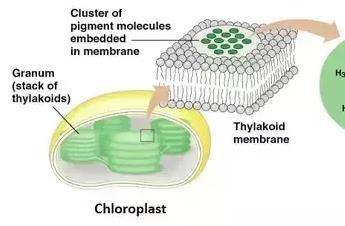
Stage 1: Light Reactions – Occur in the thylakoid membranes of chloroplasts and convert light energy into ATP and NADPH.
Stage 2: Calvin Cycle – Occurs in the stroma of chloroplasts and uses ATP and NADPH to fix carbon dioxide into sugars.
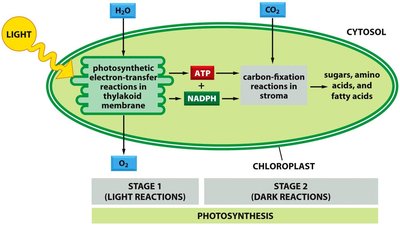
Light Energy and Pigments
Electromagnetic Radiation and Visible Light
Light energy is a form of electromagnetic radiation that travels in waves. The visible spectrum is the range of wavelengths detectable by the human eye, and photons are discrete packets of light energy. The energy of a photon is inversely proportional to its wavelength: shorter wavelengths carry more energy.
Wavelength – The distance between two peaks of a wave.
Photon – A quantum of light energy.
Visible Light – Wavelengths from approximately 380 nm to 740 nm.
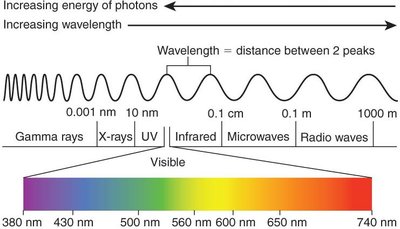
Interaction of Light with Matter
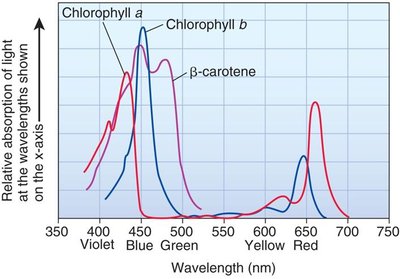
When visible light strikes an object, it can be transmitted, reflected, or absorbed. Pigments are substances that absorb specific wavelengths of visible light, and plant leaves appear green because chlorophyll absorbs red and blue light but reflects green.
Transmitted – Light passes through the object.
Reflected – Light bounces off the object.
Absorbed – Light is taken up by the object, often by pigments.
Electron Excitation and Energy Transfer
Electron Potential Energy
Electrons in atoms have potential energy depending on their shell. Photons can transfer energy to electrons, boosting them to an excited state. Excited electrons are unstable and may release energy as heat, light, or be transferred to another molecule, capturing the energy for biological processes.
Ground State – Lowest energy level of an electron.
Excited State – Higher energy level after absorbing a photon.
Energy Release – As electrons return to lower energy levels, energy is released.
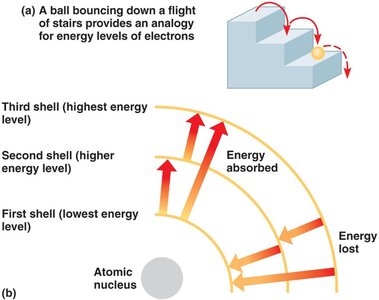
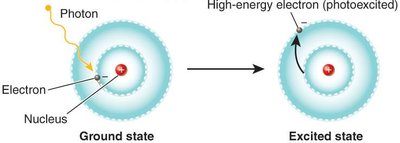
Pigments in Photosynthesis
Chlorophyll and Other Pigments
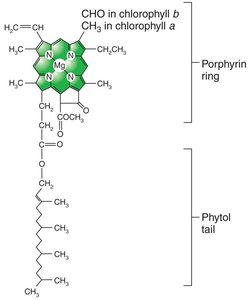
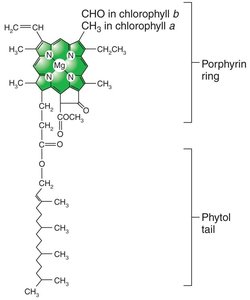
Plants contain multiple pigments, primarily chlorophyll a and chlorophyll b, which are bound to proteins in the thylakoid membrane. The porphyrin ring in chlorophyll allows electrons to be delocalized and absorb light energy. The phytol tail anchors chlorophyll in the membrane.
Chlorophyll a – Main pigment in photosynthesis.
Chlorophyll b – Accessory pigment, broadens absorption spectrum.
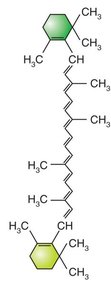
β-carotene – Another pigment, absorbs different wavelengths.
Absorption and Action Spectra
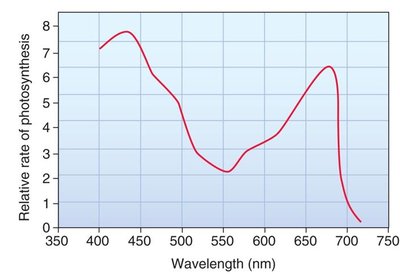
Having multiple pigments allows plants to absorb light at many different wavelengths, increasing the efficiency of light energy capture. The absorption spectrum shows which wavelengths are absorbed, while the action spectrum shows the rate of photosynthesis at different wavelengths.
Absorption Spectrum – Graph of light absorption versus wavelength.
Action Spectrum – Graph of photosynthetic rate versus wavelength.
Photosystems and Electron Transport
Photosystem II and Photosystem I
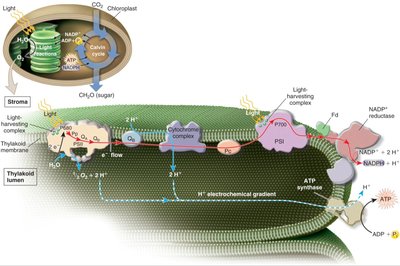
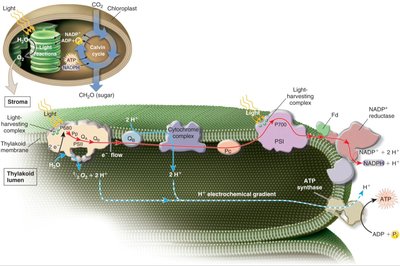
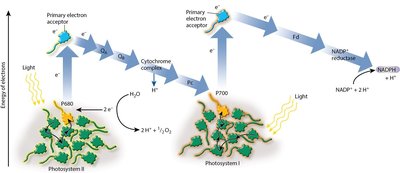
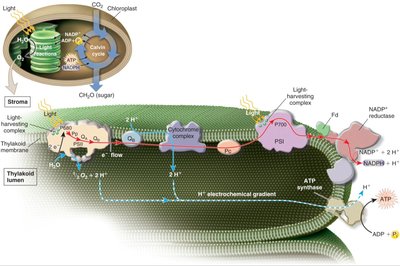
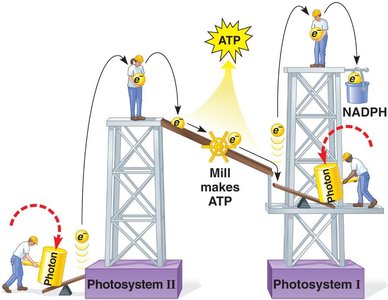
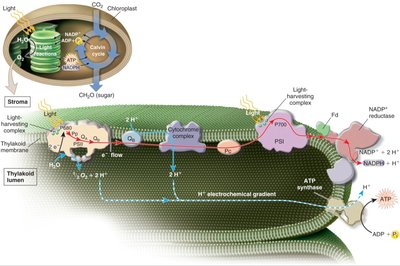
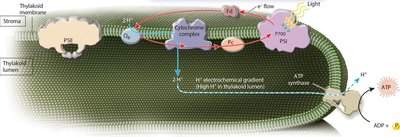
Light is absorbed by two distinct protein-pigment complexes: Photosystem II (PSII) and Photosystem I (PSI). Electrons are excited and transferred through an electron transport chain (ETC), generating ATP, NADPH, and O2.
Linear Electron Flow – Involves both PSII and PSI, produces ATP, NADPH, and O2.
Cyclic Photophosphorylation – Involves PSI only, produces additional ATP.
ATP and NADPH Production
ATP and NADPH are produced in the light reactions and are required for the Calvin Cycle. The Z scheme describes the energy changes of electrons as they move through PSII and PSI.
ATP – Produced by ATP synthase using the H+ gradient.
NADPH – Produced by reduction of NADP+ at the end of the ETC.
The Calvin Cycle
Carbon Fixation and Energy Requirements
The Calvin Cycle fixes carbon by converting CO2 into carbohydrates. It requires a massive input of energy: 18 ATP and 12 NADPH to incorporate 6 carbon atoms from CO2 into a carbohydrate.
Phase 1: Carbon Fixation – CO2 is fixed into RuBP (ribulose bisphosphate).
Phase 2: Reduction – 3-phosphoglycerate is reduced to G3P (glyceraldehyde-3-phosphate).
Phase 3: Regeneration – RuBP is regenerated to continue the cycle.
Overall Photosynthesis Equation
The overall process of photosynthesis can be summarized by the following equation:
Light Energy + 6CO2 + 12H2O → C6H12O6 + 6O2 + 6H2O
Light reactions produce ATP, NADPH, and O2; the Calvin Cycle produces sugars and H2O.
Summary Table: Products of Photosynthesis Stages
Stage | Location | Inputs | Outputs |
|---|---|---|---|
Light Reactions | Thylakoid Membrane | Light, H2O | ATP, NADPH, O2 |
Calvin Cycle | Stroma | CO2, ATP, NADPH | Sugars, H2O |
Key Terms: Photosystem, Electron Transport Chain, ATP, NADPH, Calvin Cycle, Carbon Fixation, Pigment, Chlorophyll, Photon, Excited State, Ground State.
