 Indietro
Photosynthesis: Light Reactions, Calvin Cycle, and Adaptations
Guida di studio - Note intelligenti
 Appunti personalizzati basati sui tuoi materiali, ampliati con definizioni chiave, esempi e contesto.
Photosynthesis
Overview of Photosynthesis
Photosynthesis is the process by which plants, algae, and some bacteria convert light energy into chemical energy, producing glucose and oxygen from carbon dioxide and water. It consists of two main stages: the light reactions and the Calvin cycle.
Light Reactions: Occur in the thylakoid membranes; convert solar energy to chemical energy (ATP and NADPH).
Calvin Cycle: Occurs in the stroma; uses ATP and NADPH to fix carbon dioxide and synthesize sugars.
Light Reactions
Photosystems and Electron Transport
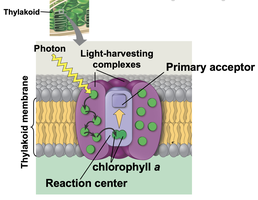
Light reactions begin with the absorption of photons by chlorophyll molecules in the photosystems. There are two main photosystems: Photosystem II (PSII) and Photosystem I (PSI).
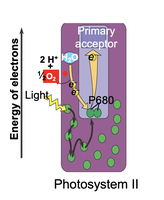
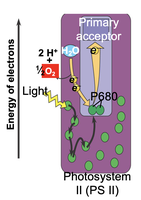
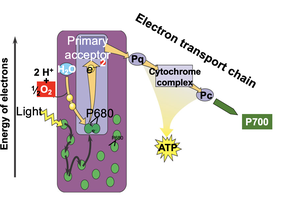
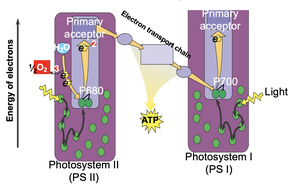
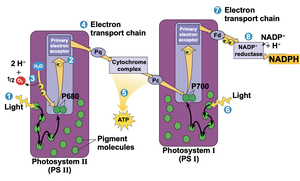
Photosystem II (PSII): Absorbs light, splits water to release O2, and transfers electrons to the electron transport chain.
Photosystem I (PSI): Absorbs light and transfers electrons to NADP+ to form NADPH.
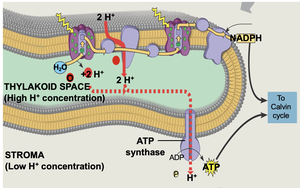
Electron Transport Chain: Electrons move through a series of carriers, generating a proton gradient used to produce ATP.
Linear Electron Flow
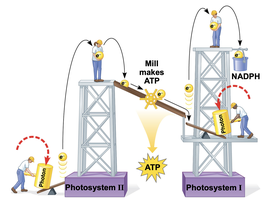
Linear electron flow involves both photosystems and results in the production of ATP and NADPH.
Electrons from water are excited by light in PSII, passed through the electron transport chain, and eventually reach PSI.
Electrons are re-excited in PSI and used to reduce NADP+ to NADPH.
ATP is produced via chemiosmosis as protons flow through ATP synthase.
Cyclic Electron Flow
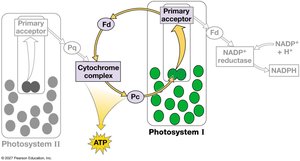
Cyclic electron flow occurs when electrons from PSI are cycled back to the electron transport chain, producing ATP but not NADPH.
Purpose: Provides additional ATP for the Calvin cycle.
Photoprotection: Helps protect plants in intense light conditions.
Some bacteria: Only use cyclic electron flow.
The Calvin Cycle
Carbon Fixation
The Calvin cycle uses ATP and NADPH to convert CO2 into sugars. It is an anabolic process and occurs in the stroma of the chloroplast.
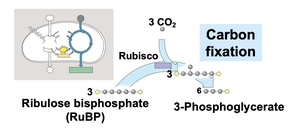
Step 1: Carbon Fixation: CO2 is attached to ribulose bisphosphate (RuBP) by the enzyme Rubisco, forming a six-carbon intermediate that splits into two molecules of 3-phosphoglycerate.
Step 2: Reduction: 3-phosphoglycerate is converted to glyceraldehyde-3-phosphate (G3P) using ATP and NADPH.
Step 3: Regeneration: Some G3P is used to regenerate RuBP, enabling the cycle to continue.
Energy and Reduction
More reduced molecules: Contain more energy (e.g., NADPH vs. NADP+).
Reduction: Addition of electrons to a molecule, increasing its energy content.
Photorespiration and Adaptations
Photorespiration
Photorespiration occurs when O2 substitutes for CO2 in the active site of Rubisco, leading to the oxidation of RuBP and loss of energy.
Photorespiration: Mostly a waste of energy; occurs when the Calvin cycle runs in the wrong direction.
Hot and dry climates: Plants close stomata to reduce water loss, causing O2 to accumulate and increasing photorespiration risk.
C4 and CAM Plant Adaptations
Plants in hot and dry environments have evolved mechanisms to minimize photorespiration.
C4 Plants: (e.g., corn, sugarcane) Fix CO2 in different cells using phosphoenolpyruvate carboxylase (PEPC), which has no affinity for O2, thus avoiding photorespiration.
CAM Plants: (e.g., succulents) Open stomata at night to fix CO2 with PEPC, store it as organic acids, and release CO2 during the day for the Calvin cycle.
Plant Type | CO2 Fixation Enzyme | Photorespiration Risk | Habitat |
|---|---|---|---|
C3 (Typical) | Rubisco | High | Temperate |
C4 | PEPC | Low | Dry |
CAM | PEPC (night) | Low | Very dry |
PEPC Advantages: High affinity for CO2, no affinity for O2, thus no risk of photorespiration.
Example: Corn (C4 plant) and cacti (CAM plant) thrive in hot, dry climates due to these adaptations. Additional info: C4 and CAM pathways are evolutionary solutions to the challenge of photorespiration, allowing plants to maximize photosynthetic efficiency under environmental stress.
