 Indietro
Photosynthesis: Light Reactions, Pigments, and the Calvin Cycle
Guida di studio - Note intelligenti
 Appunti personalizzati basati sui tuoi materiali, ampliati con definizioni chiave, esempi e contesto.
Photosynthesis: Harnessing Light Energy
Photopigments and Light Absorption
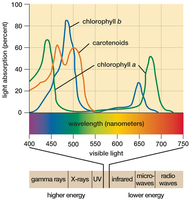
Photosynthetic organisms use specialized pigments to capture light energy for the process of photosynthesis. The main pigments include chlorophyll a, chlorophyll b, and accessory pigments such as carotenoids and anthocyanins.
Chlorophyll a: The primary pigment directly involved in the light reactions; absorbs mainly blue-violet and red light.
Chlorophyll b: An accessory pigment that absorbs mainly blue and orange light, expanding the range of light usable for photosynthesis.
Accessory pigments: Carotenoids and anthocyanins absorb wavelengths not efficiently captured by chlorophylls and transfer the energy to chlorophyll a. They also protect the plant by dissipating excess light energy.
Accessory Pigments: Carotenoids and Anthocyanins
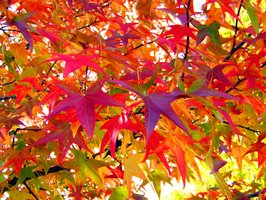
Accessory pigments contribute to the vivid colors seen in plants, especially during autumn. They also play protective roles by absorbing and dissipating excessive light energy that could damage chlorophyll.
Carotenoids: Responsible for yellow-orange colors in leaves and some fruits. They are also important human nutrients (e.g., beta-carotene and lycopene).
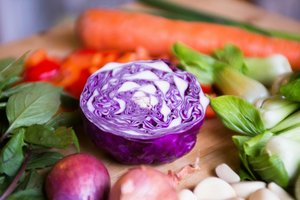
Anthocyanins: Provide deep purples and blues, attracting pollinators and offering additional photoprotection.
Carotenoids as Human Nutrients
Some carotenoids are essential nutrients for humans:
Beta-carotene: Found in pumpkins, sweet potatoes, and carrots; converted to vitamin A in the body.
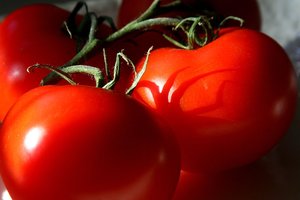
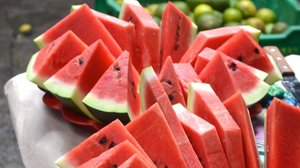
Lycopene: Found in tomatoes, watermelon, and red peppers; acts as an antioxidant and is studied for potential anti-cancer properties.


Chloroplast Structure and Function
Organization of the Chloroplast
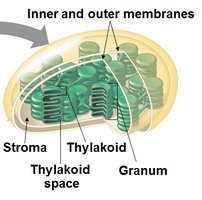
Chloroplasts are the organelles where photosynthesis occurs. They have a double-membrane envelope and contain internal structures crucial for capturing light energy.
Stroma: The fluid-filled compartment inside the inner membrane, containing enzymes for the Calvin cycle.
Thylakoids: Interconnected membranous sacs suspended in the stroma; contain chlorophyll and are the site of the light reactions.
Grana: Stacks of thylakoids that increase the surface area for light absorption.
Overview of Photosynthesis
Two Main Stages
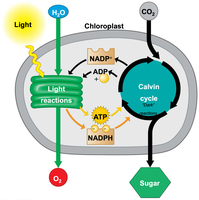
Photosynthesis consists of two interconnected stages:
Light-dependent reactions: Convert solar energy into chemical energy (ATP and NADPH).
Calvin Cycle (Light-independent reactions): Uses ATP, NADPH, and CO2 to synthesize carbohydrates.
Light Reactions
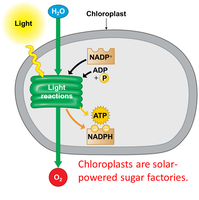
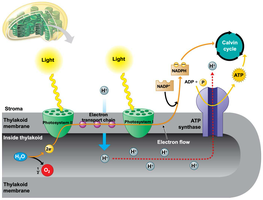
The light reactions occur in the thylakoid membranes and transform light energy into ATP and NADPH. Water is split, providing electrons and releasing O2 as a by-product.
Chlorophyll absorbs solar energy and excites electrons.
Electron transport chain (ETC): Transfers electrons, pumps H+ ions, and generates ATP via ATP synthase.
NADPH: Electron carrier used in the Calvin cycle.
Calvin Cycle
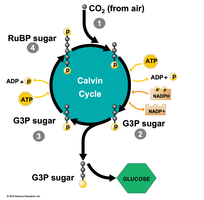
The Calvin cycle occurs in the stroma and incorporates atmospheric CO2 into organic molecules (carbon fixation), using ATP and NADPH from the light reactions to build sugars.
Carbon fixation: Incorporation of CO2 into organic molecules.
G3P (glyceraldehyde-3-phosphate): The three-carbon sugar produced, which can be converted into glucose.
Photosystems and Electron Flow
Photosystems I and II
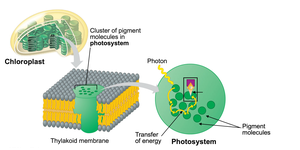
Photosystems are clusters of pigment molecules in the thylakoid membrane that capture light energy and initiate electron flow.
Photosystem II: Contains the water-splitting enzyme; initiates electron flow by extracting electrons from water.
Photosystem I: Receives electrons and further energizes them for NADPH production.
Electron Transport Chain and ATP Synthesis
As electrons move through the ETC, their energy is used to pump H+ ions, creating a gradient that drives ATP synthesis. The final electron acceptor is NADP+, forming NADPH.
ATP synthase: Enzyme that synthesizes ATP using the energy from the H+ gradient.
Key difference: In cellular respiration, food provides electrons; in photosynthesis, light excites electrons.
Calvin Cycle: Inputs, Outputs, and Enzymes
Inputs and Outputs of the Calvin Cycle
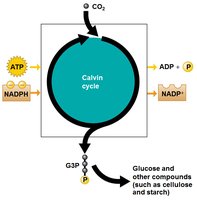
The Calvin cycle uses CO2, ATP, and NADPH to produce G3P, which can be converted into glucose or recycled to regenerate RuBP.
Inputs | Outputs |
|---|---|
CO2 (from air) | G3P (sugar) |
ATP (from light reactions) | ADP (recycled) |
NADPH (from light reactions) | NADP+ (recycled) |
RuBisCo and RuBP Cycling
RuBisCo is the enzyme that catalyzes the first step of the Calvin cycle, attaching CO2 to RuBP (ribulose bisphosphate). RuBP is a five-carbon molecule that is regenerated in the cycle, allowing the process to continue efficiently.
RuBisCo: Most abundant protein on Earth; catalyzes carbon fixation.
G3P: Can be used to make glucose or recycled to regenerate RuBP.
Photosynthesis and Cellular Respiration: Energy Cycling
Relationship Between Photosynthesis and Respiration
The products of photosynthesis (glucose and O2) are the reactants for cellular respiration, and vice versa. This cyclical relationship is fundamental to energy flow in ecosystems.
Photosynthesis: Converts CO2 and H2O into glucose and O2 using light energy.
Cellular respiration: Breaks down glucose and O2 to release energy, producing CO2 and H2O as waste products.
Evolutionary Connections
Photosynthesis and the Evolution of Life
The emergence of photosynthetic organisms dramatically increased atmospheric O2, enabling the evolution of aerobic respiration and complex life forms. Glycolysis, a universal energy-harvesting process, predates photosynthesis and is found in all domains of life.
Ancient prokaryotes: Used glycolysis before the atmosphere contained significant O2.
Photosynthesis: Led to the accumulation of O2 and the evolution of aerobic metabolism.
Summary Table: Key Steps in Photosynthesis
Stage | Main Events | Location |
|---|---|---|
Light Reactions | Light absorption, water splitting, ATP & NADPH production, O2 release | Thylakoid membranes |
Calvin Cycle | CO2 fixation, G3P synthesis, RuBP regeneration | Stroma |
