 Indietro
Photosynthesis: Mechanisms, Adaptations, and Applications
Guida di studio - Note intelligenti
 Appunti personalizzati basati sui tuoi materiali, ampliati con definizioni chiave, esempi e contesto.
Photosynthesis Overview
Introduction to Photosynthesis
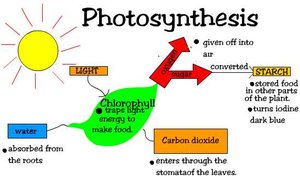
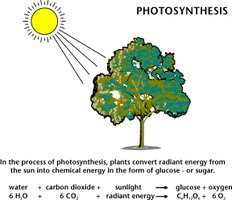
Photosynthesis is the process by which plants, algae, and some bacteria convert light energy into chemical energy, producing organic molecules from inorganic substances. This process is fundamental to life on Earth, as it provides the primary energy source for most ecosystems. - Key Point 1: Photosynthesis uses sunlight to synthesize carbohydrates from carbon dioxide and water. - Key Point 2: Oxygen is released as a byproduct. - Example: The general equation for photosynthesis is: 
Chloroplast Structure and Function
Chloroplasts: The Site of Photosynthesis
Chloroplasts are specialized organelles found in plant cells and are the site where photosynthesis occurs. Their internal structure is optimized for capturing light and facilitating the biochemical reactions of photosynthesis. - Key Point 1: The thylakoid membrane contains chlorophyll and other pigments essential for light absorption. - Key Point 2: The stroma is the site of the Calvin Cycle, where carbon fixation occurs. - Example: Granum stacks increase surface area for light reactions. 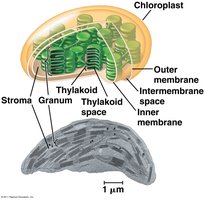
Photosynthesis as a Redox Reaction
Redox Chemistry in Photosynthesis
Photosynthesis is a redox reaction in which water is oxidized and carbon dioxide is reduced. Electrons from water are transferred to carbon dioxide, increasing their potential energy and forming glucose. - Key Point 1: Water is split, releasing electrons and protons. - Key Point 2: The reaction is endergonic, requiring energy input from sunlight. - Example: The overall redox equation: 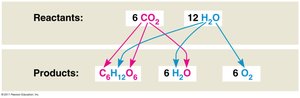
Light: The Energy Source
Electromagnetic Spectrum and Visible Light
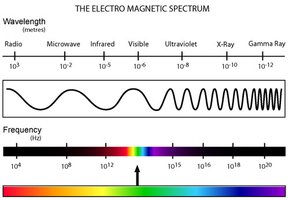
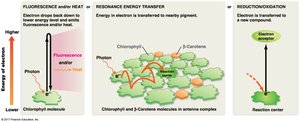
Light is a form of electromagnetic radiation, and only a small portion of the spectrum (visible light) is used in photosynthesis. Photons are discrete packets of energy that drive the reactions in chloroplasts. - Key Point 1: Visible light ranges from 380 to 750 nm. - Key Point 2: Shorter wavelengths have higher energy. - Example: Plants absorb specific wavelengths for photosynthesis. 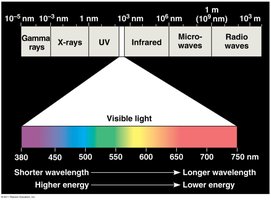
Pigments and Light Absorption
Types of Pigments
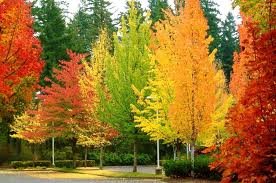
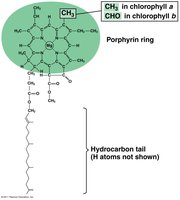
Pigments are substances that absorb visible light. Chlorophyll a and b are the primary pigments in plants, while carotenoids serve as accessory pigments. - Key Point 1: Different pigments absorb different wavelengths, determining leaf color. - Key Point 2: Accessory pigments protect against excess light and oxidative damage. - Example: Leaves change color in autumn as chlorophyll degrades, revealing carotenoids. 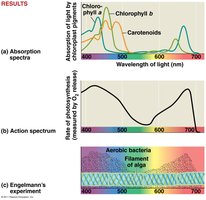
Stages of Photosynthesis
Light Reactions and Calvin Cycle
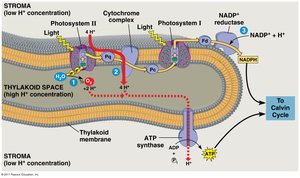
Photosynthesis consists of two main stages: the light reactions and the Calvin Cycle. The light reactions convert solar energy into chemical energy, while the Calvin Cycle uses this energy to fix carbon. - Key Point 1: Light reactions occur in the thylakoid membrane, producing ATP, NADPH, and O2. - Key Point 2: The Calvin Cycle occurs in the stroma, fixing CO2 into sugars. - Example: ATP and NADPH generated in light reactions are used in the Calvin Cycle. 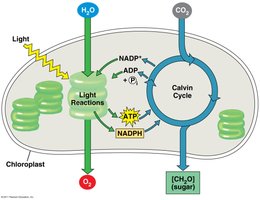
Light Reactions
Mechanism of Light Reactions
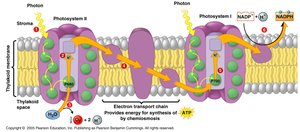
Light reactions involve photosystems that capture light energy and transfer electrons through an electron transport chain, resulting in the production of ATP and NADPH. - Key Point 1: Photosystems contain light-harvesting complexes and reaction-center complexes. - Key Point 2: Water is split, releasing O2 as a byproduct. - Example: Linear electron flow produces both ATP and NADPH. 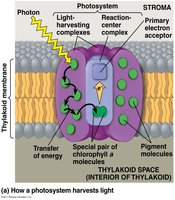
Cyclic Electron Flow
Cyclic electron flow is an alternative pathway in which electrons from photosystem I are cycled back to the electron transport chain, producing ATP but not NADPH. - Key Point 1: Provides additional ATP for the Calvin Cycle. - Key Point 2: Does not produce O2. 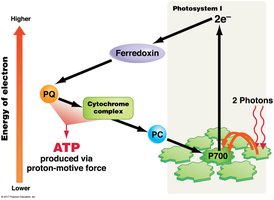
The Calvin Cycle
Phases of the Calvin Cycle
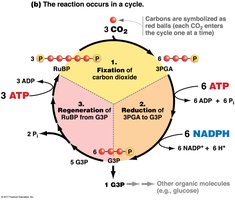
The Calvin Cycle uses ATP and NADPH to fix CO2 and produce G3P, a three-carbon sugar. The cycle consists of three phases: carbon fixation, reduction, and regeneration of the CO2 acceptor. - Key Point 1: Rubisco catalyzes the fixation of CO2 to RuBP. - Key Point 2: For each G3P produced, the cycle uses 9 ATP and 6 NADPH. - Example: Five G3P molecules are used to regenerate RuBP; only one is exported for biosynthesis. 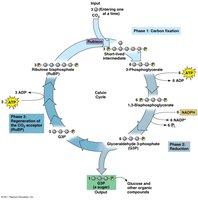
Rubisco and Photorespiration
Limitations of Rubisco
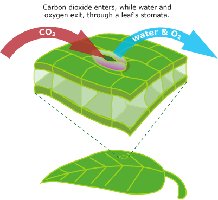
Rubisco can fix O2 instead of CO2, leading to photorespiration, which consumes ATP and reduces photosynthetic efficiency. This is problematic in hot, dry climates where stomata close to conserve water, increasing O2 concentration. - Key Point 1: Photorespiration decreases carbohydrate production. - Key Point 2: Plants have evolved adaptations to minimize photorespiration. 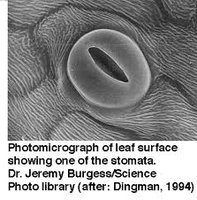
Alternative Mechanisms for CO2 Fixation
C3, C4, and CAM Plants
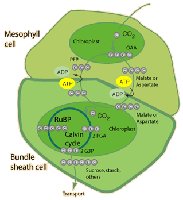
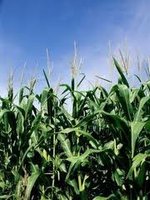
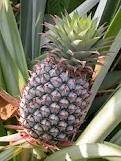
Plants have developed alternative mechanisms to increase carbon fixation and reduce photorespiration. C3 plants use the standard Calvin Cycle, while C4 and CAM plants have adaptations for hot, dry environments. - Key Point 1: C4 plants separate carbon fixation spatially; CAM plants separate it temporally. - Key Point 2: PEP carboxylase is used in C4 and CAM plants to initially fix CO2. - Example: Corn is a C4 plant; pineapple is a CAM plant. 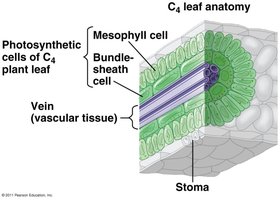
Fate of Photosynthetic Products
Utilization of Sugars
The sugars produced by photosynthesis are used for cellular respiration, transported throughout the plant, linked to form cellulose, or stored as starch. - Key Point 1: About 50% of sugar is used for energy. - Key Point 2: Excess sugar is stored or used for structural components.
Historical Experiments and Applications
van Helmont's Experiment
van Helmont tested the hypothesis that plant mass comes from water, but later experiments showed that most mass comes from CO2 fixed during photosynthesis. - Key Point 1: Light and water are essential for photosynthesis. - Key Point 2: The added mass of a growing plant is primarily from carbon dioxide.
Plant Type | CO2 Fixation Mechanism | Adaptation |
|---|---|---|
C3 | Rubisco (Calvin Cycle) | Standard photosynthesis; susceptible to photorespiration |
C4 | PEP carboxylase (spatial separation) | Minimizes photorespiration; adapted to hot climates |
CAM | PEP carboxylase (temporal separation) | Stomata open at night; adapted to arid environments |
Additional info: The notes have been expanded to include definitions, examples, and a comparison table for plant adaptations.
