 Indietro
Photosynthesis: Mechanisms, Adaptations, and Experimental Analysis
Guida di studio - Note intelligenti
 Appunti personalizzati basati sui tuoi materiali, ampliati con definizioni chiave, esempi e contesto.
Photosynthesis
Introduction to Photosynthesis
Photosynthesis is the process by which plants, algae, and some prokaryotes convert light energy into chemical energy, producing organic molecules from inorganic substances. This process is fundamental to life on Earth, as it provides the primary energy source for most ecosystems.
Autotrophs: Organisms that produce their own food from simple substances in their environment. Plants are photoautotrophs, using light as an energy source.
Heterotrophs: Organisms that cannot make their own food and must obtain organic molecules by consuming other organisms.
Evolution of Photosynthesis
Photosynthesis first evolved in prokaryotic organisms, such as cyanobacteria.
Cyanobacteria played a crucial role in oxygenating the early Earth's atmosphere.
Prokaryotic photosynthetic pathways laid the foundation for eukaryotic photosynthesis.
Site and Structure of Photosynthesis
Leaves are the primary site of photosynthesis in most plants.
Chloroplasts are the organelles where photosynthesis occurs, mainly in the mesophyll cells of leaves.
Stomata are pores that allow gas exchange (CO2 in, O2 out).
Chloroplasts have a double membrane, internal fluid called stroma, and stacks of thylakoids called grana.
Chlorophyll is the green pigment embedded in thylakoid membranes, essential for capturing light energy.
Photosynthesis Equation
The overall chemical equation for photosynthesis is:
This process involves the splitting of water and the reduction of carbon dioxide to form glucose.
It is a redox reaction: CO2 is reduced to sugar, and H2O is oxidized to O2.
Stages of Photosynthesis
Light Reactions: Convert solar energy to chemical energy (ATP and NADPH); occur in the thylakoid membranes.
Calvin Cycle: Uses ATP and NADPH to reduce CO2 to sugar; occurs in the stroma.
Light and Pigments
Properties of Light
Light is electromagnetic energy, traveling in waves and composed of photons. The visible spectrum ranges from 380 nm to 750 nm.
Shorter wavelengths (e.g., violet, blue) have higher energy.
Longer wavelengths (e.g., red) have lower energy.
When light strikes an object, it can be reflected, transmitted, or absorbed.
Pigments absorb specific wavelengths; the color seen is the reflected wavelength.
Photosynthetic Pigments
Chlorophyll a: Primary pigment, blue-green, directly involved in light reactions.
Chlorophyll b: Accessory pigment, yellow-green, broadens the spectrum of light used.
Carotenoids: Accessory pigments, yellow-orange, provide photoprotection by dissipating excess energy.
The Light Reactions
Overview of Light Reactions
Light reactions occur in the thylakoid membranes and convert light energy into chemical energy stored in ATP and NADPH. Water is split, releasing O2 as a by-product.
Inputs: H2O, ADP, NADP+
Outputs: O2, ATP, NADPH
Photosystems and Electron Flow
Photosystem II (PSII): Absorbs light at 680 nm (P680), initiates electron transport by splitting water.
Photosystem I (PSI): Absorbs light at 700 nm (P700), transfers electrons to NADP+ to form NADPH.
Electron flow from PSII to PSI generates a proton gradient used by ATP synthase to produce ATP.
Summary of Light Reactions
Solar energy is converted to chemical energy (ATP and NADPH).
Water is split, providing electrons and protons, and releasing O2.
NADP+ is reduced to NADPH.
ATP is generated by photophosphorylation.
The Calvin Cycle
Overview of the Calvin Cycle
The Calvin cycle uses ATP and NADPH from the light reactions to fix CO2 and produce the three-carbon sugar G3P. The cycle must turn three times to produce one net G3P molecule.
Inputs: 3 CO2, 9 ATP, 6 NADPH
Outputs: 1 G3P, 9 ADP, 6 NADP+
Phases of the Calvin Cycle
Carbon Fixation: CO2 is attached to RuBP by the enzyme rubisco, forming 3-phosphoglycerate.
Reduction: 3-phosphoglycerate is phosphorylated by ATP and reduced by NADPH to form G3P.
Regeneration of RuBP: Most G3P is used to regenerate RuBP, enabling the cycle to continue.
Photorespiration and Plant Adaptations
Photorespiration: On hot, dry days, stomata close to conserve water, leading to low CO2 and high O2 inside the leaf. Rubisco binds O2 instead of CO2, consuming ATP and releasing CO2 without producing sugar.
This process is wasteful and reduces photosynthetic efficiency.
Adaptations to Photorespiration
C4 Plants: Spatially separate carbon fixation and the Calvin cycle. CO2 is initially fixed into a 4-carbon compound in mesophyll cells, then transported to bundle sheath cells where the Calvin cycle occurs. Examples: maize, sugarcane.
CAM Plants: Temporally separate carbon fixation and the Calvin cycle. Stomata open at night to fix CO2 into organic acids, which release CO2 during the day for the Calvin cycle. Examples: pineapples, cacti, succulents.
Experimental Analysis: Effect of Light Wavelength on Plant Growth
Practice FRQ: Light Wavelength and Plant Growth
A student exposed tomato plants to three different wavelengths of light (490 nm blue, 550 nm green, 680 nm red) and measured plant height over one week. All other conditions were kept constant.
Wavelength (nm) | Color | Growth Outcome |
|---|---|---|
490 | Blue | Steady increase in height |
550 | Green | Decrease in height |
680 | Red | Steady increase in height |
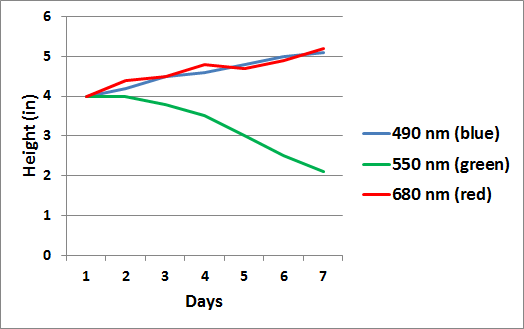
Wavelength with least growth: 550 nm (green)
Explanation: Green light is least effective for photosynthesis because chlorophyll reflects green wavelengths rather than absorbing them. As a result, plants exposed to green light alone receive less usable energy for growth.
Practice FRQ: Rubisco and Photorespiration
Rubisco can bind to either CO2 or O2 in the Calvin cycle. A student claims that photorespiration is a metabolic relic, as early Earth had little oxygen. This claim is supported because rubisco evolved in an environment with low O2, so there was little selective pressure to distinguish between CO2 and O2. As atmospheric O2 increased, photorespiration became a disadvantage, leading to the evolution of C4 and CAM pathways in some plants.
