 Indietro
Photosynthesis: Mechanisms, Adaptations, and Importance Ch 10
Guida di studio - Note intelligenti
 Appunti personalizzati basati sui tuoi materiali, ampliati con definizioni chiave, esempi e contesto.
Photosynthesis
Overview of Photosynthesis
Photosynthesis is the process by which plants, algae, and some bacteria convert solar energy into chemical energy, producing organic molecules and oxygen from carbon dioxide and water. This process sustains almost all life on Earth by providing food and atmospheric oxygen.
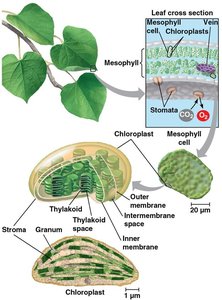
Photosynthesis occurs in the chloroplasts of plant cells, primarily within the mesophyll tissue of leaves.
It is a redox process: carbon dioxide is reduced to form glucose, and water is oxidized to release oxygen.
The overall chemical equation for photosynthesis is:

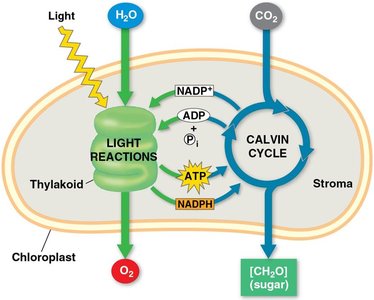
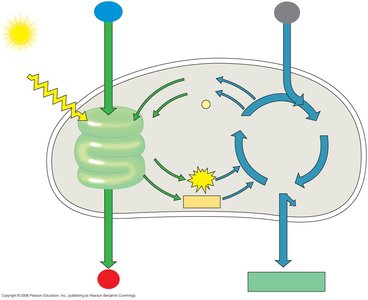
Photosynthesis consists of two main stages: the light reactions and the Calvin cycle.
Location and Structure of Photosynthesis in Plants
Photosynthesis takes place in the chloroplasts, which are specialized organelles found mainly in the mesophyll cells of leaves. The structure of the chloroplast is essential for its function in capturing light energy and converting it into chemical energy.
Chloroplasts contain an outer membrane, an inner membrane, and an internal system of interconnected sacs called thylakoids, which are stacked into grana.
The stroma is the fluid-filled space surrounding the thylakoids, where the Calvin cycle occurs.
Gas exchange occurs through stomata, allowing CO2 to enter and O2 to exit the leaf.
The Two Stages of Photosynthesis
Photosynthesis is divided into two stages: the light reactions and the Calvin cycle. These stages are interconnected and occur in different parts of the chloroplast.
Light reactions (in the thylakoid membranes):
Split water molecules, releasing O2 as a by-product.
Generate ATP and NADPH by transferring electrons and protons.
Calvin cycle (in the stroma):
Uses ATP and NADPH to convert CO2 into sugars (G3P).
Regenerates its starting molecule, ribulose bisphosphate (RuBP).
The Nature of Sunlight
Electromagnetic Spectrum and Light
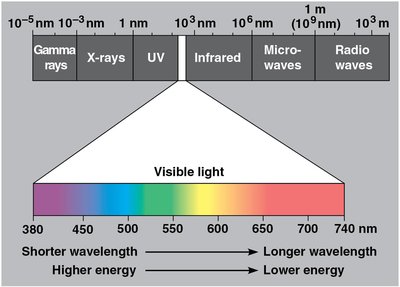
Light is a form of electromagnetic energy that travels in waves. The electromagnetic spectrum encompasses all wavelengths of electromagnetic radiation, but only a small portion (visible light) is used in photosynthesis.
Wavelength is the distance between the crests of waves and determines the energy of light; shorter wavelengths have higher energy.
Visible light ranges from about 380 nm (violet) to 740 nm (red).
Photosynthetic Pigments
Pigments are molecules that absorb specific wavelengths of light. The main pigment in plants is chlorophyll, which absorbs violet-blue and red light but reflects green, giving leaves their color.
Different pigments absorb different wavelengths, maximizing the use of solar energy.
Light also behaves as particles called photons, each with a fixed energy inversely related to its wavelength.
The Light Reactions
Photosystems and Electron Flow
Light reactions occur in the thylakoid membranes and involve two types of photosystems: Photosystem II (PS II) and Photosystem I (PS I). These systems work together to transfer electrons from water to NADP+, forming NADPH, and to generate ATP.
Photosystem II (PS II) absorbs light best at 680 nm (P680) and initiates the splitting of water.
Photosystem I (PS I) absorbs light best at 700 nm (P700) and facilitates the transfer of electrons to NADP+.
Electrons move linearly from water through PS II, the electron transport chain, PS I, and finally to NADP+.
The energy released during electron transport is used to pump protons, creating a gradient that drives ATP synthesis (photophosphorylation).
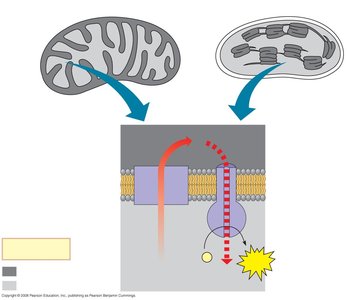
Comparison of Chemiosmosis in Chloroplasts and Mitochondria
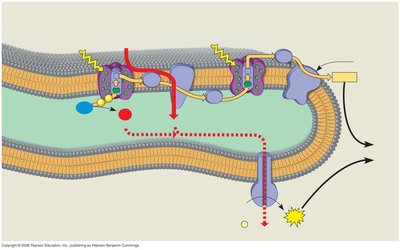
Both chloroplasts and mitochondria use chemiosmosis to generate ATP, but the energy sources and locations of proton gradients differ.
In mitochondria, chemical energy from food is used to pump protons into the intermembrane space; ATP is synthesized as protons flow back into the matrix.
In chloroplasts, light energy is used to pump protons into the thylakoid space; ATP is synthesized as protons flow back into the stroma.
Cyclic Electron Flow
In addition to linear electron flow, some electrons cycle back to PS I, generating extra ATP but not NADPH. This process is called cyclic electron flow and helps balance the ATP/NADPH ratio required for the Calvin cycle.
The Calvin Cycle
Phases of the Calvin Cycle
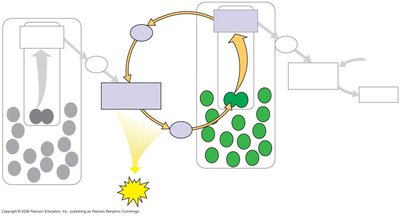
The Calvin cycle uses ATP and NADPH from the light reactions to fix carbon dioxide and produce sugars. It consists of three main phases:
Carbon fixation: CO2 is attached to RuBP by the enzyme rubisco, forming 3-phosphoglycerate.
Reduction: ATP and NADPH are used to convert 3-phosphoglycerate into glyceraldehyde-3-phosphate (G3P), a sugar.
Regeneration: Some G3P is used to regenerate RuBP, enabling the cycle to continue.

For the net synthesis of one G3P, the cycle must turn three times, fixing three molecules of CO2.
Photorespiration and Adaptations
Photorespiration
Photorespiration is a process that occurs when rubisco adds O2 instead of CO2 to RuBP, leading to the consumption of energy and release of CO2 without producing sugar. This process is considered wasteful and is favored under hot, dry conditions when stomata are closed.
Photorespiration may be an evolutionary relic from a time when atmospheric O2 was much lower.
It can significantly reduce the efficiency of photosynthesis in C3 plants.
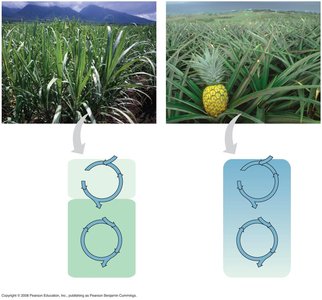
C4 and CAM Plant Adaptations
Some plants have evolved mechanisms to minimize photorespiration and increase photosynthetic efficiency in hot, arid environments.
C4 plants (e.g., sugarcane):
Fix CO2 into four-carbon compounds in mesophyll cells using PEP carboxylase, which has a higher affinity for CO2 than rubisco.
These compounds are transported to bundle-sheath cells, where CO2 is released for use in the Calvin cycle.
CAM plants (e.g., pineapple):
Open stomata at night to fix CO2 into organic acids, which release CO2 during the day for the Calvin cycle.
This adaptation allows CAM plants to conserve water in arid conditions.
The Importance of Photosynthesis
Photosynthesis is essential for life on Earth. It provides the organic molecules and oxygen required by most living organisms. Plants store excess sugar as starch and use it for growth and development. Additionally, photosynthesis is the primary source of atmospheric oxygen.
Summary Table: Comparison of C3, C4, and CAM Plants
Plant Type | Initial CO2 Fixation | Key Enzyme | Adaptation |
|---|---|---|---|
C3 | 3-carbon compound (3-phosphoglycerate) | Rubisco | Most common; susceptible to photorespiration |
C4 | 4-carbon compound (oxaloacetate) | PEP carboxylase | Spatial separation of steps; minimizes photorespiration |
CAM | 4-carbon organic acids (at night) | PEP carboxylase | Temporal separation of steps; conserves water |
Key Terms and Concepts
Photosynthesis: Conversion of light energy to chemical energy in plants.
Chloroplast: Organelle where photosynthesis occurs.
Thylakoid: Membranous sac within chloroplasts; site of light reactions.
Stroma: Fluid surrounding thylakoids; site of Calvin cycle.
Rubisco: Enzyme that catalyzes CO2 fixation in the Calvin cycle.
Photorespiration: Process that consumes O2 and releases CO2 without producing ATP or sugar.
PEP carboxylase: Enzyme in C4 and CAM plants that fixes CO2 efficiently.
