 Indietro
Photosynthesis: Mechanisms, Adaptations, and Importance
Guida di studio - Note intelligenti
 Appunti personalizzati basati sui tuoi materiali, ampliati con definizioni chiave, esempi e contesto.
Photosynthesis: Feeding the Biosphere
Overview of Photosynthesis
Photosynthesis is the fundamental process by which plants, algae, and some bacteria convert solar energy into chemical energy, sustaining nearly all life on Earth. It occurs within specialized organelles called chloroplasts and provides both food and oxygen for the biosphere.
Definition: Photosynthesis is the conversion of light energy into chemical energy, stored in glucose and other organic molecules.
Importance: Directly or indirectly nourishes almost all living organisms.
General Equation:

Redox Process: CO2 is reduced to glucose; H2O is oxidized to O2.
Location and Structure of Photosynthesis
Chloroplast Structure and Leaf Anatomy
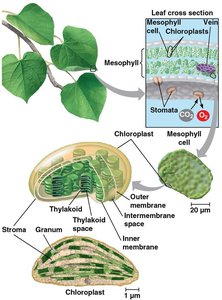
Photosynthesis takes place in chloroplasts, which are found mainly in the mesophyll cells of leaves. Chloroplasts contain internal membranes called thylakoids, organized into stacks (grana), surrounded by stroma.
Key Components: Outer membrane, inner membrane, intermembrane space, stroma, thylakoid membrane, thylakoid space, granum.
Leaf Anatomy: Mesophyll cells contain chloroplasts; stomata allow gas exchange (CO2 in, O2 out).
The Two Stages of Photosynthesis
Light Reactions and Calvin Cycle
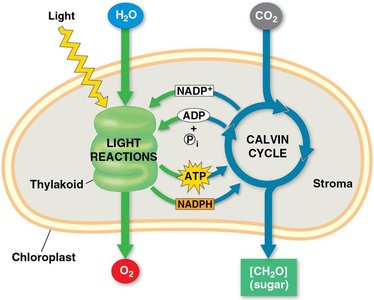
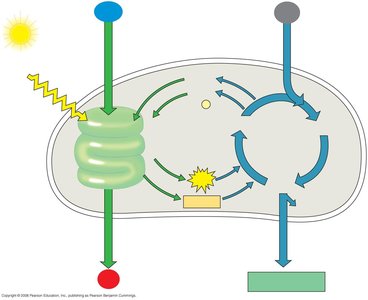
Photosynthesis consists of two main stages: the light reactions and the Calvin cycle. The light reactions occur in the thylakoid membranes and convert solar energy to chemical energy (ATP and NADPH). The Calvin cycle occurs in the stroma and uses ATP and NADPH to synthesize sugars from CO2.
Light Reactions: Split water, release O2, reduce NADP+ to NADPH, generate ATP by photophosphorylation.
Calvin Cycle: Uses ATP and NADPH to convert CO2 to sugar (G3P).
The Nature of Sunlight
Electromagnetic Spectrum and Light Energy
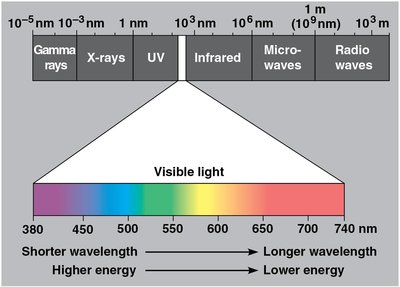
Light is a form of electromagnetic energy, traveling in waves. The wavelength determines the energy of light; shorter wavelengths have higher energy. Only a small portion of the spectrum, visible light, is used in photosynthesis.
Electromagnetic Spectrum: Includes gamma rays, X-rays, UV, visible light, infrared, microwaves, and radio waves.
Visible Light: 380–740 nm; used by photosynthetic pigments.
Photons: Discrete particles of light, each with a fixed energy.
Photosynthetic Pigments: Light Receptors
Types and Functions of Pigments
Pigments are molecules that absorb specific wavelengths of light. The main pigment in plants is chlorophyll, which absorbs violet-blue and red light, reflecting green. Different pigments allow plants to capture a broader range of the light spectrum.
Chlorophyll a: Primary pigment; absorbs blue-violet and red.
Chlorophyll b: Accessory pigment; broadens absorption.
Carotenoids: Accessory pigments; absorb additional wavelengths and protect against photo-damage.
Mechanisms of ATP and NADPH Production
Chemiosmosis in Chloroplasts and Mitochondria
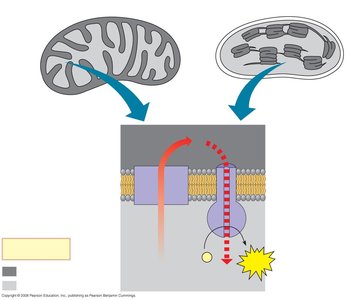
Both chloroplasts and mitochondria generate ATP by chemiosmosis, but use different energy sources. Chloroplasts use light energy, while mitochondria use chemical energy from food. The spatial organization of proton gradients differs between the two organelles.
Chloroplasts: Protons pumped into thylakoid space; ATP synthesized as protons diffuse back into stroma.
Mitochondria: Protons pumped into intermembrane space; ATP synthesized as protons diffuse back into matrix.
Photosystems and Electron Flow
Photosystem II and Photosystem I
Photosystems are complexes of pigments and proteins in the thylakoid membrane. Photosystem II (PS II) absorbs light at 680 nm (P680), while Photosystem I (PS I) absorbs at 700 nm (P700). Both participate in linear electron flow, which produces ATP and NADPH.
Linear Electron Flow: Electrons move from water through PS II and PS I to NADP+, forming NADPH.
Cyclic Electron Flow: Uses only PS I; produces ATP but not NADPH.
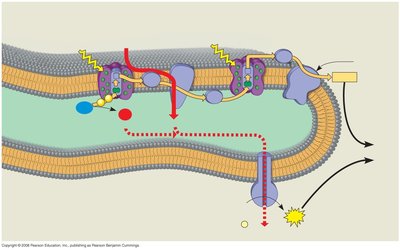
Stepwise Movement of Electrons
Light energy excites electrons in pigment molecules, which are transferred through a series of acceptors and carriers, ultimately reducing NADP+ to NADPH and generating ATP.
Water Splitting: Enzymes split H2O, releasing O2 and providing electrons.
Electron Transport Chain: Energy released creates a proton gradient for ATP synthesis.
NADPH Formation: Electrons reduce NADP+ to NADPH.
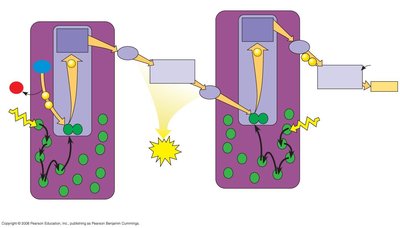
The Calvin Cycle
Phases and Functions
The Calvin cycle is a series of biochemical reactions that convert CO2 into sugar using ATP and NADPH. It consists of three phases: carbon fixation, reduction, and regeneration of the CO2 acceptor (RuBP).
Phase 1: Carbon Fixation – CO2 is attached to RuBP by the enzyme rubisco.
Phase 2: Reduction – ATP and NADPH are used to convert 3-phosphoglycerate into G3P (a sugar).
Phase 3: Regeneration – RuBP is regenerated to continue the cycle.
Output: For every three turns, one G3P is produced.

Photorespiration and Adaptations
Photorespiration: Consequences and Solutions
Photorespiration occurs when rubisco adds O2 instead of CO2 to RuBP, leading to a wasteful process that consumes energy and releases CO2 without producing sugar. This is problematic in hot, dry climates where stomata close to conserve water.
Photorespiration: Reduces photosynthetic efficiency; may be an evolutionary relic.
C3 Plants: Use standard Calvin cycle; susceptible to photorespiration.
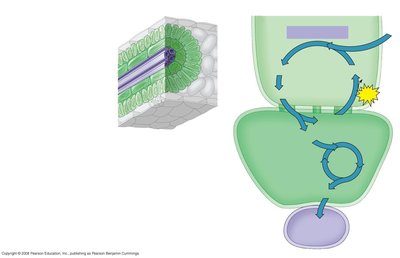
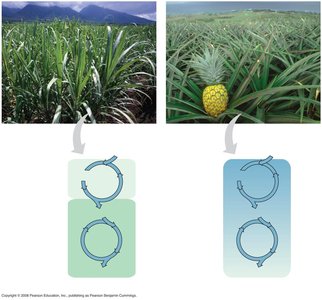
C4 Plants: Minimize photorespiration by spatially separating carbon fixation and Calvin cycle; use PEP carboxylase.
CAM Plants: Minimize photorespiration by temporally separating carbon fixation (night) and Calvin cycle (day).
The Importance of Photosynthesis
Ecological and Biological Significance
Photosynthesis is essential for life, providing food, oxygen, and the basis for most ecosystems. Plants store excess sugar as starch and produce the O2 necessary for aerobic respiration.
Food Production: Sugar made in chloroplasts supplies energy and carbon skeletons for cells.
Oxygen Production: Photosynthesis produces the O2 in our atmosphere.
Storage: Excess sugar is stored as starch in roots, tubers, seeds, and fruits.
Summary Table: Photosynthetic Adaptations
Plant Type | Adaptation | Mechanism | Benefit |
|---|---|---|---|
C3 | Standard Calvin cycle | CO2 fixed by rubisco | Efficient in cool, moist environments |
C4 | Spatial separation | CO2 fixed by PEP carboxylase in mesophyll; Calvin cycle in bundle-sheath cells | Minimizes photorespiration in hot, dry climates |
CAM | Temporal separation | CO2 fixed at night; Calvin cycle during day | Conserves water in arid environments |
Key Concepts for Exam Preparation
Describe the structure of a chloroplast and its role in photosynthesis.
Explain the relationship between action spectrum and absorption spectrum.
Trace the movement of electrons in linear and cyclic electron flow.
Compare oxidative phosphorylation in mitochondria and photophosphorylation in chloroplasts.
Describe the role of ATP and NADPH in the Calvin cycle.
Discuss the consequences of photorespiration and adaptations in C4 and CAM plants.
