 Indietro
Photosynthesis: Chapter 7
Guida di studio - Note intelligenti
 Appunti personalizzati basati sui tuoi materiali, ampliati con definizioni chiave, esempi e contesto.
Photosynthesis
Overview of Photosynthesis
Photosynthesis is a fundamental biological process by which solar energy is converted into chemical energy, primarily in the form of carbohydrates. This process sustains life on Earth by providing energy and organic molecules for autotrophs and heterotrophs. - Photosynthetic organisms (autotrophs) include algae, plants, and cyanobacteria. - Heterotrophs depend on autotrophs for organic molecules and energy. - Photosynthesis produces glucose and oxygen, which are used in cellular respiration by heterotrophs. 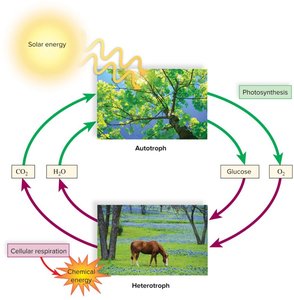
Photosynthesis in Flowering Plants
In flowering plants, leaves are the primary site of photosynthesis. - Mesophyll tissue contains cells with chloroplasts, the organelles where photosynthesis occurs. - Chloroplasts act as mini solar panels, capturing light energy. - Raw materials: CO2 enters through stomata; H2O is absorbed by roots. 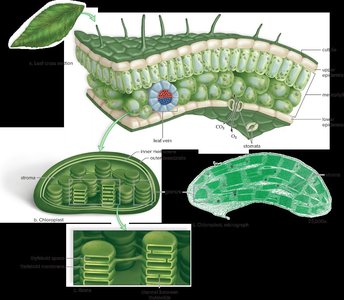
The Process of Photosynthesis
Photosynthesis consists of two main stages: Light Reactions and Calvin Cycle Reactions. Both occur in the chloroplast and are interdependent. - Light Reactions: Energy-capturing reactions that require sunlight. - Calvin Cycle Reactions: Synthesis reactions that do not require direct sunlight. - Overall, photosynthesis is a redox reaction: CO2 is reduced, H2O is oxidized. 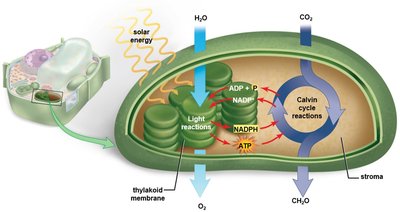
Light Reactions
Light reactions occur in the thylakoid membranes and capture solar energy. - Chlorophyll absorbs solar energy, energizing electrons. - Electrons move down an electron transport chain (ETC), pumping H+ into thylakoids. - ATP and NADPH are produced from ADP and NADP+. 
Calvin Cycle Reactions
Calvin Cycle reactions occur in the stroma and use ATP and NADPH from light reactions to reduce CO2 to carbohydrates. - Named after Melvin Calvin, who traced carbon in photosynthesis. - ATP and NADPH are used to produce glucose (C6H12O6).
Plants Convert Solar Energy
Pigments and Light Absorption
Pigments are chemicals that absorb specific wavelengths of light. - Absorption spectrum: Graph showing relative absorption of various colors. - Chlorophyll absorbs red and blue light, reflects green. - Carotenoids absorb violet-blue-green, reflect yellow and orange. 

Electron Flow in Light Reactions
Photosystems and Pathways
Light reactions utilize photosystems (PS I and PS II) located in thylakoid membranes. - Photosystem II (PS II) captures light, splits water, releases O2, and pumps H+. - Photosystem I (PS I) captures light, transfers electrons to NADP+ to form NADPH. - Two electron pathways: Noncyclic (produces ATP and NADPH) and Cyclic (produces ATP only). 

ATP Production: Chemiosmosis
The thylakoid space acts as a reservoir for H+ ions. - Energy from ETC pumps H+ across the membrane. - Flow of H+ back through ATP synthase produces ATP from ADP and phosphate. - This process is called chemiosmosis. 
The Calvin Cycle
C3 Photosynthesis
C3 Photosynthesis is a cyclical series of reactions that utilize atmospheric CO2 to produce carbohydrates. - Three stages: Carbon Dioxide Fixation, Carbon Dioxide Reduction, RuBP Regeneration. 
Step 1: Carbon Dioxide Fixation
- CO2 is attached to a 5-carbon RuBP by the enzyme Rubisco, forming a 6-carbon molecule. - The molecule splits into two 3-carbon molecules (3PG). - CO2 is now "fixed" as part of a carbohydrate. 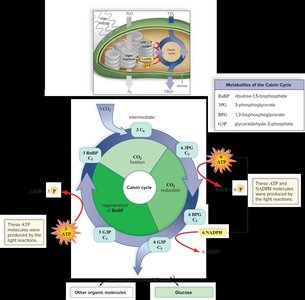
Step 2: Reduction of Carbon Dioxide
- 3PG is reduced to BPG, then to G3P, using NADPH and ATP from light reactions. - G3P can store more energy and form larger organic molecules like glucose. 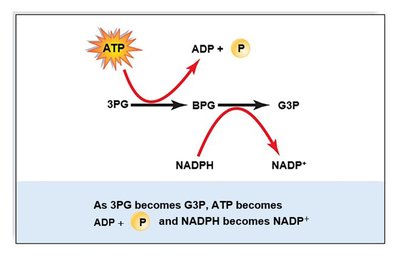
Step 3: Regeneration of RuBP
- RuBP must be regenerated every three turns of the cycle. - Five G3P molecules are used to remake three RuBP molecules. 
Importance of the Calvin Cycle
G3P (glyceraldehyde-3-phosphate) is a versatile molecule that can be converted into many other compounds. - Forms fatty acids, glycerol, glucose phosphate, fructose, starch, cellulose, and amino acids.
Other Types of Photosynthesis
C4 and CAM Photosynthesis
Some plants have adapted to hot, dry climates by modifying their photosynthetic pathways. - C4 Plants: Fix CO2 to PEP, forming oxaloacetate (C4 molecule), avoiding photorespiration. - CAM Plants: Partition carbon fixation by time; fix CO2 at night, release it to Calvin Cycle during the day.
Adaptations to Environment
- C4 plants: High light intensity, high temperature, limited rainfall. - C3 plants: Cold temperatures, high moisture. - CAM plants: Extreme aridity; found in 23 families of flowering plants and some nonflowering plants.
Type | CO2 Fixation | Adaptation |
|---|---|---|
C3 | Directly to RuBP | Cool, moist environments |
C4 | To PEP, then oxaloacetate | Hot, dry climates |
CAM | Night: CO2 fixed, Day: CO2 released | Extreme aridity |
Example: Corn (C4), Pineapple (CAM), Wheat (C3). Additional info: C4 and CAM pathways are evolutionary adaptations to minimize water loss and maximize carbon fixation under environmental stress. ----------------------------------------
