 Indietro
Photosynthesis: Mechanisms, Adaptations, and Importance
Guida di studio - Note intelligenti
 Appunti personalizzati basati sui tuoi materiali, ampliati con definizioni chiave, esempi e contesto.
Photosynthesis and Organisms
Overview of Photosynthesis
Photosynthesis is the process by which autotrophic organisms convert solar energy into chemical energy stored in carbohydrates. This process is fundamental for life on Earth, providing both food and oxygen for nearly all living organisms.
Autotrophs produce their own food by converting inorganic CO2 into organic sugars (glucose).
Heterotrophs (consumers) obtain organic molecules from plants, animals, or fungi for energy and building blocks.
Oxygen is a byproduct of photosynthesis, enabling aerobic respiration.
Photosynthesis reactants: solar energy, water (enters via roots), and CO2 (enters via stomata).
Prokaryotic (cyanobacterial) photosynthesis was responsible for Earth's oxygenated atmosphere and laid the foundation for eukaryotic photosynthesis.
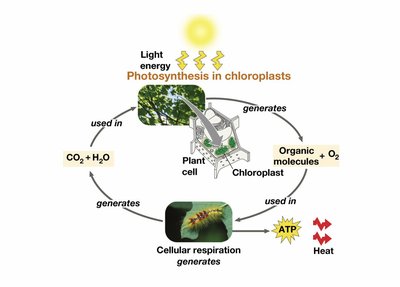
Photosynthesis Converts Light Energy to Chemical Energy
Chloroplast Structure and Function
Chloroplasts are the site of photosynthesis in plant cells. They possess a double membrane, their own DNA, and ribosomes, making them self-replicating organelles.
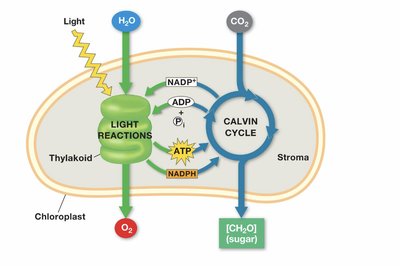
The stroma is the semifluid interior where the Calvin cycle occurs.
Thylakoid membranes provide surface area for light capture and ATP/NADPH generation.
A stack of thylakoids is called a granum (plural: grana).
Photosynthesis: Redox Reaction and Role of NADP+
The overall photosynthesis reaction is:
Solar Energy + 6CO2 + 6H2O → C6H12O6 + 6O2
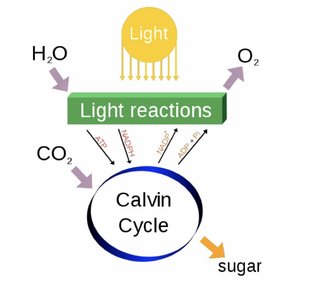
Water provides electrons to reduce CO2 into glucose, transferred via NADP+.
Light-dependent reactions split water, producing NADPH, ATP, and O2.
Calvin cycle (light-independent) uses ATP and NADPH to reduce CO2 into glucose.
The Light Reactions: Conversion of Solar Energy
Light Absorption and Pigments
Light reactions occur in the thylakoid membranes and convert light energy into chemical energy.
Most light reaching Earth is visible light (380–740 nm).
Light can be absorbed, transmitted, or reflected; plants appear green because chlorophyll reflects green light.
Chlorophyll a and b absorb violet, blue, and red light; carotenoids absorb violet, blue, and green, reflecting yellow/red.
A photosystem is a pigment complex embedded in the thylakoid membrane, consisting of chlorophylls and carotenoids.
Photosystems and Electron Flow
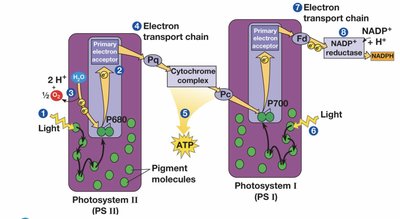
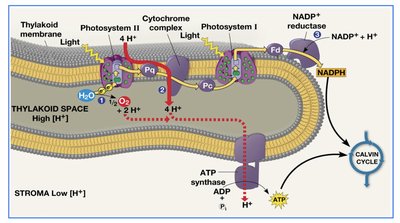
Photosystem II (PSII) splits water, releasing O2 and generating electrons.
Electrons are excited by light energy and transferred through an electron transport chain (ETC).
Energy from electrons is used to concentrate hydrogen ions inside the thylakoid membrane.
Photosystem I (PSI) re-excites electrons, which are passed to NADP+ to form NADPH.
Cyclic vs. Noncyclic Electron Flow
Noncyclic (linear) electron flow produces ATP, NADPH, and O2.
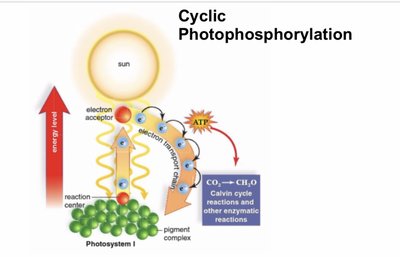
Cyclic electron flow (mainly in prokaryotes or under high O2) produces only ATP, recycling electrons within PSI.
ATP Production: Chemiosmosis
Chemiosmosis is the process by which ATP is generated using the electrochemical gradient of hydrogen ions across the thylakoid membrane.
Hydrogen ions accumulate in the thylakoid space, creating a gradient.
ATP synthase allows H+ to flow into the stroma, forming ATP from ADP and inorganic phosphate.
The Calvin Cycle: Carbon Fixation and Sugar Production
Overview of the Calvin Cycle
The Calvin cycle is a series of reactions in the stroma that produce carbohydrates, requiring CO2, ATP, and NADPH.
Also called the light-independent reaction or "dark reaction" (misleading, as it does not require darkness).
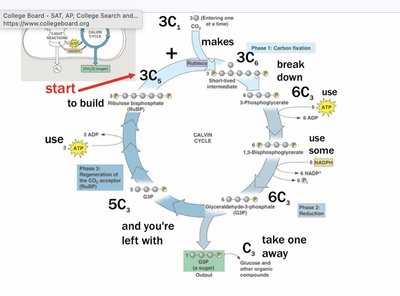
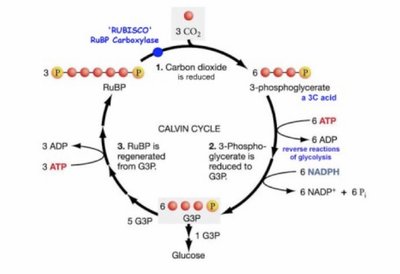
Three main steps: (i) carbon fixation, (ii) reduction, (iii) regeneration of RuBP.
Step 1: Carbon Fixation
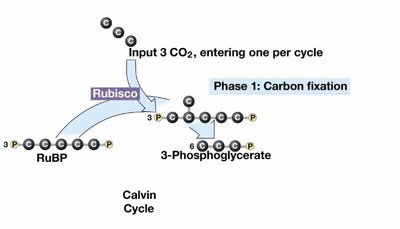
CO2 binds to a five-carbon molecule, RuBP, forming an unstable six-carbon compound.
Enzyme Rubisco catalyzes this reaction.
Each six-carbon molecule splits into two three-carbon molecules, 3PG (3-phosphoglycerate).
Step 2: Reduction of Carbon Dioxide
Each 3PG is phosphorylated and reduced by NADPH, forming G3P (glyceraldehyde-3-phosphate).
One G3P is removed as the product; the remaining five G3P molecules proceed to regeneration.
Step 3: Regeneration of RuBP
Three ATP molecules are used to rearrange five G3P into three RuBP, allowing the cycle to continue.
Two turns of the cycle (using 6 CO2) produce one glucose molecule.
Importance of Photosynthesis
G3P is the precursor for glucose, starch, cellulose, fatty acids, and amino acids.
Photosynthesis provides food and oxygen for nearly all life.
Factors Affecting Photosynthesis
Environmental Influences
Increasing light intensity increases photosynthesis rate until saturation.
Temperature affects enzyme activity; rate increases to a point, then decreases as enzymes denature.
High O2 concentration decreases photosynthesis due to photorespiration.
Other Types of Photosynthesis: Adaptations
Photorespiration
Occurs when stomata close in hot conditions, reducing CO2 and increasing O2 inside the leaf.
O2 competes with CO2 for RuBP, leading to inefficient carbon fixation.
C4 Plants
Adaptation to avoid photorespiration by spatially separating carbon fixation.
Bundle-sheath cells are photosynthetic and insulated by mesophyll cells.
PEP initially fixes CO2, which is then delivered to RuBP in bundle-sheath cells.
Advantageous in hot, dry climates but more sensitive to cold.
CAM Plants
Adaptation to avoid photorespiration by temporally separating carbon fixation.
CO2 is fixed at night when stomata are open, stored, and released during the day for photosynthesis.
Allows survival in extremely dry/arid conditions.
Comparative Adaptation
C4 plants excel in high light, high temperature, and limited rainfall.
C3 plants perform better in cooler conditions.
CAM plants are best suited for arid environments.
Photosynthesis Summary Table
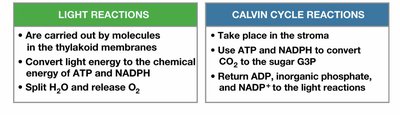
Light Reactions | Calvin Cycle Reactions |
|---|---|
Carried out by molecules in thylakoid membranes | Take place in the stroma |
Convert light energy to ATP and NADPH | Use ATP and NADPH to convert CO2 to G3P |
Split H2O and release O2 | Return ADP, inorganic phosphate, and NADP+ to light reactions |
Photosynthesis Summary
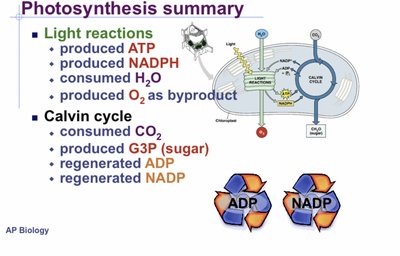
Light reactions produce ATP, NADPH, and O2 (byproduct); consume H2O.
Calvin cycle consumes CO2, produces G3P (sugar), regenerates ADP and NADP+.
Key Concepts to Know
The summary equation of photosynthesis, including the source and fate of reactants and products.
Leaf and chloroplast anatomy as it relates to photosynthesis.
How photosystems convert solar energy to chemical energy.
How linear electron flow results in ATP, NADPH, and O2 formation.
How the proton gradient is used to form ATP via ATP synthase.
How the Calvin cycle uses ATP and NADPH to produce carbohydrates (G3P) and CO2.
Comparison of chemiosmosis in mitochondria and chloroplasts (after studying cellular respiration).
Additional info: The notes include detailed diagrams and stepwise explanations of photosynthesis, Calvin cycle, and adaptations in C4 and CAM plants, making them suitable for exam preparation in General Biology.
