 Indietro
Photosynthesis: Mechanisms, Adaptations, and Importance in the Biosphere
Guida di studio - Note intelligenti
 Appunti personalizzati basati sui tuoi materiali, ampliati con definizioni chiave, esempi e contesto.
Photosynthesis: An Overview
Introduction to Photosynthesis
Photosynthesis is the process by which plants, algae, and certain prokaryotes convert solar energy into chemical energy, producing organic molecules from carbon dioxide and water. This process is fundamental to life on Earth, as it provides the energy and organic matter required by most living organisms.
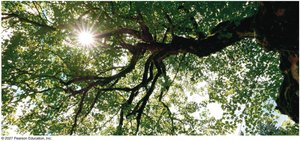
Autotrophs are organisms that produce their own food from inorganic substances. Most plants are photoautotrophs, using sunlight as their energy source.
Heterotrophs obtain organic molecules by consuming other organisms and are dependent on autotrophs for food and oxygen.
Fossil fuels are ancient stores of solar energy, originally captured by photosynthetic organisms.
Sites and Structures of Photosynthesis
Chloroplasts and Leaf Anatomy
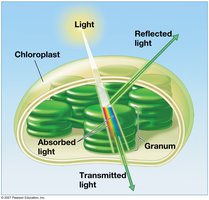
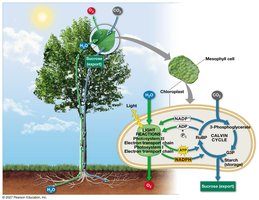
Photosynthesis primarily occurs in the chloroplasts of leaf mesophyll cells. Chloroplasts contain an outer and inner membrane, enclosing a dense fluid called the stroma. Within the stroma are thylakoids, which may be stacked into grana, and contain the pigment chlorophyll.
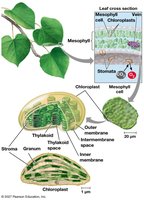
Stomata are microscopic pores that allow gas exchange (CO2 in, O2 out).
Veins transport water to leaves and export sugars to other plant parts.
The Photosynthetic Equation and Redox Nature
Overall Chemical Equation
The overall process of photosynthesis can be summarized by the following equation:
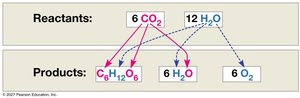
Photosynthesis is a redox process: CO2 is reduced to sugar, and H2O is oxidized to O2.
It is an endergonic process, requiring energy input from sunlight.

Stages of Photosynthesis
Light Reactions and the Calvin Cycle
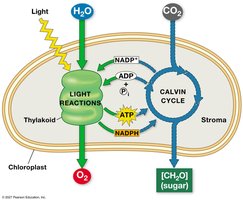
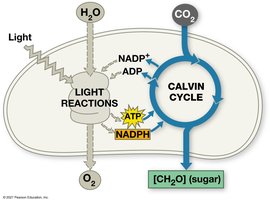
Photosynthesis consists of two main stages: the light reactions and the Calvin cycle.
Light reactions (in the thylakoids): Convert solar energy to chemical energy (ATP and NADPH), split water, and release O2.
Calvin cycle (in the stroma): Uses ATP and NADPH to convert CO2 into sugars through carbon fixation.
The Nature of Sunlight and Pigments
Electromagnetic Spectrum and Light Absorption
Light is a form of electromagnetic energy. The visible spectrum (380–740 nm) is used in photosynthesis. Pigments absorb specific wavelengths; chlorophyll a is the main pigment, while chlorophyll b and carotenoids are accessory pigments.
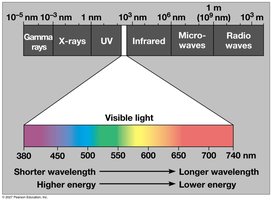
Photons are discrete packets of light energy; shorter wavelengths have higher energy.
Leaves appear green because chlorophyll absorbs violet-blue and red light, reflecting green.
Measuring Pigment Absorption
A spectrophotometer measures how much light a pigment absorbs at different wavelengths, producing an absorption spectrum. The action spectrum shows the effectiveness of different wavelengths in driving photosynthesis.
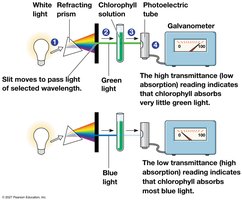
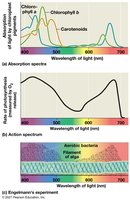
Chlorophyll a absorbs best in violet-blue and red regions.
Accessory pigments broaden the spectrum and provide photoprotection.
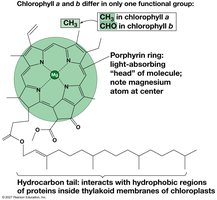
Excitation of Chlorophyll
When chlorophyll absorbs light, electrons are excited to a higher energy state. In isolation, this energy is released as heat or fluorescence.
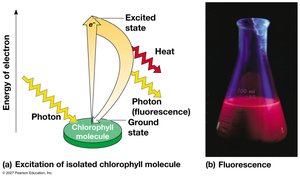
Photosystems and Electron Flow
Photosystems: Structure and Function
A photosystem consists of a reaction-center complex surrounded by light-harvesting complexes. There are two types: Photosystem II (P680) and Photosystem I (P700).
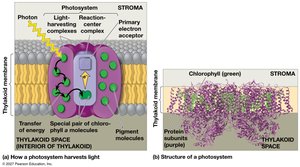
Light-harvesting complexes transfer energy to the reaction center, where an excited electron is transferred to a primary electron acceptor.
Linear Electron Flow
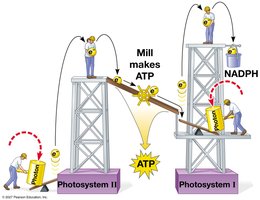
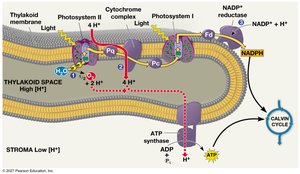
Linear electron flow is the main pathway during the light reactions, involving both photosystems and resulting in the production of ATP and NADPH.
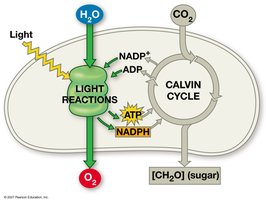
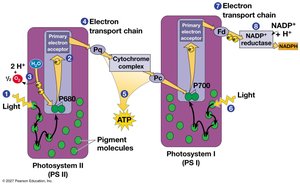
Water is split, providing electrons and releasing O2.
Electrons move through an electron transport chain, generating a proton gradient used to synthesize ATP (photophosphorylation).
NADP+ is reduced to NADPH.
Cyclic Electron Flow
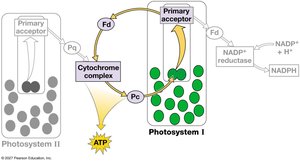
In cyclic electron flow, electrons cycle back to Photosystem I, producing ATP but not NADPH or O2. This process provides additional ATP for the Calvin cycle and may protect cells from light-induced damage.
Chemiosmosis and ATP Synthesis
Comparison of Chemiosmosis in Chloroplasts and Mitochondria
Both organelles use chemiosmosis to generate ATP, but the sources of energy and spatial organization differ.
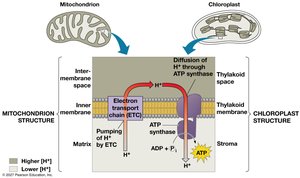
In chloroplasts, light energy drives electron flow from water to NADP+.
ATP and NADPH are produced on the stroma side of the thylakoid membrane for use in the Calvin cycle.
The Calvin Cycle
Phases of the Calvin Cycle
The Calvin cycle uses ATP and NADPH to convert CO2 into the three-carbon sugar glyceraldehyde 3-phosphate (G3P). The cycle has three phases: carbon fixation, reduction, and regeneration of the CO2 acceptor (RuBP).
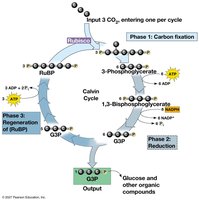
Carbon fixation: CO2 is attached to RuBP by the enzyme rubisco, forming 3-phosphoglycerate.
Reduction: ATP and NADPH are used to convert 3-phosphoglycerate into G3P.
Regeneration: Some G3P is used to regenerate RuBP, enabling the cycle to continue.
For each G3P produced, the cycle consumes 9 ATP and 6 NADPH molecules.
Adaptations in Carbon Fixation
Photorespiration and Its Alternatives
Photorespiration occurs when rubisco binds O2 instead of CO2, reducing photosynthetic efficiency. Plants have evolved alternative mechanisms to minimize photorespiration, especially in hot, arid climates.
C4 Plants
C4 plants, such as corn and sugarcane, fix CO2 into a four-carbon compound in mesophyll cells. This compound is transported to bundle-sheath cells, where CO2 is released for the Calvin cycle, minimizing photorespiration.
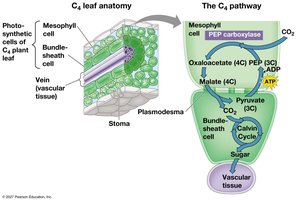
Pep carboxylase is the enzyme responsible for initial CO2 fixation in C4 plants.
CAM Plants
CAM (Crassulacean Acid Metabolism) plants, such as succulents and pineapples, open their stomata at night to fix CO2 into organic acids. During the day, CO2 is released from these acids for use in the Calvin cycle, reducing water loss.
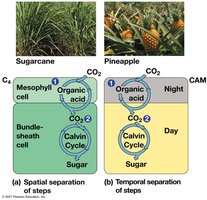
C4 and CAM pathways both help plants survive in hot, dry environments by reducing photorespiration and conserving water.
Importance of Photosynthesis
Photosynthesis and the Biosphere
Photosynthesis is essential for life on Earth, providing the energy and organic molecules required by most organisms. Plants store excess sugar as starch and supply energy and carbon skeletons for biosynthesis.
Summary Table: Comparison of C3, C4, and CAM Pathways
Pathway | Initial CO2 Fixation | Key Enzyme | Adaptation | Examples |
|---|---|---|---|---|
C3 | 3-phosphoglycerate (3C) | Rubisco | Most efficient under cool, moist conditions | Wheat, rice |
C4 | Oxaloacetate (4C) | PEP carboxylase | Minimizes photorespiration; spatial separation | Corn, sugarcane |
CAM | Organic acids (4C) | PEP carboxylase | Temporal separation; stomata open at night | Pineapple, cacti |
Additional info: The Calvin cycle is the central pathway for carbon fixation in all photosynthetic organisms, and adaptations such as C4 and CAM metabolism have evolved to optimize photosynthesis under environmental stress.
