 Indietro
Photosynthesis: Mechanisms and Adaptations
Guida di studio - Note intelligenti
 Appunti personalizzati basati sui tuoi materiali, ampliati con definizioni chiave, esempi e contesto.
Photosynthesis: Feeding the Biosphere
Introduction to Photosynthesis
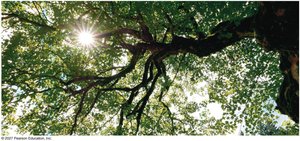
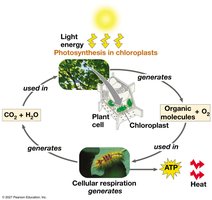
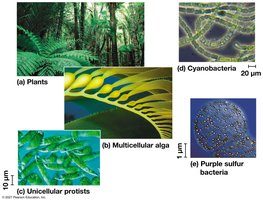
Photosynthesis is the process by which plants, algae, and certain prokaryotes convert solar energy into chemical energy, sustaining nearly all life on Earth. This process occurs within chloroplasts and provides the organic molecules and oxygen necessary for heterotrophic organisms.
Autotrophs: "Self-feeders" that produce organic molecules from CO2 and other inorganic substances.
Photoautotrophs: Use sunlight to synthesize organic compounds; includes plants, algae, and some bacteria.
Heterotrophs: Obtain organic material by consuming other organisms; includes consumers and decomposers.
Chloroplasts: The Sites of Photosynthesis
Structure and Function
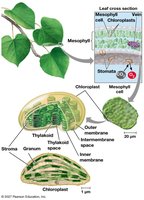
Chloroplasts are specialized organelles found mainly in the mesophyll cells of leaves. Their structural organization enables the chemical reactions of photosynthesis.
Stomata: Microscopic pores for gas exchange (CO2 in, O2 out).
Thylakoids: Membranous sacs, often stacked as grana, containing chlorophyll.
Stroma: Dense fluid surrounding thylakoids, site of the Calvin cycle.
Photosynthesis: Chemical Overview
Photosynthesis Equation and Redox Process
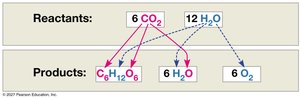
Photosynthesis is a complex series of reactions summarized by the following equation:
Overall equation:
Redox process: CO2 is reduced, H2O is oxidized; energy input is required (endergonic).

The Two Stages of Photosynthesis
Light Reactions and Calvin Cycle
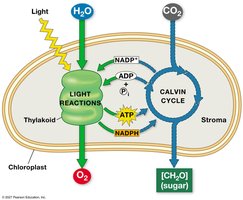
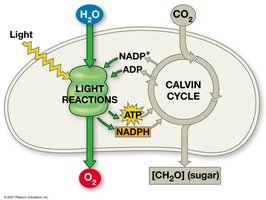
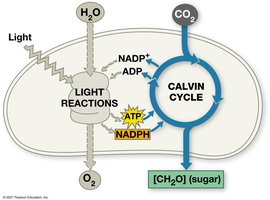
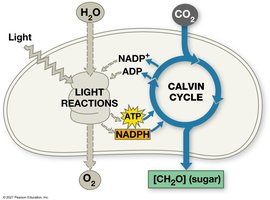
Photosynthesis consists of two main stages:
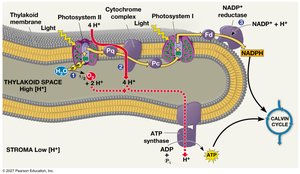
Light Reactions (in thylakoids): Split water, release O2, produce ATP and NADPH.
Calvin Cycle (in stroma): Uses ATP and NADPH to convert CO2 into sugar (G3P).
The Nature of Sunlight
Electromagnetic Spectrum and Light Energy
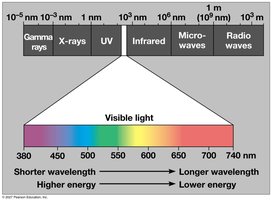
Light is electromagnetic energy, traveling in waves. The visible spectrum (380–740 nm) is most effective for photosynthesis.
Photons: Discrete particles of light, each with a fixed energy inversely related to wavelength.
Photosynthetic Pigments: Light Receptors
Pigments and Absorption
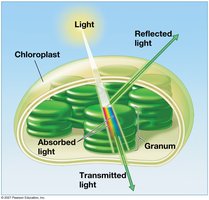
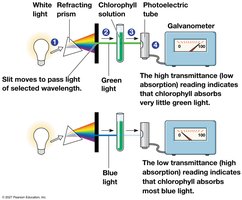
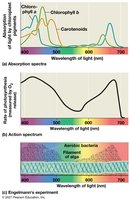
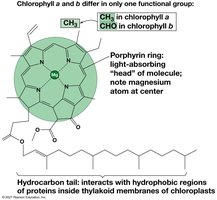
Pigments absorb specific wavelengths of light. Chlorophylls and carotenoids are key pigments in chloroplasts.
Chlorophyll a: Main pigment for light reactions.
Chlorophyll b: Accessory pigment, broadens absorption spectrum.
Carotenoids: Accessory pigments, absorb violet and blue-green light, provide photoprotection.
Excitation of Chlorophyll by Light
Fluorescence and Energy Transfer
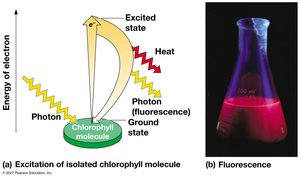
When chlorophyll absorbs light, electrons are excited to higher energy states. In isolation, this energy is released as heat or fluorescence.
Fluorescence: Afterglow from excited electrons returning to ground state.
Photosystems: Light-Harvesting Complexes
Structure and Function
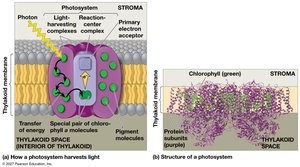
Photosystems are complexes in the thylakoid membrane, consisting of a reaction-center surrounded by light-harvesting complexes.
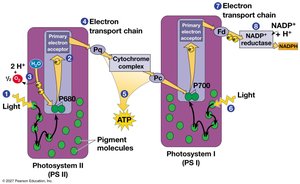
Photosystem II (PSII): P680 chlorophyll, absorbs 680 nm light.
Photosystem I (PSI): P700 chlorophyll, absorbs 700 nm light.
Primary electron acceptor: Receives excited electrons from chlorophyll.
Light Reactions: Electron Flow
Linear and Cyclic Electron Flow
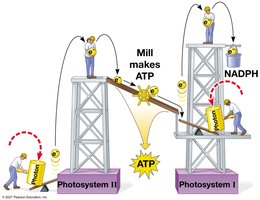
Linear electron flow: Involves both photosystems, produces ATP and NADPH, releases O2.
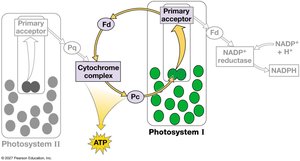
Cyclic electron flow: Uses only PSI, produces ATP, no NADPH or O2.
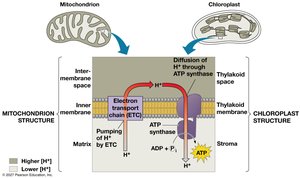
Comparison of Chemiosmosis in Chloroplasts and Mitochondria
ATP Synthesis Mechanisms
Both organelles use chemiosmosis to generate ATP, but differ in electron sources and spatial organization.
Chloroplasts: Electrons from water, ATP synthesis in stroma.
Mitochondria: Electrons from organic molecules, ATP synthesis in matrix.
The Calvin Cycle: Sugar Synthesis
Phases and Key Steps
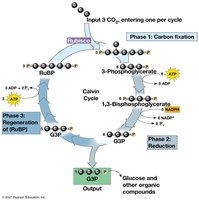
The Calvin cycle uses ATP and NADPH to fix carbon and produce G3P, a precursor to glucose and other carbohydrates.
Phase 1: Carbon fixation – CO2 binds to RuBP via rubisco, forming 3-phosphoglycerate.
Phase 2: Reduction – 3-phosphoglycerate is converted to G3P using ATP and NADPH.
Phase 3: Regeneration – RuBP is regenerated, enabling the cycle to continue.
Alternative Mechanisms of Carbon Fixation
C4 and CAM Pathways
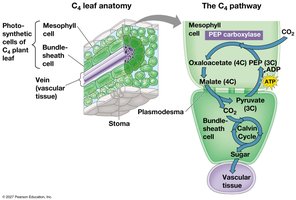
Plants in hot, arid climates have evolved adaptations to minimize water loss and photorespiration.
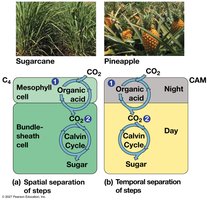
C4 plants: Spatial separation of carbon fixation and Calvin cycle; use PEP carboxylase to fix CO2 in mesophyll cells, then transfer to bundle-sheath cells.
CAM plants: Temporal separation; fix CO2 at night into organic acids, release CO2 for Calvin cycle during the day.
Photosynthesis: Essential for Life
Ecological and Cellular Importance
Photosynthesis stores solar energy in organic compounds, providing energy and carbon skeletons for all living organisms. Plants store excess sugar as starch in various tissues. 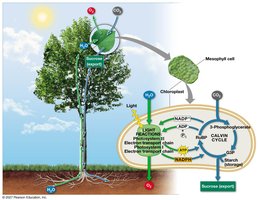
Summary Tables
Key Concepts: Linear Electron Flow
Process | Photosystem(s) | Products |
|---|---|---|
Linear Electron Flow | PSII & PSI | ATP, NADPH, O2 |
Cyclic Electron Flow | PSI | ATP only |
Key Concepts: Calvin Cycle
Phase | Input | Output |
|---|---|---|
Carbon Fixation | CO2, RuBP | 3-Phosphoglycerate |
Reduction | ATP, NADPH | G3P |
Regeneration | ATP | RuBP |
Summary Equation
Additional info:
The notes expand on brief points with academic context, including definitions, examples, and comparisons. All images included are directly relevant to the adjacent content, reinforcing key concepts in photosynthesis.
