 Indietro
Photosynthesis: Mechanisms and Adaptations
Guida di studio - Note intelligenti
 Appunti personalizzati basati sui tuoi materiali, ampliati con definizioni chiave, esempi e contesto.
Photosynthesis: Overview and Significance
Introduction to Photosynthesis
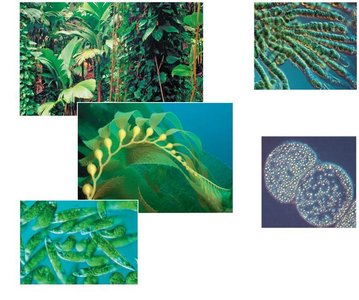
Photosynthesis is the process by which plants, algae, and certain prokaryotes convert solar energy into chemical energy, producing organic compounds from inorganic molecules. This process is fundamental to life on Earth, as it provides the oxygen we breathe and the food we consume.
Photosynthetic Organisms: Includes plants, multicellular algae, unicellular eukaryotes, cyanobacteria, and some other prokaryotes.
General Equation: The overall chemical reaction for photosynthesis is:
Photosynthesis is an endergonic process (requires energy input from light).
Redox Process: Water is oxidized, and carbon dioxide is reduced.
Chloroplast Structure and Function
Chloroplast Anatomy
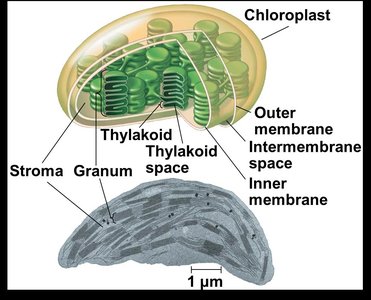
Chloroplasts are the organelles where photosynthesis occurs in eukaryotic cells. They have a complex structure that facilitates the light-dependent and light-independent reactions.
Double Membrane: Chloroplasts are surrounded by an outer and inner membrane.
Stroma: The dense fluid inside the chloroplast, where the Calvin cycle takes place.
Thylakoids: Flattened sacs that contain chlorophyll and are the site of the light reactions. Thylakoids are often stacked into structures called grana.
Chlorophyll: The green pigment responsible for capturing light energy.
The Light Reactions
Overview of Light Reactions
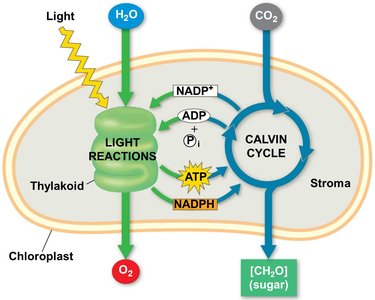
The light reactions occur in the thylakoid membranes and convert solar energy into chemical energy in the form of ATP and NADPH. Oxygen is produced as a by-product from the splitting of water.
Inputs: Light, water, ADP, NADP+
Outputs: Oxygen, ATP, NADPH
Photosystems: Complexes of proteins and pigments (chlorophyll a, chlorophyll b, carotenoids) that absorb light and transfer energy.
Photosystems and Electron Flow
Photosystem II (PSII): Absorbs light, splits water, and transfers electrons to the electron transport chain.
Photosystem I (PSI): Absorbs light and transfers electrons to NADP+, forming NADPH.
Linear Electron Flow: Involves both PSII and PSI, producing ATP and NADPH.
Cyclic Electron Flow: Involves only PSI, producing ATP but not NADPH or O2.
Key Equation for Light Reactions:
The Calvin Cycle (Light-Independent Reactions)
Overview of the Calvin Cycle
The Calvin cycle occurs in the stroma and uses ATP and NADPH from the light reactions to fix carbon dioxide into organic molecules, ultimately producing glyceraldehyde-3-phosphate (G3P), a precursor to glucose and other carbohydrates.
Phases of the Calvin Cycle:
Carbon Fixation: CO2 is attached to ribulose bisphosphate (RuBP) by the enzyme rubisco, forming 3-phosphoglycerate.
Reduction: ATP and NADPH are used to convert 3-phosphoglycerate into G3P.
Regeneration: Some G3P is used to regenerate RuBP, enabling the cycle to continue.
For every three CO2 molecules fixed, one G3P is produced (net gain).
Energy Requirement: To produce one glucose (from two G3P), the cycle consumes 18 ATP and 12 NADPH.
Adaptations in Photosynthetic Pathways
C3, C4, and CAM Plants
Plants have evolved different mechanisms to fix carbon, especially in response to environmental stresses such as heat and aridity.
C3 Plants: Use the Calvin cycle directly; most common but susceptible to photorespiration under hot, dry conditions.
C4 Plants: Spatially separate carbon fixation and the Calvin cycle. CO2 is initially fixed into a four-carbon compound in mesophyll cells, then transported to bundle-sheath cells where the Calvin cycle occurs. This adaptation reduces photorespiration.
CAM Plants: Temporally separate carbon fixation and the Calvin cycle. Stomata open at night to fix CO2 into organic acids, which release CO2 during the day for use in the Calvin cycle. This conserves water in arid environments.
Key Enzyme: Rubisco (Ribulose-1,5-bisphosphate carboxylase/oxygenase) is the most abundant protein on Earth and catalyzes the first step of the Calvin cycle.
Summary Table: Comparison of Photosynthetic Pathways
Pathway | Initial CO2 Fixation | Adaptation | Example Plants |
|---|---|---|---|
C3 | 3-phosphoglycerate (Calvin cycle) | Most efficient under cool, moist conditions | Wheat, rice, most plants |
C4 | Oxaloacetate (4-carbon compound) | Reduces photorespiration; spatial separation | Corn, sugarcane |
CAM | Organic acids (at night) | Water conservation; temporal separation | Cacti, succulents |
Key Concepts to Master
Follow the flow of energy and matter in photosynthesis.
Know the inputs and outputs of Photosystem II, Photosystem I, and the Calvin cycle.
Understand the differences between linear and cyclic electron flow.
Identify the roles of key enzymes (e.g., rubisco, PEP carboxylase).
Recognize the structural organization of the chloroplast and where each process occurs (thylakoid, stroma, etc.).
Compare and contrast C3, C4, and CAM photosynthetic adaptations.
