 Indietro
Photosynthesis: Mechanisms and Adaptations in Plants CH.7
Guida di studio - Note intelligenti
 Appunti personalizzati basati sui tuoi materiali, ampliati con definizioni chiave, esempi e contesto.
Photosynthesis
Introduction to Photosynthetic Organisms
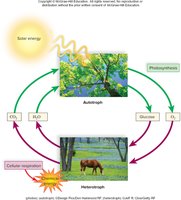
Photosynthesis is a fundamental biological process that sustains life on Earth by converting solar energy into chemical energy. This process is carried out by autotrophs—organisms such as plants, algae, and cyanobacteria—that produce their own food. In contrast, heterotrophs (consumers) rely on autotrophs for organic molecules and energy.
Autotrophs: Organisms that synthesize organic molecules from inorganic substances using light or chemical energy.
Heterotrophs: Organisms that obtain energy by consuming other organisms.
Photosynthesis: The process by which solar energy is captured and stored in carbohydrates.
Photosynthesis in Flowering Plants
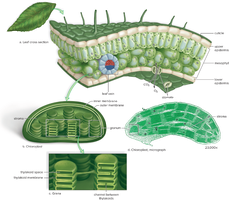
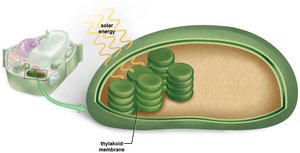
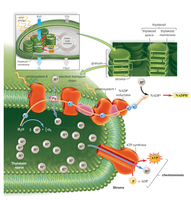
Photosynthesis primarily occurs in the leaves of flowering plants. The leaf structure is adapted to maximize light absorption and gas exchange. Chloroplasts, the organelles responsible for photosynthesis, contain internal membranes called thylakoids where the light-dependent reactions take place.
Chloroplast: Organelle with a double membrane, containing thylakoids stacked into grana and surrounded by stroma.
Stomata: Pores in the leaf epidermis that allow gas exchange (CO2 in, O2 out).
The Process of Photosynthesis
Photosynthesis Releases Oxygen
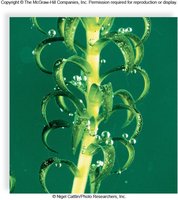
During photosynthesis, oxygen is released as a byproduct. This can be observed as bubbles forming on aquatic plants submerged in water when exposed to light.
Overview of Photosynthesis
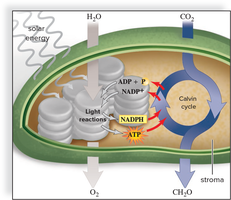
Photosynthesis consists of two main stages: the light reactions and the Calvin cycle (light-independent reactions). The light reactions occur in the thylakoid membranes and produce ATP and NADPH, which are then used in the Calvin cycle to fix carbon dioxide into carbohydrates.
Light Reactions: Capture solar energy to produce ATP and NADPH; oxygen is released from water.
Calvin Cycle: Uses ATP and NADPH to convert CO2 into glucose and other carbohydrates.
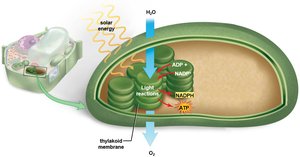
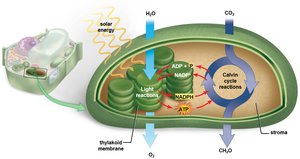
Plants Convert Solar Energy
Pigments and Photosystems
Photosynthetic pigments absorb specific wavelengths of light. The main pigment, chlorophyll, absorbs red and blue light, reflecting green. Carotenoids are accessory pigments that absorb additional wavelengths, broadening the spectrum of light usable for photosynthesis.
Absorption Spectrum: A graph showing the relative absorption of different wavelengths by pigments.
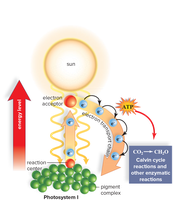
Photosystem: A complex of pigments and proteins that captures light energy and initiates electron transport.
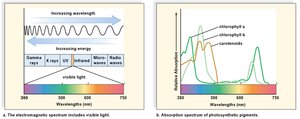
Electron Flow in the Light Reactions
There are two electron pathways in the light reactions: the noncyclic pathway and the cyclic pathway. Both occur in the thylakoid membranes and involve two photosystems (PS II and PS I).
Noncyclic Pathway: Produces both ATP and NADPH; electrons flow from water to NADP+.
Cyclic Pathway: Produces only ATP; electrons cycle back to PS I.
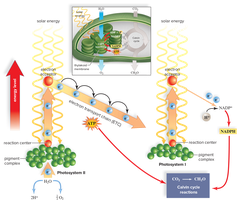
Plants Fix Carbon Dioxide
The Calvin Cycle
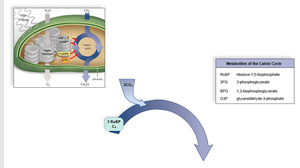
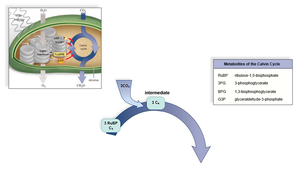
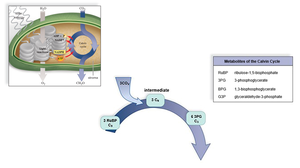
The Calvin cycle is the set of light-independent reactions in photosynthesis that convert CO2 into organic molecules. It occurs in the stroma of the chloroplast and consists of three main phases: carbon fixation, reduction, and regeneration of RuBP.
Carbon Fixation: CO2 is attached to ribulose-1,5-bisphosphate (RuBP) by the enzyme Rubisco, forming 3-phosphoglycerate (3PG).
Reduction: 3PG is converted to glyceraldehyde-3-phosphate (G3P) using ATP and NADPH.
Regeneration: RuBP is regenerated from G3P, allowing the cycle to continue.
Importance of the Calvin Cycle
The product of the Calvin cycle, G3P, can be used to synthesize a variety of organic molecules, including glucose, fatty acids, amino acids, starch, and cellulose. This versatility is essential for plant metabolism and growth.
Other Types of Photosynthesis
C3, C4, and CAM Pathways
Plants have evolved different mechanisms to fix carbon dioxide, adapting to various environmental conditions:
C3 Plants: Use the Calvin cycle directly; most common in temperate climates.
C4 Plants: Fix CO2 into a four-carbon compound before entering the Calvin cycle; adapted to high light and temperature.
CAM Plants: Open stomata at night to fix CO2, reducing water loss; common in arid environments.
Summary Table: Key Steps and Products of Photosynthesis
Stage | Location | Inputs | Outputs | Main Products |
|---|---|---|---|---|
Light Reactions | Thylakoid membrane | H2O, Light, NADP+, ADP + Pi | O2, NADPH, ATP | ATP, NADPH |
Calvin Cycle | Stroma | CO2, ATP, NADPH | CH2O (glucose), ADP + Pi, NADP+ | G3P (precursor to glucose) |
Key Equations
Overall Photosynthesis Equation:
Calvin Cycle (simplified):
