 Indietro
Photosynthesis: Mechanisms and Adaptations in Plants
Guida di studio - Note intelligenti
 Appunti personalizzati basati sui tuoi materiali, ampliati con definizioni chiave, esempi e contesto.
Photosynthetic Organisms
Autotrophs and Heterotrophs
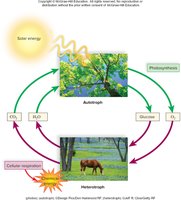
Photosynthetic organisms, including algae, plants, and cyanobacteria, are essential for life on Earth as they convert solar energy into chemical energy stored in carbohydrates. These organisms are known as autotrophs because they produce their own food through photosynthesis. Heterotrophs, or consumers, rely on autotrophs for food and energy. Both groups utilize organic molecules produced by photosynthesis for cellular work.
Autotrophs: Organisms that synthesize their own food from inorganic substances using light or chemical energy.
Heterotrophs: Organisms that obtain energy by consuming other organisms.
Photosynthesis: The process by which autotrophs capture solar energy and convert it into chemical energy.
The Process of Photosynthesis
Photosynthesis Releases Oxygen
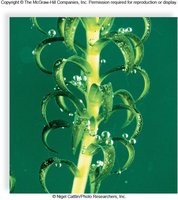
Photosynthesis is a vital process that releases oxygen as a byproduct. This oxygen is essential for the survival of aerobic organisms.
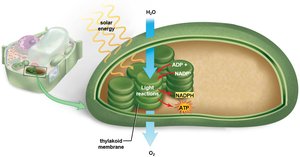
Oxygen Release: Occurs during the light reactions of photosynthesis when water is split.
Importance: Maintains atmospheric oxygen levels and supports aerobic life.
Overview of Photosynthesis
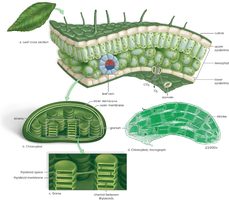
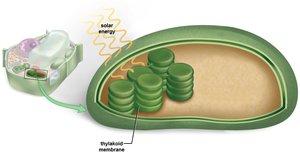
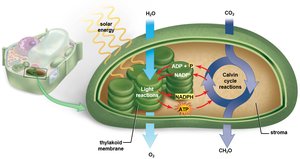
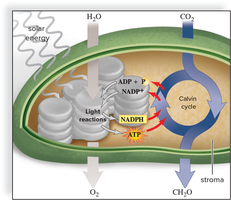
Photosynthesis occurs in two main stages: the light reactions and the Calvin cycle. The light reactions capture solar energy and produce ATP and NADPH, while the Calvin cycle uses these products to fix carbon dioxide and synthesize carbohydrates.
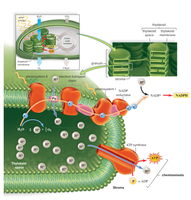
Light Reactions: Occur in the thylakoid membranes; produce ATP and NADPH.
Calvin Cycle: Occurs in the stroma; uses ATP and NADPH to convert CO2 into glucose.
Plants Convert Solar Energy
Pigments and Photosystems
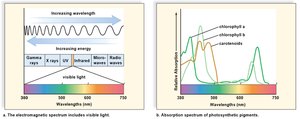
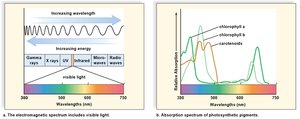
Pigments are chemicals that absorb specific wavelengths of light. The main photosynthetic pigment is chlorophyll, which absorbs red and blue light and reflects green. Carotenoids are accessory pigments that absorb light in the violet-blue-green range and reflect yellow and orange.
Absorption Spectrum: A graph showing the relative absorption of different wavelengths by pigments.
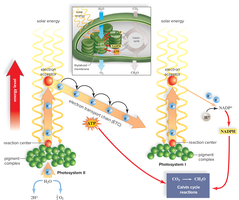
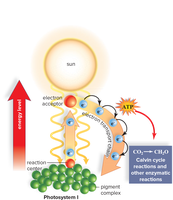
Photosystems: Complexes of pigments that collect solar energy and initiate electron transport.
Electron Flow in the Light Reactions
The light reactions involve two electron pathways: the noncyclic pathway and the cyclic pathway. Both pathways produce ATP, but only the noncyclic pathway produces NADPH. Photosystems I and II are located in the thylakoid membranes and function as antennae to collect solar energy.
Noncyclic Pathway: Produces ATP and NADPH; involves both photosystems.
Cyclic Pathway: Produces ATP only; involves photosystem I.
Plants Fix Carbon Dioxide
Step 1: Fixation of Carbon Dioxide
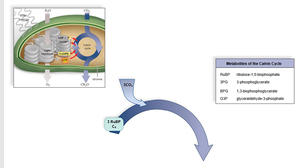
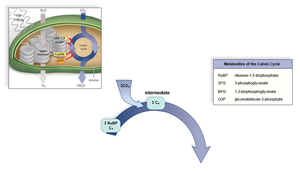
Carbon dioxide is attached to ribulose-1,5-bisphosphate (RuBP) by the enzyme RuBP carboxylase (Rubisco), forming a 6-carbon molecule that splits into two 3-carbon molecules (3-phosphoglycerate, 3PG). This step is the initial fixation of carbon in the Calvin cycle.
Rubisco: The enzyme responsible for carbon fixation.
3PG: The first stable product of carbon fixation.
Step 2: Reduction of Carbon Dioxide
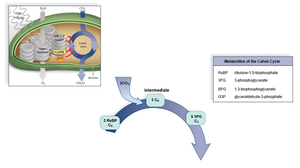
3PG is reduced to 1,3-bisphosphoglycerate (BPG), which is then reduced to glyceraldehyde-3-phosphate (G3P). This stage requires electrons and energy from NADPH and ATP produced in the light reactions. G3P can be used to form larger organic molecules such as glucose.
NADPH and ATP: Provide energy and reducing power for the reduction step.
G3P: A versatile molecule that can be converted into various carbohydrates.
Step 3: Regeneration of RuBP
Some G3P molecules are used to regenerate RuBP, allowing the cycle to continue. This regeneration requires ATP.
Regeneration: Ensures the Calvin cycle can proceed with new CO2 fixation.
The Importance of the Calvin Cycle
G3P produced in the Calvin cycle can be converted into a variety of organic molecules, including fatty acids, glycerol, glucose, fructose, sucrose, starch, cellulose, and amino acids. This versatility makes the Calvin cycle central to plant metabolism.
Glucose and Fructose: Used for energy and as building blocks for other carbohydrates.
Starch and Cellulose: Storage and structural carbohydrates in plants.
Amino Acids: Building blocks for proteins.
Other Types of Photosynthesis
C3, C4, and CAM Photosynthesis
Plants have evolved different mechanisms to fix carbon dioxide, adapting to various environmental conditions. C3 plants use the Calvin cycle directly, while C4 plants and CAM plants have adaptations to minimize photorespiration and conserve water.
C3 Plants: Use the Calvin cycle; most common in temperate climates.
C4 Plants: Fix CO2 in mesophyll cells and transfer it to bundle sheath cells; adapted to hot, dry environments.
CAM Plants: Fix CO2 at night; adapted to arid environments.
Summary Table: Photosynthetic Pathways
Pathway | Main Features | Adaptation |
|---|---|---|
C3 | Direct Calvin cycle; 3-carbon product (3PG) | Temperate climates |
C4 | CO2 fixed in mesophyll, transferred to bundle sheath | Hot, dry climates |
CAM | CO2 fixed at night, stored as organic acids | Arid climates |
