 Indietro
Photosynthesis: Mechanisms and Significance in the Biosphere
Guida di studio - Note intelligenti
 Appunti personalizzati basati sui tuoi materiali, ampliati con definizioni chiave, esempi e contesto.
Photosynthesis: Feeding the Biosphere
Introduction to Photosynthesis
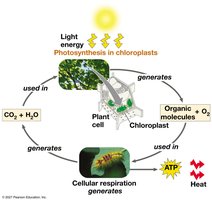
Photosynthesis is a fundamental biological process that converts solar energy into chemical energy, sustaining nearly all life on Earth. It occurs primarily in chloroplasts of plant cells and is essential for the production of organic molecules. - Autotrophs: Organisms that produce their own food from inorganic substances. - Photoautotrophs: Use sunlight to synthesize organic compounds. - Heterotrophs: Rely on consuming other organisms for energy. - Decomposers: Consume dead organic material or waste. 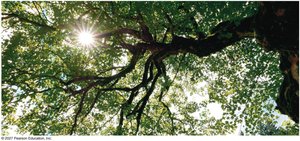
Types of Photosynthetic Organisms
Photosynthesis is not limited to plants; it also occurs in algae, protists, and certain bacteria. 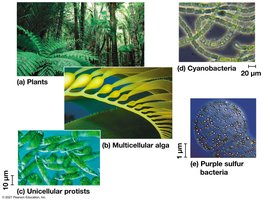
Chloroplasts: The Sites of Photosynthesis
Structure and Function of Chloroplasts
Chloroplasts are specialized organelles found mainly in the mesophyll cells of leaves. Their structure is optimized for photosynthesis. - Stomata: Microscopic pores for gas exchange. - Stroma: Dense fluid inside chloroplasts. - Thylakoids: Membranous sacs, often stacked as grana, containing chlorophyll. 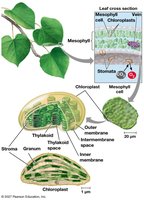
Photosynthesis: The Chemical Process
Overall Equation and Atom Tracking
Photosynthesis can be summarized by the following equation, which is the reverse of cellular respiration: - Reactants: Carbon dioxide and water. - Products: Glucose, oxygen, and water. 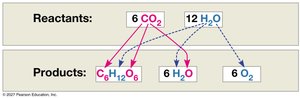
Photosynthesis as a Redox Process
Photosynthesis involves the oxidation of water and reduction of carbon dioxide. It is an endergonic process, requiring energy input from light. 
The Two Stages of Photosynthesis
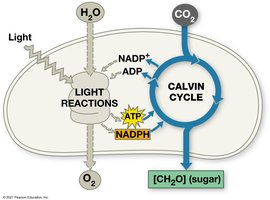
Light Reactions and Calvin Cycle
Photosynthesis consists of two main stages: Light Reactions and the Calvin Cycle. - Light Reactions: Occur in thylakoids, split water, release oxygen, produce ATP and NADPH. - Calvin Cycle: Occurs in stroma, uses ATP and NADPH to fix carbon dioxide and synthesize sugars. 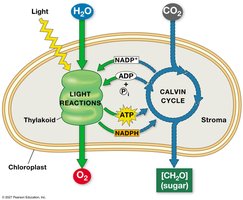
The Nature of Sunlight
Electromagnetic Spectrum and Light Energy
Light is electromagnetic energy, traveling in waves. The visible spectrum (380–740 nm) is crucial for photosynthesis. - Photons: Discrete particles of light, each with a fixed energy inversely related to wavelength. 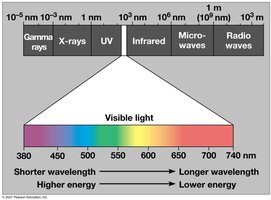
Photosynthetic Pigments: Light Receptors
Pigments and Light Absorption
Pigments absorb specific wavelengths of light. Chlorophyll absorbs violet-blue and red light, reflecting green. - Chlorophyll a: Main pigment. - Chlorophyll b and Carotenoids: Accessory pigments. 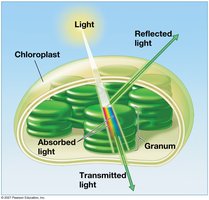
Measuring Pigment Absorption
A spectrophotometer measures how pigments absorb light. - Absorption spectrum: Graph of light absorption vs. wavelength. 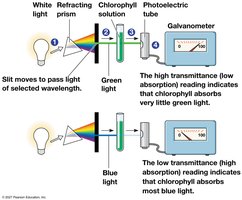
Action Spectrum and Pigment Structure
The action spectrum shows which wavelengths are most effective for photosynthesis. Accessory pigments broaden the usable spectrum. 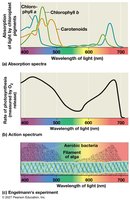
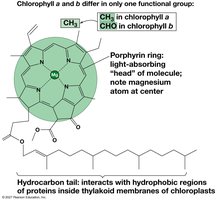
Excitation of Chlorophyll
When chlorophyll absorbs light, electrons are excited to higher energy states, releasing energy as heat or fluorescence when returning to ground state. 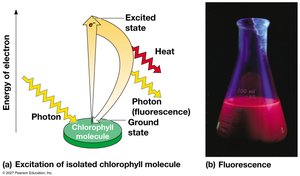
Photosystems and Electron Flow
Structure and Function of Photosystems
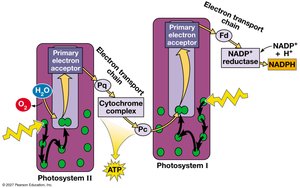
Photosystems are complexes in the thylakoid membrane that harvest light and initiate electron transfer. - Photosystem II (P680): Absorbs 680 nm light. - Photosystem I (P700): Absorbs 700 nm light. 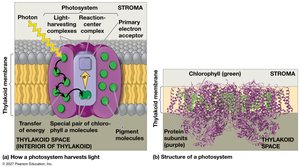
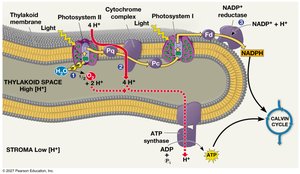
Linear Electron Flow
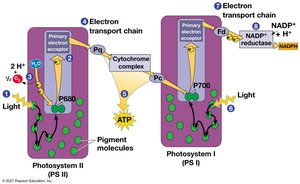
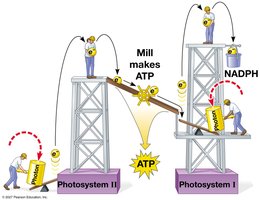
Linear electron flow involves both photosystems, producing ATP and NADPH. - Water is split, electrons are transferred, and oxygen is released. - Electron transport chains create a proton gradient for ATP synthesis. 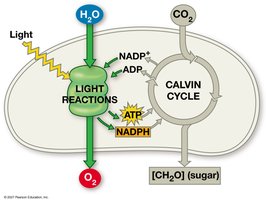
Cyclic Electron Flow
Cyclic electron flow uses only Photosystem I, producing ATP but not NADPH or oxygen. 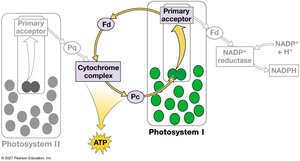
Chemiosmosis: ATP Generation
Comparison in Chloroplasts and Mitochondria
Both organelles use chemiosmosis to generate ATP, but differ in electron sources and spatial organization. - Chloroplasts: Protons pumped into thylakoid space, ATP synthesized in stroma. - Mitochondria: Protons pumped into intermembrane space, ATP synthesized in matrix. 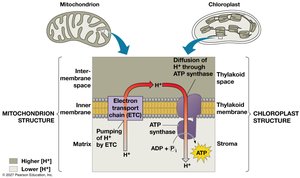
The Calvin Cycle: Sugar Synthesis
Phases of the Calvin Cycle
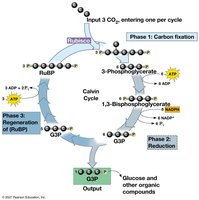
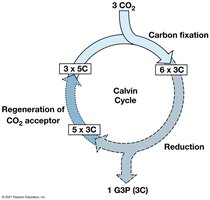
The Calvin cycle uses ATP and NADPH to fix carbon dioxide and produce G3P, a precursor to glucose. - Phase 1: Carbon Fixation: CO2 binds to RuBP via rubisco. - Phase 2: Reduction: 3-phosphoglycerate is converted to G3P. - Phase 3: Regeneration: RuBP is regenerated. 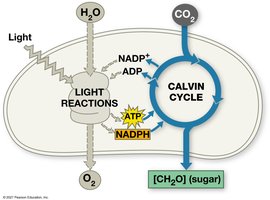
Alternative Carbon Fixation Mechanisms
C4 and CAM Pathways
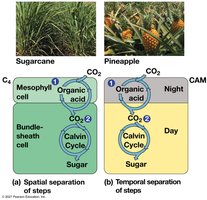
Plants in hot, arid climates have evolved mechanisms to minimize water loss and photorespiration. - C4 Plants: Spatial separation of steps; CO2 fixed in mesophyll, Calvin cycle in bundle-sheath cells. - CAM Plants: Temporal separation; CO2 fixed at night, Calvin cycle during the day. 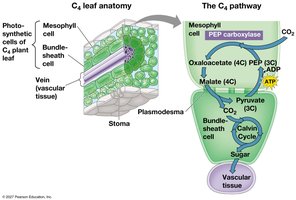
Photosynthesis: Essential for Life
Significance and Review
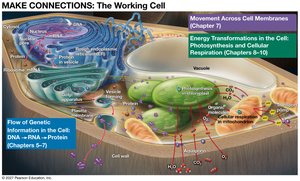
Photosynthesis stores solar energy in organic compounds, providing energy and carbon skeletons for all living organisms. Excess sugars are stored as starch in various plant structures. 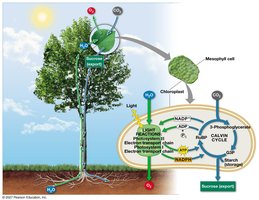
Summary Tables and Exercises
Summary of Key Concepts
Process | Main Function | Location |
|---|---|---|
Light Reactions | Produce ATP, NADPH, O2 | Thylakoid membrane |
Calvin Cycle | Fix CO2, produce G3P | Stroma |
Experimental Exercises
Experiment | Purpose |
|---|---|
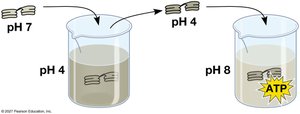
Thylakoid pH experiment | Demonstrate ATP synthesis via chemiosmosis |
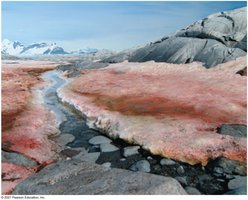
Watermelon snow | Study photosynthetic organisms in extreme environments |
Conclusion
Photosynthesis is a complex, multi-stage process essential for life on Earth. It not only sustains autotrophs but also provides energy and organic molecules for heterotrophs, maintaining the balance of the biosphere. Key Equations: Important Terms: Autotroph, Heterotroph, Chloroplast, Thylakoid, Stroma, Calvin Cycle, Light Reactions, Chemiosmosis, Photorespiration, C4 Pathway, CAM Pathway.
