 Indietro
Photosynthesis: Mechanisms, Energy Transformations, and Adaptations
Guida di studio - Note intelligenti
 Appunti personalizzati basati sui tuoi materiali, ampliati con definizioni chiave, esempi e contesto.
Photosynthesis: Turning Light into Chemical Energy
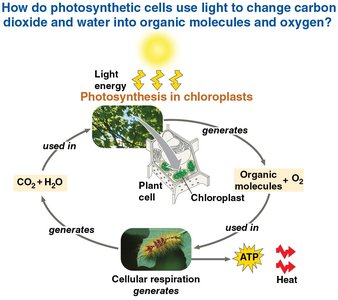
Overview of Photosynthesis and Cellular Respiration
Photosynthesis is the process by which autotrophic organisms convert light energy into chemical energy, producing organic molecules and oxygen from carbon dioxide and water. Cellular respiration, in turn, breaks down these organic molecules to generate ATP, releasing carbon dioxide and water as by-products. These two processes are interconnected, cycling matter and energy through the biosphere.
Photosynthesis Equation:
Cellular Respiration Equation:
Energy Transformation: Photosynthesis is endergonic (requires energy), while cellular respiration is exergonic (releases energy).
Redox Reactions: In photosynthesis, water is oxidized and carbon dioxide is reduced; in respiration, glucose is oxidized and oxygen is reduced.
Sources of CO2 and H2O in Respiration
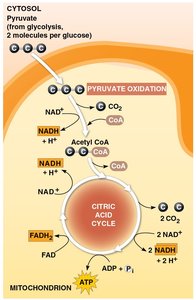
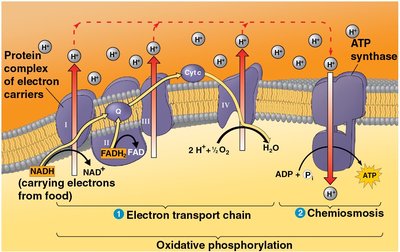
CO2 is released during pyruvate oxidation and the citric acid cycle, while H2O is formed when oxygen accepts electrons and protons at the end of the electron transport chain. The products of respiration are the reactants for photosynthesis, demonstrating the cyclical nature of these processes.
Photosynthesis Feeds the Biosphere
Autotrophs and Heterotrophs
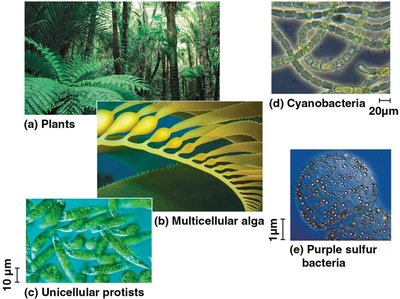
Photosynthesis is essential for life, as it provides the energy and organic molecules needed by all organisms. Autotrophs, such as plants, algae, and some bacteria, produce their own food from inorganic sources. Heterotrophs rely on consuming other organisms for energy and nutrients.
Photoautotrophs: Use light as their energy source (e.g., plants, algae, cyanobacteria).
Heterotrophs: Obtain organic molecules from other organisms (e.g., animals, fungi).
Chloroplasts: The Sites of Photosynthesis
Structure and Function
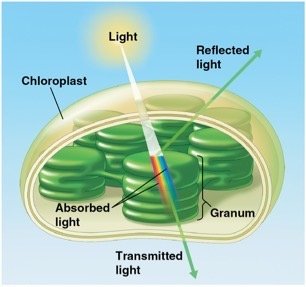
Chloroplasts are specialized organelles where photosynthesis occurs, primarily in the mesophyll cells of leaves. They contain a double membrane, a dense fluid called the stroma, and a third membrane system of thylakoids stacked into grana. Chlorophyll, the main photosynthetic pigment, is embedded in the thylakoid membranes.
Stroma: Site of the Calvin cycle (carbon fixation).
Thylakoids: Site of the light reactions.
Endosymbiosis: Chloroplasts are believed to have evolved from engulfed photosynthetic bacteria.
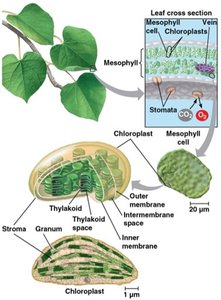
Stomata: Gatekeepers of Gas Exchange
Mechanism and Regulation
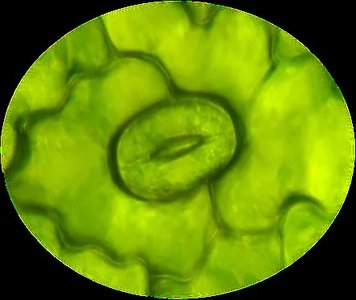
Stomata are pores on the leaf surface flanked by guard cells, allowing CO2 to enter and O2 and water vapor to exit. Their opening and closing are regulated by environmental cues and internal signals, balancing CO2 uptake with water conservation.
Opening: Guard cells take up K+, water follows by osmosis, cells become turgid and bow apart.
Closing: K+ leaves, water leaves, cells become flaccid, pore closes.
Trade-off: Open stomata allow CO2 for photosynthesis but increase water loss; closed stomata conserve water but limit CO2 uptake.
Tracking Atoms and Electrons Through Photosynthesis
Reactants and Products
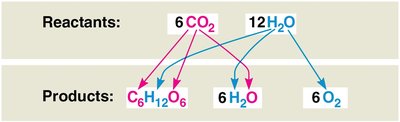
The oxygen released during photosynthesis comes from water, not carbon dioxide. The carbon atoms from CO2 are incorporated into sugar molecules. Water is both split and re-formed during the process.
Overall Equation:
Redox Changes in Photosynthesis
Photosynthesis is a redox process: water is oxidized (loses electrons), and carbon dioxide is reduced (gains electrons). The process is endergonic, requiring energy input from light.

The Two Stages of Photosynthesis
Light Reactions and Calvin Cycle
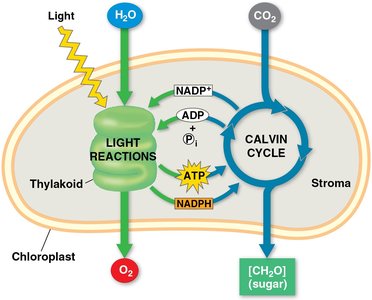
Photosynthesis consists of two main stages: the light reactions and the Calvin cycle. The light reactions occur in the thylakoid membranes and produce ATP, NADPH, and O2. The Calvin cycle occurs in the stroma and uses ATP and NADPH to fix carbon dioxide into sugar.
Light Reactions: Split water, release O2, reduce NADP+ to NADPH, and generate ATP by photophosphorylation.
Calvin Cycle: Fixes CO2 into organic molecules, uses ATP and NADPH, regenerates RuBP.
The Nature of Sunlight and Pigments
Electromagnetic Spectrum and Pigment Absorption
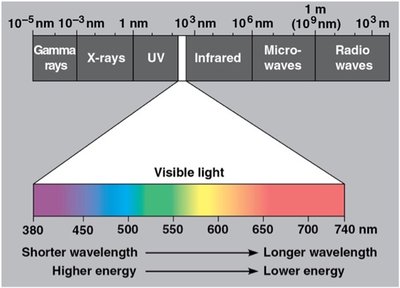
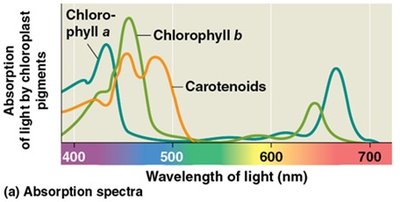
Light is electromagnetic energy, and its wavelength determines its energy. Pigments absorb specific wavelengths of visible light, driving photosynthesis. Chlorophyll absorbs violet-blue and red light, reflecting green.
Visible Light: 380–740 nm; drives photosynthesis.
Absorption Spectrum: Shows which wavelengths are absorbed by pigments.
Chlorophyll Structure and Excitation
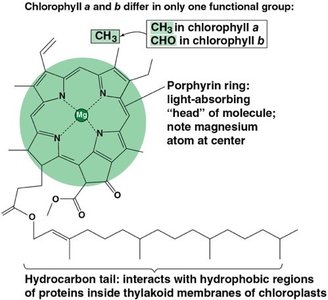
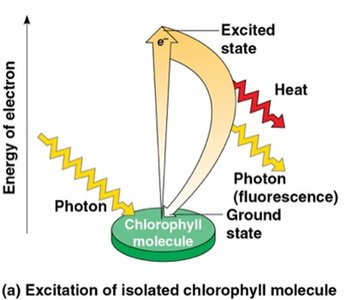
Chlorophyll a and b differ in one functional group, affecting their absorption spectra. Absorbing a photon excites an electron to a higher energy state; in isolated chlorophyll, the electron returns to the ground state, releasing energy as heat and fluorescence.
Photosystems and Electron Flow
Photosystem Structure and Function
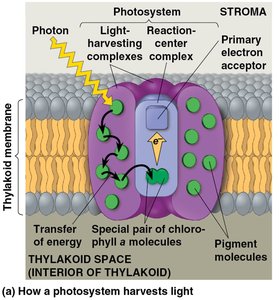
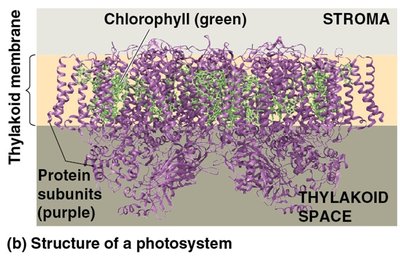
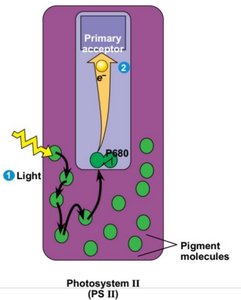
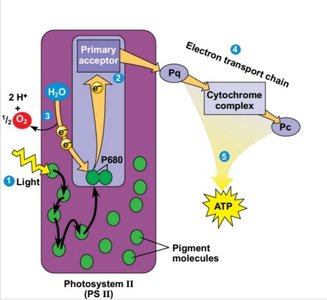
Photosystems are complexes in the thylakoid membrane that harvest light energy. Each consists of a reaction-center complex surrounded by light-harvesting complexes. Energy is funneled to a special pair of chlorophyll a molecules, which pass excited electrons to a primary electron acceptor.
Photosystem II (PSII) and Photosystem I (PSI)
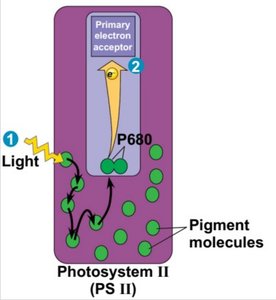
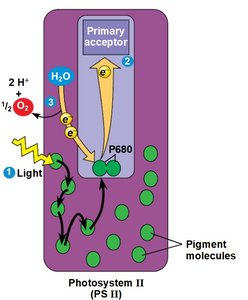
There are two types of photosystems: PSII (P680) acts first, absorbing light at 680 nm, and PSI (P700) acts second, absorbing at 700 nm. Both are essential for the linear electron flow that produces ATP and NADPH.
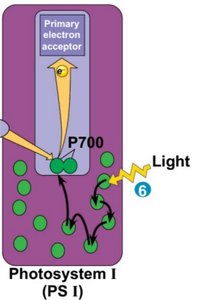
Linear Electron Flow: Steps and Products
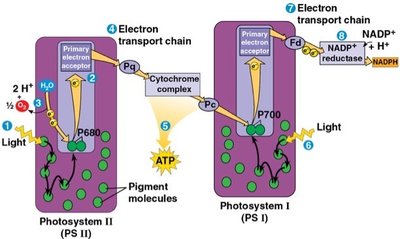
Linear electron flow involves both photosystems and produces ATP, NADPH, and O2. The process includes excitation of pigments, water splitting, electron transport, and chemiosmosis.
Step 1: Photon excites pigment in PSII.
Step 2: Excited electron moves to primary acceptor.
Step 3: Water is split, electrons refill P680+, O2 released.
Step 4–5: Electrons pass through ETC, energy pumps H+, ATP produced.
Step 6–8: PSI re-excites electrons, NADPH produced.
Cyclic Electron Flow
Cyclic electron flow uses PSI only, cycling electrons back to the cytochrome complex. It produces ATP but not NADPH or O2, supplying extra ATP needed for the Calvin cycle and protecting cells from light-induced damage.
Calvin Cycle: Reducing CO2 to Sugar
Stages and Energy Requirements
The Calvin cycle is an anabolic pathway that builds sugar using ATP and NADPH. It regenerates its starting material, RuBP, and occurs entirely in the stroma. Carbon enters as CO2 and leaves as G3P (glyceraldehyde 3-phosphate).
Carbon Fixation: Rubisco attaches CO2 to RuBP.
Reduction: ATP and NADPH convert 3-PGA to G3P.
Regeneration: ATP rebuilds RuBP.
Energy Demand: 3 CO2 + 9 ATP + 6 NADPH per G3P.
Plant Mass and Carbon Fixation
Nearly half of a plant's dry mass is carbon, fixed from atmospheric CO2 via the Calvin cycle. This process builds glucose, sucrose, starch, cellulose, amino acids, and lipids, forming the plant body.
Alternative Mechanisms: C3, C4, and CAM Plants
Photorespiration and Adaptations
Photorespiration occurs when rubisco binds O2 instead of CO2, wasting energy and carbon. C4 and CAM plants have evolved mechanisms to minimize photorespiration, allowing them to thrive in hot, dry climates.
C3 Plants: Rubisco fixes CO2 into 3-PGA; high photorespiration in heat.
C4 Plants: PEP carboxylase fixes CO2 into a 4-carbon compound; steps separated in space.
CAM Plants: CO2 fixed at night into organic acids; steps separated in time.
Summary Table: PSII, PSI, and Calvin Cycle
Component | Location | Inputs | Outputs | Energy Transformation |
|---|---|---|---|---|
PSII (P680) + ETC | Thylakoid membrane | Light, H2O, ADP + Pi | O2, H+ gradient, e- to PSI, ATP | Light → excited e- → H+ gradient → ATP |
PSI (P700) | Thylakoid membrane | Light, e- from PSII, NADP+ + H+ | NADPH, extra ATP by cyclic flow | Light re-energizes e- → reducing power in NADPH |
Calvin cycle | Stroma | CO2, ATP, NADPH | G3P → glucose, ADP + Pi, NADP+ | ATP + NADPH → C–H bonds of sugar |
Key Takeaways
Light reactions (thylakoids) split water, release O2, and make ATP + NADPH.
The Calvin cycle (stroma) uses ATP + NADPH to reduce CO2 to sugar; rubisco fixes the carbon.
Water is oxidized and CO2 is reduced; light powers this endergonic process.
Carbon fixation builds nearly all of a plant’s mass.
Stomata balance CO2 uptake against water loss; C4 and CAM plants reduce photorespiration.
