 Indietro
Photosynthesis: Mechanisms, Energy Transformations, and Adaptations
Guida di studio - Note intelligenti
 Appunti personalizzati basati sui tuoi materiali, ampliati con definizioni chiave, esempi e contesto.
Photosynthesis: Turning Light into Chemical Energy
Overview of Photosynthesis and Cellular Respiration
Photosynthesis is the process by which autotrophic organisms convert light energy into chemical energy, producing organic molecules and oxygen from carbon dioxide and water. Cellular respiration, in turn, breaks down these organic molecules to generate ATP, releasing carbon dioxide and water as by-products. These two processes are interconnected, cycling matter and energy through the biosphere.
Photosynthesis Equation:
Cellular Respiration Equation:
Energy Transformation: Photosynthesis is endergonic (requires energy), while cellular respiration is exergonic (releases energy).
Redox Reactions: In photosynthesis, water is oxidized and carbon dioxide is reduced; in respiration, glucose is oxidized and oxygen is reduced.
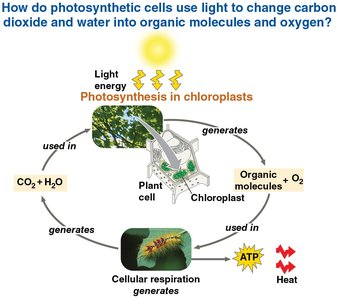
Sources of CO2 and H2O in Respiration
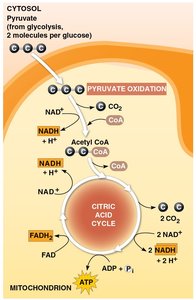
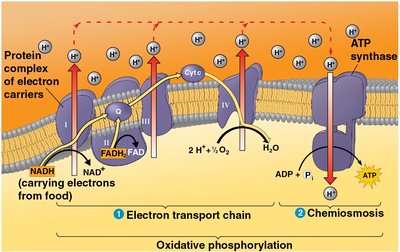
CO2 is released during pyruvate oxidation and the citric acid cycle, while H2O is formed when oxygen accepts electrons and protons at the end of the electron transport chain. The products of respiration serve as reactants for photosynthesis, demonstrating the cyclical nature of these processes.
Photosynthesis Feeds the Biosphere
Autotrophs and Heterotrophs
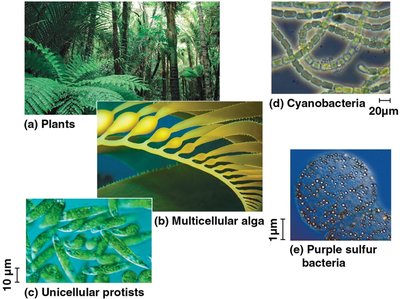
Photosynthesis is essential for life on Earth, as it provides the energy and organic molecules required by all organisms. Autotrophs, such as plants, algae, and some bacteria, produce their own food from inorganic sources. Heterotrophs, including animals and fungi, rely on consuming organic molecules produced by autotrophs.
Photoautotrophs: Use light as an energy source (e.g., plants, algae, cyanobacteria).
Heterotrophs: Obtain organic molecules from other organisms.
Chloroplasts: The Sites of Photosynthesis
Structure and Function
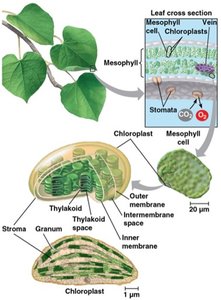
Photosynthesis occurs primarily in the mesophyll cells of leaves, within specialized organelles called chloroplasts. Chloroplasts contain a double membrane, a dense fluid called the stroma, and a third membrane system of thylakoids stacked into grana. Chlorophyll, the main photosynthetic pigment, is embedded in the thylakoid membranes.
Stroma: Site of the Calvin cycle (carbon fixation).
Thylakoids: Site of the light reactions.
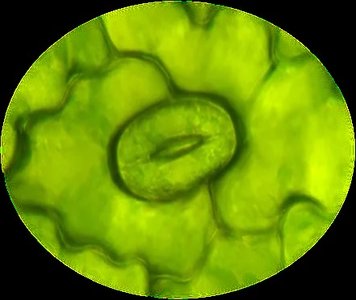
Stomata: Pores for gas exchange (CO2 in, O2 and water vapor out).
Stomata: Gatekeepers of Gas Exchange
Stomata are pores flanked by guard cells that regulate the exchange of gases and water vapor. Their opening and closing are controlled by environmental cues and internal signals, balancing CO2 uptake with water conservation.
Open: Guard cells take up K+, water follows by osmosis, cells become turgid.
Closed: K+ leaves, water leaves, cells become flaccid.
Trade-off: Open stomata allow CO2 for photosynthesis but increase water loss; closed stomata conserve water but limit CO2 uptake.
Tracking Atoms and Electrons Through Photosynthesis
Atom Flow in the Overall Reaction
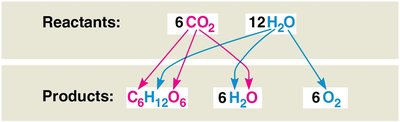
The oxygen released during photosynthesis comes from water, not carbon dioxide. Carbon atoms from CO2 are incorporated into sugar, while water is both split and re-formed during the process.
Redox Changes in Photosynthesis
Photosynthesis is a redox process where water is oxidized (loses electrons) and carbon dioxide is reduced (gains electrons). The movement of electrons is "uphill," requiring energy input from light.

The Two Stages of Photosynthesis
Light Reactions and the Calvin Cycle
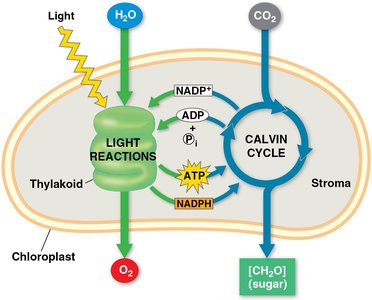
Photosynthesis consists of two main stages: the light reactions and the Calvin cycle. The light reactions occur in the thylakoid membranes and produce ATP and NADPH, while the Calvin cycle takes place in the stroma and uses these products to fix carbon dioxide into sugar.
Light Reactions: Split water, release O2, reduce NADP+ to NADPH, and generate ATP by photophosphorylation.
Calvin Cycle: Fixes CO2 into organic molecules using ATP and NADPH.
The Nature of Sunlight and Pigments
Electromagnetic Spectrum and Visible Light
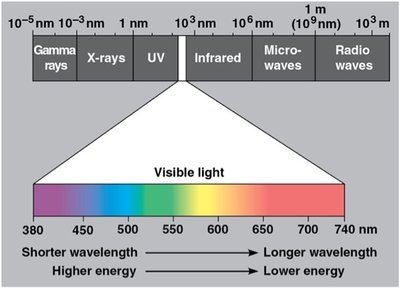
Light is electromagnetic energy, and its wavelength determines its energy. Photosynthesis is driven by visible light, with shorter wavelengths (violet) carrying more energy than longer wavelengths (red).
Pigments: Light Absorption and Reflection
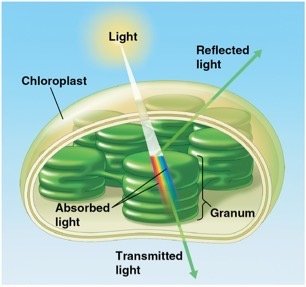
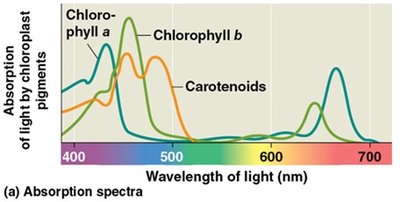
Pigments absorb specific wavelengths of light. Chlorophyll absorbs violet-blue and red light, reflecting green, which gives leaves their color. The absorption spectrum shows which wavelengths are absorbed by each pigment.
Chlorophyll Structure and Excitation
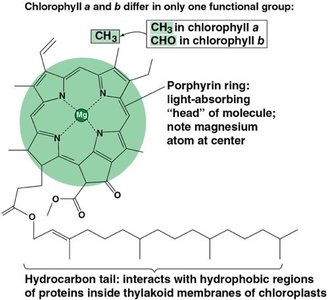
Chlorophyll a and b differ in one functional group, affecting their absorption properties. When a pigment absorbs a photon, an electron is excited to a higher energy state. In isolated chlorophyll, the electron returns to the ground state, releasing energy as heat and light (fluorescence).
Photosystems and Electron Flow
Photosystems: Harvesting Light
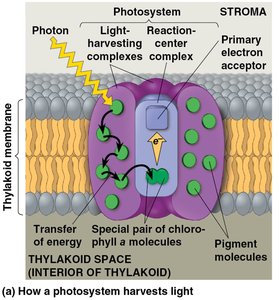
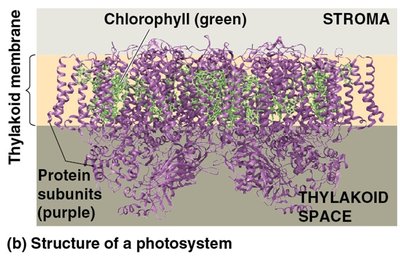
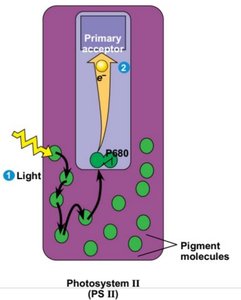
A photosystem consists of a reaction-center complex surrounded by light-harvesting complexes. Light energy is funneled to the reaction center, where a special pair of chlorophyll a molecules passes an excited electron to the primary electron acceptor, converting light energy to chemical energy.
Photosystem II (PSII) and Photosystem I (PSI)
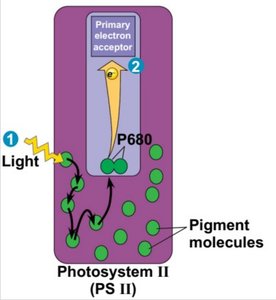
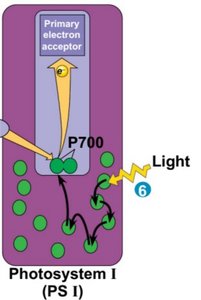
There are two types of photosystems: PSII (P680) and PSI (P700). PSII acts first, absorbing light at 680 nm, while PSI acts second, absorbing at 700 nm. Both are essential for the linear electron flow that produces ATP, NADPH, and O2.
Linear Electron Flow: Steps 1–5
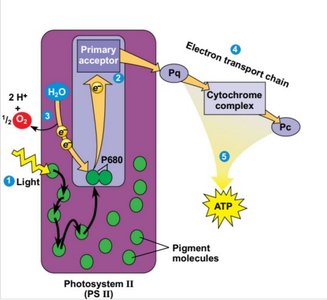
Linear electron flow involves the following steps:
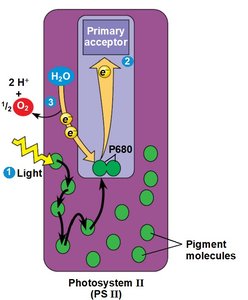
A photon excites a pigment in PSII; energy is relayed to P680.
P680’s excited electron moves to the primary electron acceptor.
An enzyme splits water, providing electrons to refill P680+ and releasing O2.
Electrons pass from PSII to PSI via an electron transport chain, pumping H+ into the thylakoid space.
H+ flows back into the stroma through ATP synthase, generating ATP by photophosphorylation.
Linear Electron Flow: Steps 6–8
Light excites P700 in PSI; its electron moves to the primary acceptor.
The excited electron passes through a second electron transport chain (no H+ pumping).
NADP+ reductase transfers electrons to NADP+, forming NADPH for the Calvin cycle.
Cyclic Electron Flow
Cyclic electron flow uses PSI only, cycling electrons back to the cytochrome complex. It produces ATP but not NADPH or O2, supplying extra ATP needed for the Calvin cycle and protecting cells from light-induced damage.
The Calvin Cycle: Reducing CO2 to Sugar
Overview and Steps
The Calvin cycle is an anabolic pathway that builds sugar using ATP and NADPH. It regenerates its starting material, RuBP, each turn, and all reactions occur in the stroma.
Carbon fixation: Rubisco attaches CO2 to RuBP.
Reduction: ATP and NADPH convert 3-PGA to G3P.
Regeneration: ATP rebuilds RuBP.
Where Does a Plant’s Mass Come From?
Nearly half of a plant’s dry mass is carbon, fixed from atmospheric CO2 via the Calvin cycle. This carbon forms the backbone of glucose, sucrose, starch, cellulose, amino acids, and lipids, building the plant body.
Adaptations: C3, C4, and CAM Plants
Photorespiration and Its Solutions
Photorespiration occurs when rubisco binds O2 instead of CO2, wasting energy and carbon. C4 and CAM plants have evolved mechanisms to minimize photorespiration, allowing them to thrive in hot, dry climates.
C3 Plants: Rubisco fixes CO2 into 3-PGA; high photorespiration in heat.
C4 Plants: PEP carboxylase fixes CO2 into a 4-carbon compound; steps separated in space.
CAM Plants: CO2 fixed at night into organic acids; steps separated in time.
Summary Chart: PSII, PSI, and the Calvin Cycle
Component | Location | Inputs | Outputs | Energy Transformation |
|---|---|---|---|---|
PSII (P680) + ETC | Thylakoid membrane | Light; H2O; ADP + Pi | O2; H+ gradient; e- to PSI; ATP | Light → excited e- → H+ gradient → ATP |
PSI (P700) | Thylakoid membrane | Light; e- from PSII; NADP+ + H+ | NADPH; extra ATP by cyclic flow | Light re-energizes e- → reducing power in NADPH |
Calvin cycle | Stroma | CO2; ATP; NADPH | G3P → glucose; ADP + Pi; NADP+ | ATP + NADPH → C–H bonds of sugar |
Key Takeaways
Light reactions (thylakoids) split water, release O2, and make ATP + NADPH.
The Calvin cycle (stroma) uses ATP + NADPH to reduce CO2 to sugar; rubisco fixes the carbon.
Water is oxidized and CO2 is reduced; light powers this endergonic process.
Carbon fixation builds nearly all of a plant’s mass.
Stomata balance CO2 uptake against water loss; C4 and CAM plants reduce photorespiration.
